Pre-Monsoon Winds and Rainfall Bring Relief Across Madhya Pradesh
Source:freepressjournal ↗
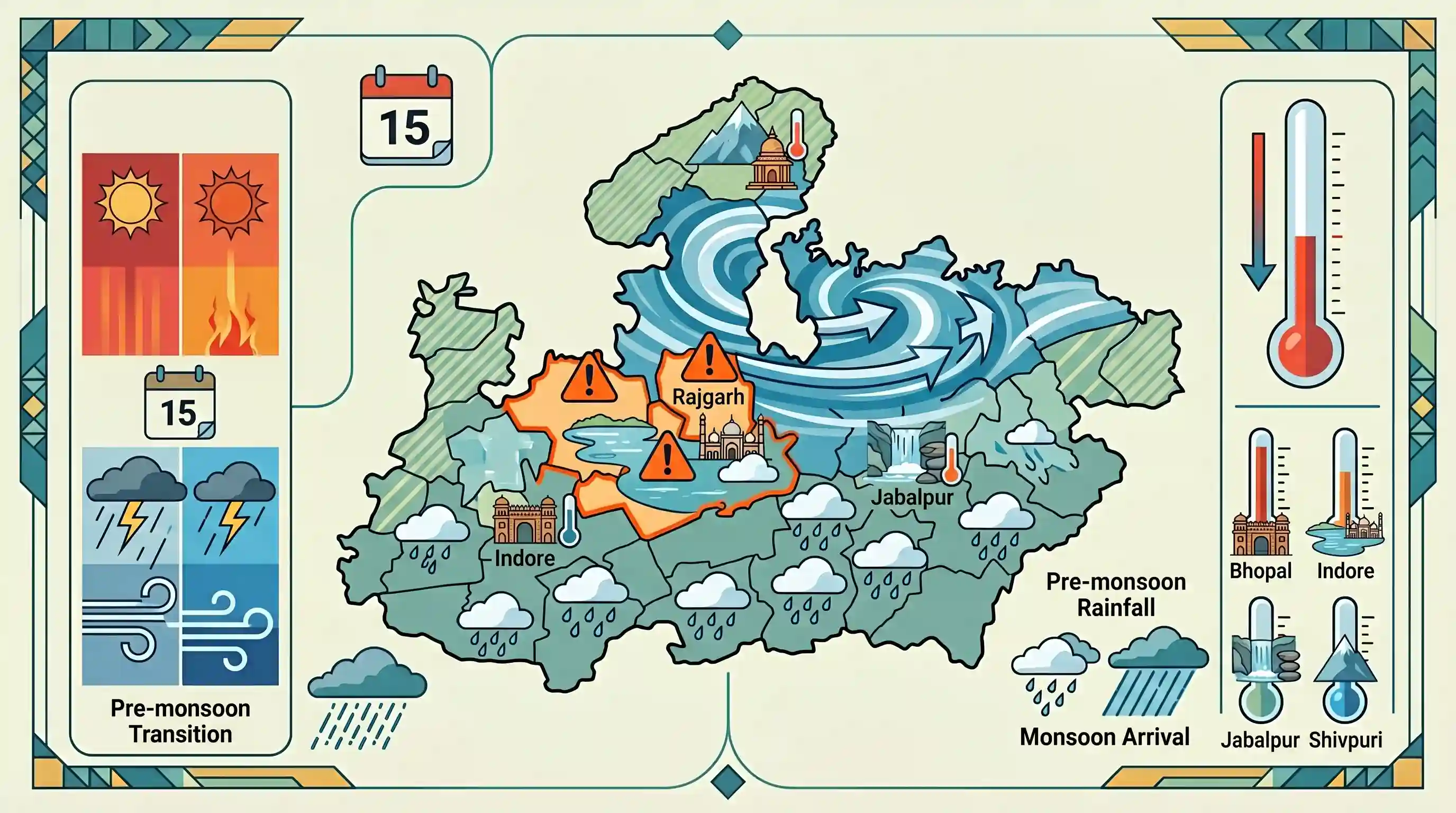
Why It Matters
Madhya Pradesh's climate, regional rainfall patterns, temperature variations (such as the coolest regions like Shivpuri), and wind speeds during pre-monsoon transitions are repeatedly tested in the MPPSC State Service Prelims under physical and regional geography.
Summary
The article reports on a significant weather transition in Madhya Pradesh on June 15, 2026, driven by active pre-monsoon winds reaching up to 70 kmph and light to moderate rainfall. The India Meteorological Department (IMD) issued orange alerts for strong winds in Agar Malwa, Rajgarh, and Sehore, and rain forecasts for several districts, lowering temperatures below 40°C in key hubs like Bhopal, Indore, and Jabalpur, with Shivpuri registering the state's lowest temperature (33.2°C).
Key Points
- Active pre-monsoon conditions on June 15, 2026, brought significant rainfall and high-speed winds (crossing 70 kmph in parts of Bhopal and Indore divisions) across Madhya Pradesh, disrupting power and farming in some districts like Khargone and Raisen.
- The India Meteorological Department (IMD) issued rain alerts for Bhopal and Gwalior alongside an 'orange alert' for strong winds (50 to 60 kmph) specifically for Agar Malwa, Rajgarh, and Sehore.
- The weather transition lowered temperatures to under 40°C in major cities (Bhopal 35.4°C, Indore 36.3°C, Gwalior 39.2°C, Ujjain 36.5°C, Jabalpur 38.5°C), while only Khajuraho, Datia, Nowgong, and Mandla crossed 40°C. Shivpuri recorded the lowest temperature in the state at 33.2°C.
- From an MPPSC perspective, these pre-monsoon transitions highlight the seasonal wind dynamics in MP, where wind speeds during summer/monsoon seasons are historically faster than in winters (as highlighted in previous prelims papers).
Important Terms
India Meteorological Department (IMD)

India's primary government agency under the Ministry of Earth Sciences responsible for meteorological observations, weather forecasting, seismology, and issuing early hazard warnings.
UPSC context
GS Paper I (Geography) and GS III (Disaster Management); tests administrative roles in weather-risk and early warning systems.
Pre-monsoon Showers
Localized, convective rainfall and thunderstorms occurring from March to June before the southwest monsoon onset, driven by intense summer continental heating.
UPSC context
GS Paper I (Indian Physical Geography); tests mechanisms of local summer storms, regional nomenclature, and agricultural significance.
Color-Coded Weather Alerts
A standardized warning system (Green, Yellow, Orange, Red) used by the IMD to communicate the severity of incoming weather and public action required.
UPSC context
GS Paper III (Disaster Management); tests hazard preparedness, early-warning frameworks, and mitigation strategies.
Convective Rainfall
Precipitation produced when intense solar heating causes warm, moisture-laden air to rise rapidly, cool, condense, and form heavy local thunderstorms.
UPSC context
GS Paper I (Physical Geography); tests atmospheric thermodynamics, convective circulation, and local precipitation types.
Tropical Monsoon Climate
A climate type featuring high temperatures year-round and a complete seasonal reversal of winds, causing distinct, highly concentrated summer wet seasons.
UPSC context
GS Paper I (Geography); tests Köppen's classification system, monsoon mechanics, and global atmospheric circulation.
Prelims Trap
Madhya Pradesh receives its monsoon rainfall exclusively from the Arabian Sea branch due to its western-central geographic positioning.
In reality, MP is a transition zone. The eastern and south-eastern parts receive the majority of their precipitation from the Bay of Bengal branch.
Static Concepts Connected
What is the climatological classification and local seasonal nomenclature of Madhya Pradesh?
- Tropic of Cancer: Passes through 14 districts, dividing the state into nearly equal thermal halves and causing perpendicular solar radiation on June 21.
- Local Nomenclature: The summer season is locally termed 'Unala', winter is called 'Siyala', and the wet monsoon season is known as 'Chaumasa'.
- Wind Velocity: Average wind speeds in the state peak during the hot summer and monsoon months, dropping to their lowest in winter.
How do the dual branches of the Southwest Monsoon interact over Central India?
- Branch Convergence: Madhya Pradesh acts as a major convergence zone where the Arabian Sea and Bay of Bengal monsoon branches meet.
- Precipitation Gradient: Rainfall generally decreases from the east and south-east (heavy Bay of Bengal influence) to the drier north and west.
Cross-Topic Patterns
Local Weather Terms & Crop Calendars
Regional terms like Unala and Chaumasa align with Zaid and Kharif agricultural cycles, demonstrating how traditional climate knowledge informs rural farming decisions.
Wind Dynamics & Wind Energy Potential
High summer and pre-monsoon wind speeds in western MP divisions like Indore directly support the state's wind energy infrastructure during critical peak demand periods.

Multi-statement questions on Indian climate may combine regional monsoon branch convergence with local agro-climatic terminology.
Linked PYQs · 3
Linked PYQs · 3
- 2025MPPSC_PRELIMSGS1
Read the following statements regarding the climate of Madhya Pradesh and select the correct answer from the codes given below: 1. Most of the rainfall in the state is received from the monsoon. 2. Wind speed during winters is faster than in summer and rainy seasons. 3. Distance from sea also affects the distribution of monsoon rains in the state. 4. Summer temperature in Pachmarhi is related to the altitude above sea level. Codes:
- 2024MPPSC_PRELIMSGS1
The south-eastern part of Madhya Pradesh receives maximum rainfall from :
- 2018MPPSC_PRELIMSGS1
The climate of Madhya Pradesh is
