Southwest Monsoon Expected in Madhya Pradesh by Mid-June
Source:freepressjournal ↗
Why It Matters
Monsoon arrival patterns, regional rainfall, climate classifications, and temperature extremes of Madhya Pradesh are highly high-yielding topics for the MPPSC State Service Prelims. Understanding the tropical monsoon nature of the state's climate, the roles of altitude and distance from the sea, and regional hotspots (like Khajuraho and Nowgong) is essential for solving geography-based questions.
Summary
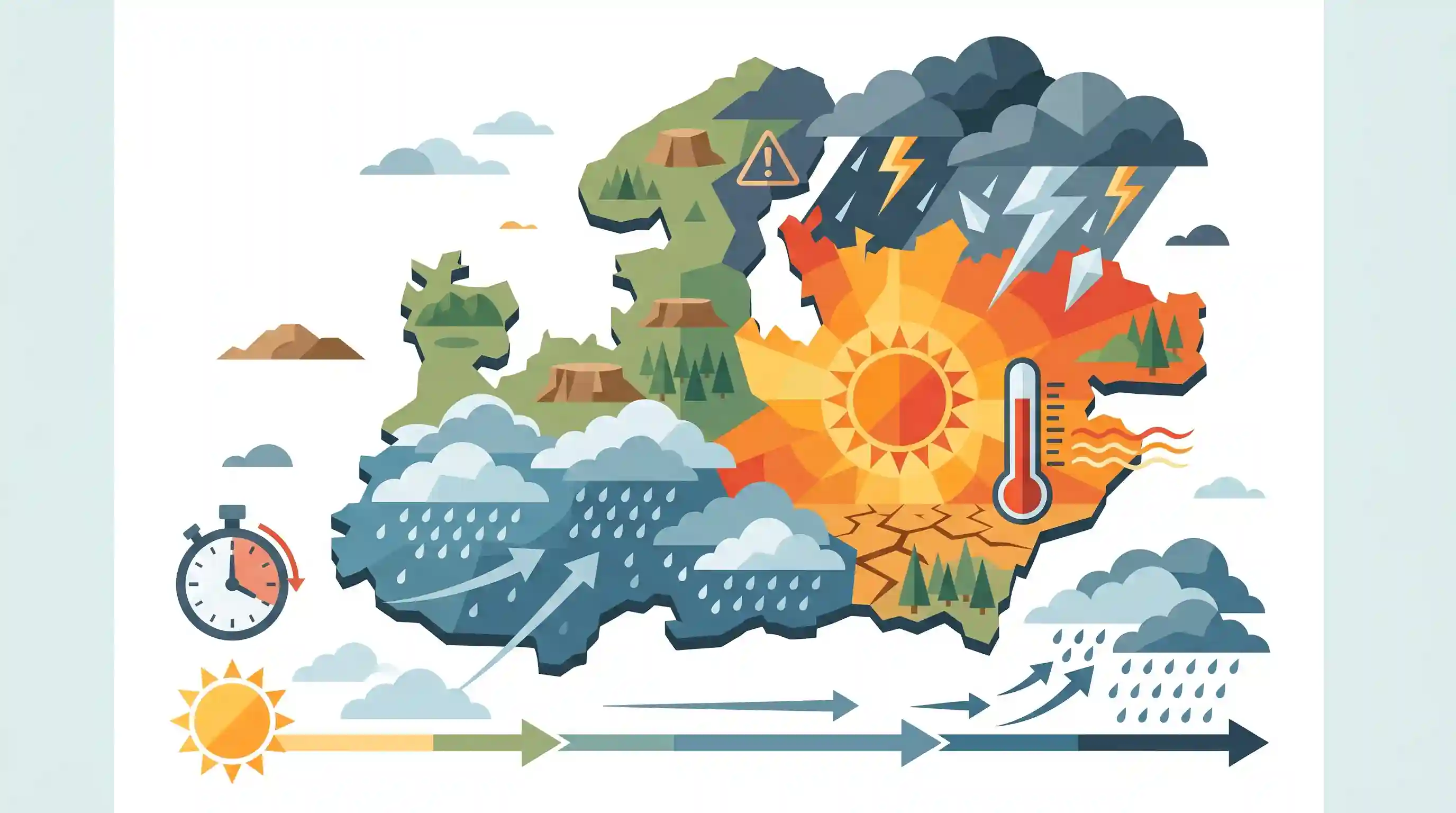
The article outlines the June 12, 2026 weather update for Madhya Pradesh, highlighting a slight delay in the arrival of the southwest monsoon, which is expected to enter the southern region by June 17-18. While pre-monsoon showers and severe hailstorm warnings have been issued for northern and Bundelkhand districts (Morena, Bhind, Datia, etc.), extreme heat continues to prevail elsewhere, with Khajuraho and Nowgong recording the state's highest temperature at 43°C.
Key Points
- The India Meteorological Department (IMD) predicted a 3 to 4-day delay in the southwest monsoon arrival in Madhya Pradesh, forecasting its entry into the southern parts around June 17-18, 2026.
- Once it enters the state, the monsoon is expected to cover the entire territory of Madhya Pradesh within the subsequent 10 to 15 days.
- A hailstorm warning was issued for districts in the Chambal and Bundelkhand regions, including Morena, Bhind, Datia, Niwari, Tikamgarh, and Chhatarpur, along with strong winds of 40 to 60 kmph.
- During this transition period, Khajuraho and Nowgong in the Chhatarpur district recorded the highest temperature in the state at 43°C, while Gwalior reached 42°C.
- In contrast to the rain alerts in northern and central regions, western districts like Indore, Ujjain, Ratlam, Jhabua, Alirajpur, Dhar, Barwani, and Khargone did not receive any immediate rain alert and continued to face hot weather.
Important Terms
India Meteorological Department

India's principal government agency under the Ministry of Earth Sciences responsible for meteorological observations, weather forecasting, seismology, and early warnings of hazardous weather events.
UPSC context
GS Paper I & III (Geography/Disaster Management); tests knowledge of key national scientific bodies and monsoon tracking frameworks.
Southwest Monsoon
A seasonal moisture-laden wind system blowing from the Indian Ocean, onsetting in June and withdrawing by September, which provides over 70% of India's annual rainfall.
UPSC context
GS Paper I (Physical Geography); tested on its mechanism, onset, spatial distribution, and critical economic impact on agriculture.
Bundelkhand Region
A historic, semi-arid plateau region in central India, divided between southern Uttar Pradesh and northern Madhya Pradesh, characterized by Vindhyan topography, granite cratons, and chronic water scarcity.
UPSC context
GS Paper I (Regional Geography); tested for its physical characteristics, water crises, and regional development challenges.
Western Disturbances
Extratropical cyclonic storms originating in the Mediterranean region that travel eastward, bringing crucial winter/pre-monsoon rainfall and occasional hailstorms to northwest and central India.
UPSC context
GS Paper I (Geography); tests the mechanism of non-monsoonal precipitation and its critical impact on Rabi crops and extreme weather.
Chambal Region
A geographical and cultural area in north-central India along the Chambal River valley, famously characterized by a massive network of badland ravines formed by severe gully soil erosion.
UPSC context
GS Paper I & III (Geography/Environment); tests knowledge of gully erosion, badland topography, and riverine ecosystem conservation.
Prelims Trap
Madhya Pradesh records its highest diurnal (daily) temperature variation during peak summer in the months of May and June.
Aspirants assume the highest daily temperature variation occurs during peak summer (May/June). Actually, Madhya Pradesh experiences its maximum diurnal temperature range in March due to dry air and rapid radiation loss at night.
Static Concepts Connected
What are the spatial rainfall distribution and climatic gradients of Madhya Pradesh?
- Rainfall Gradient: Decreases systematically from the humid southeast and east (over 200 cm in Pachmarhi) towards the semi-arid northwest and west (around 62 cm in Bhind).
- Continental Character: As a landlocked territory, it experiences a continental monsoon climate with extreme seasonal variations, influenced strongly by the Tropic of Cancer passing through 14 central districts.
- Temperature Extremes: The highest daily (diurnal) temperature fluctuation occurs in March, whereas peak absolute temperatures are reached in May/June.
What is 'Mawath' and how does it impact central Indian agriculture?
- Definition and Timing: It refers to localized light winter rainfall received during the dry Siyala (winter) season, primarily in northern and western regions of the state.
- Meteorological Origin: It is driven by non-monsoonal, temperate cyclonic systems known as Western Disturbances that originate over the Mediterranean Sea.
- Agricultural Benefit: Crucial for rainfed winter cultivation, particularly in ensuring healthy grain-filling and yield of Rabi crops like wheat, mustard, and gram.
Cross-Topic Patterns
Monsoon Onset and Kharif Sowing Risk
Delays in monsoon arrival in Central India shrink the sowing window for rainfed crops like soybean, forcing a shift to short-duration, climate-resilient crop varieties.
Bundelkhand Hydrological Instability
The pairing of extreme dry heat and violent hailstorms in Bundelkhand showcases increasing hydro-climatic volatility, accelerating land degradation in a historically drought-prone plateau.

UPSC may couple Southwest Monsoon onset dynamics with regional terms (like Mawath or Chaumasa) and local rainfall gradients in Central India.
Linked PYQs · 3
Linked PYQs · 3
- 2018MPPSC_PRELIMSGS1
The climate of Madhya Pradesh is
- 2025MPPSC_PRELIMSGS1
Read the following statements regarding the climate of Madhya Pradesh and select the correct answer from the codes given below: 1. Most of the rainfall in the state is received from the monsoon. 2. Wind speed during winters is faster than in summer and rainy seasons. 3. Distance from sea also affects the distribution of monsoon rains in the state. 4. Summer temperature in Pachmarhi is related to the altitude above sea level. Codes:
- 2023MPPSC_PRELIMSGS1
Which of the following statements is not correct regarding the climate of Madhya Pradesh?
