Bay Depression Triggers Heavy Rainfall Alert Across Eight MP Districts
Source:freepressjournal ↗
Why It Matters
Monsoon patterns, depression formation, and their impact on rainfall distribution in Madhya Pradesh are highly tested topics in the MPPSC State Service Prelims geography section. Understanding which monsoon branches and weather systems influence specific regions of MP is critical for aspirants.
Summary
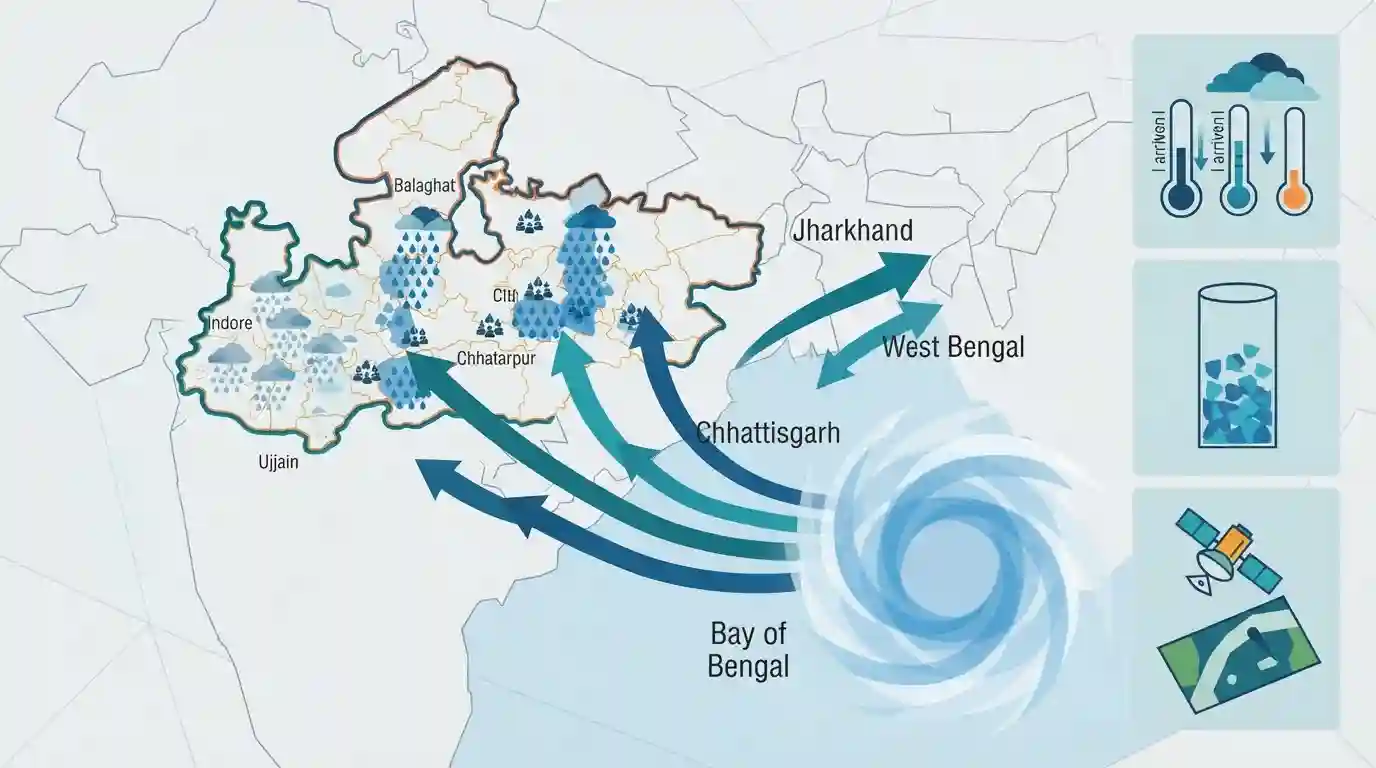
The Indian Meteorological Department (IMD) has reported that a deep depression over the Bay of Bengal is bringing a revival of the southwest monsoon to Central India, resulting in heavy rainfall warnings for eight districts in Madhya Pradesh, including Balaghat, Chhindwara, and Chhatarpur. This weather system is advancing via Jharkhand and Chhattisgarh, further highlighting the role of the Bay of Bengal branch in Madhya Pradesh's precipitation patterns. Indore and Ujjain divisions are also expected to see moderate to heavy rainfall in the coming days.
Key Points
- The India Meteorological Department (IMD) has issued a heavy rain alert for several districts in Madhya Pradesh, including Chhatarpur, Chhindwara, and Balaghat.
- A deep depression formed over the Bay of Bengal is driving the revival of the southwest monsoon, bringing significant rainfall to Central India.
- The weather system is expected to move across Jharkhand and Chhattisgarh before heavily impacting Madhya Pradesh.
- Both Indore and Ujjain divisions are forecasted to receive moderate to heavy rainfall due to the active monsoon system.
Important Terms
India Meteorological Department (IMD)

India's principal government agency under the Ministry of Earth Sciences, established in 1875. It is responsible for meteorological observations, weather forecasting, seismology, and issuing tropical cyclone and monsoon warnings across the country.
UPSC context
Relevant for GS Paper I (Geography - Climate) and GS Paper III (Disaster Management). Tests institutional frameworks for weather monitoring and disaster preparedness.
Deep Depression
An intense low-pressure weather system classified by the IMD. It features maximum sustained surface wind speeds of 28 to 33 knots (51 to 61 km/h) and often precedes a cyclonic storm, causing heavy regional precipitation.
UPSC context
Important for GS Paper I (Geography - Climatology) and GS Paper III (Disaster Management). Tests classifications of cyclonic disturbances and weather warning stages.
Southwest Monsoon
The major rain-bearing wind system blowing from the southwest over the Indian subcontinent between June and September. It provides around 75% of India’s annual rainfall, critically driving the agrarian economy and water resources.
UPSC context
Core topic in GS Paper I (Physical Geography - Climatology). Tests comprehension of monsoon mechanisms, onset dynamics, and socio-economic dependencies in India.
Bay of Bengal Branch
The eastern arm of the Southwest Monsoon that gathers moisture over the Bay of Bengal, advancing into Bangladesh, Northeast India, and deflecting westward along the Ganga plains to provide vital rainfall to Central and North India.
UPSC context
Key concept in GS Paper I (Geography - Monsoon). Tests knowledge of regional precipitation patterns, physical barriers, and branch differences.
Prelims Trap
Rainfall in Madhya Pradesh exhibits a spatial gradient that increases from the southeast to the northwest.
The gradient is the reverse: rainfall decreases from the southeast (125-150 cm) to the northwest (55-62 cm) as Bay of Bengal winds lose moisture moving inland.
Static Concepts Connected
What factors influence the rainfall distribution pattern in Madhya Pradesh?
- Dual Monsoon Branches: MP receives precipitation from both the Arabian Sea and Bay of Bengal branches, which merge over the Baghelkhand region.
- Spatial Gradient: Rainfall decreases from southeast (140+ cm) to northwest (approx 55 cm) as Bay of Bengal winds lose moisture inland.
- Orographic Relief: High-altitude zones like Pachmarhi in the Satpura range act as barrier traps, receiving over 200 cm of rainfall.
How does the IMD classify tropical low-pressure systems by wind speed?
- Depression: Characterised by wind speeds between 17 and 27 knots (31 to 49 km/h); acts as a key driver of monsoon rain.
- Deep Depression: Characterised by wind speeds between 28 and 33 knots (50 to 61 km/h), capable of bringing prolonged heavy precipitation inland.
- Cyclonic Storm: System with wind speeds exceeding 34 knots (62 km/h), categorised into various cyclonic storm intensities.
Cross-Topic Patterns
Monsoon Depressions & Kharif Sowing
The timing and frequency of Bay of Bengal depressions directly dictate the sowing cycles of key Kharif crops like soybean and pulses in Central India's rainfed black soil regions.
Extreme Weather & Basin Hydrology
Intense deep depressions cause sudden run-off, testing reservoir capacities of the Narmada and Chambal systems and challenging traditional flood-control protocols.

IMD classification of depressions combined with spatial rainfall gradients of Central India will likely feature as a physical geography MCQ.
Linked PYQs · 4
Linked PYQs · 4
- 2024MPPSC_PRELIMSGS1
The south-eastern part of Madhya Pradesh receives maximum rainfall from :
- 2025MPPSC_PRELIMSGS1
Read the following statements regarding the climate of Madhya Pradesh and select the correct answer from the codes given below: 1. Most of the rainfall in the state is received from the monsoon. 2. Wind speed during winters is faster than in summer and rainy seasons. 3. Distance from sea also affects the distribution of monsoon rains in the state. 4. Summer temperature in Pachmarhi is related to the altitude above sea level. Codes:
- 2018MPPSC_PRELIMSGS1
The climate of Madhya Pradesh is
- 2021MPPSC_PRELIMSGS1
Which one of the following statements is not correct regarding the climate of Madhya Pradesh?
