Madhya Pradesh Records Uneven Rainfall Distribution in Monsoon
Source:free-press-journal ↗
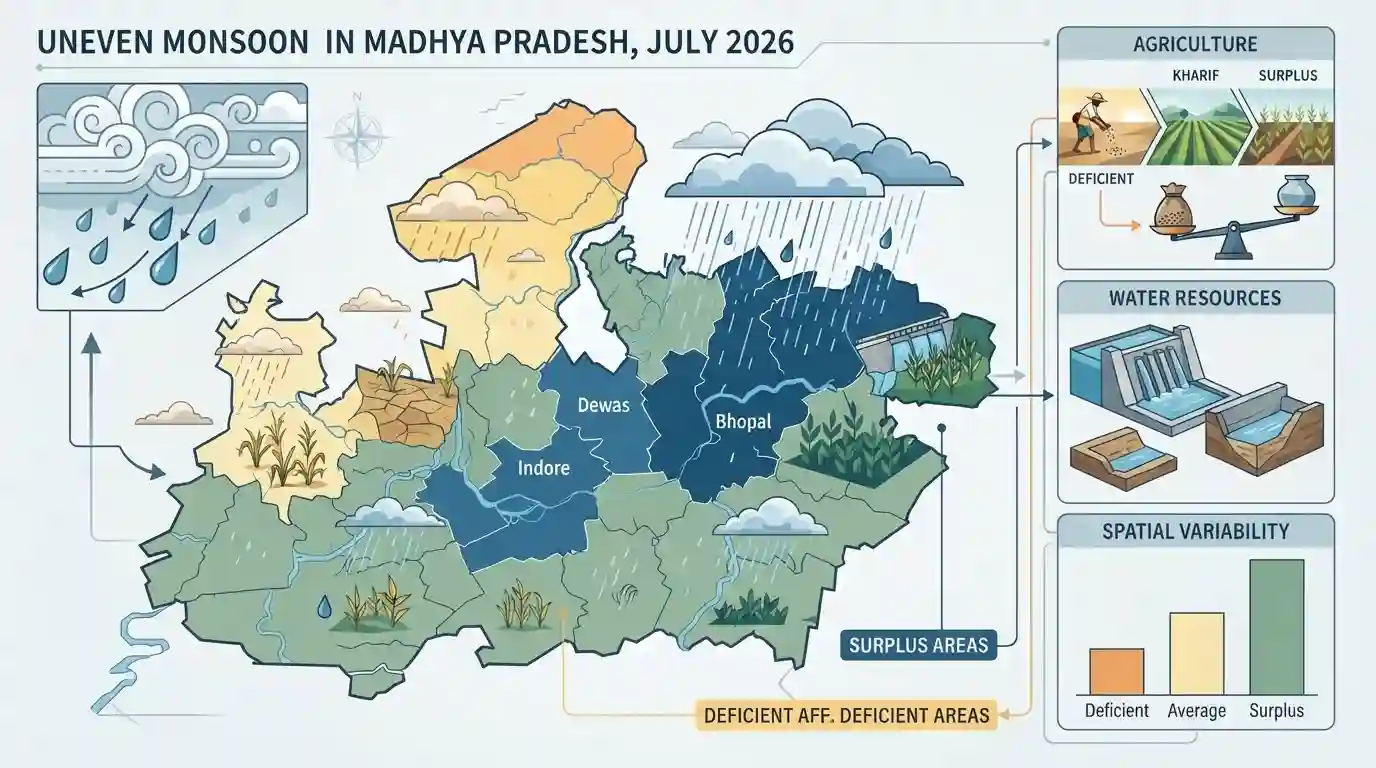
Why It Matters
Understanding the spatial and temporal variability of rainfall in Madhya Pradesh is crucial for civil servants as it directly dictates policy responses related to disaster management (droughts and floods), agricultural planning (crop selection and irrigation), and water resource management.
Summary
Madhya Pradesh is experiencing an erratic and uneven monsoon in July 2026. While cities like Bhopal experienced prolonged, continuous rainfall and districts such as Dewas and Indore registered a surplus, a large part of the state remains rain-deficient. This highlights the spatial variability of the South-West monsoon in Madhya Pradesh, which has critical implications for the state's agriculture, particularly the Kharif crop sowing season, and the management of water reservoirs.
Key Points
- Bhopal witnessed continuous rainfall for over 10 hours, reflecting heavy localized precipitation.
- Dewas and Indore districts recorded surplus rainfall during the current monsoon season.
- Despite heavy rains in certain pockets, a significant portion of Madhya Pradesh is experiencing a rain deficit.
- The uneven spatial distribution of monsoon rainfall is a key characteristic of the climate of Madhya Pradesh, impacting agriculture and water resources.
Important Terms
India Meteorological Department (IMD)

The principal government agency under the Ministry of Earth Sciences responsible for meteorological observations, weather forecasting, seismology, and early warnings for extreme weather in India.
UPSC context
GS Paper I (Climatology) and GS Paper III (Disaster Management); tests knowledge of key national scientific institutions.
South-West Monsoon
A moisture-laden seasonal wind system blowing from the Indian Ocean to the Indian subcontinent from June to September, contributing over seventy percent of India's annual precipitation.
UPSC context
GS Paper I (Climatology and Monsoon Mechanism) and GS Paper III (Agriculture and cropping patterns).
Kharif Crops
Crops sown at the onset of the southwest monsoon (June–July) and harvested in autumn, requiring warm, humid weather and significant rainfall (e.g., rice, maize, cotton).
UPSC context
GS Paper I (Cropping patterns) and GS Paper III (Agriculture, food security, and rural economy).
Long Period Average (LPA)
The benchmark average of rainfall recorded over a fifty-year interval, currently set at eighty-seven centimeters, against which the India Meteorological Department measures monsoon performance.
UPSC context
GS Paper I (Geography - Climatology) and GS Paper III (Agriculture); tests understanding of quantitative meteorological indicators.
Monsoon Deficit
A condition where actual seasonal rainfall received falls significantly below the Long Period Average (LPA), officially categorized by the India Meteorological Department as deficient when nineteen to fifty-nine percent below normal.
UPSC context
GS Paper I (Water resources) and GS Paper III (Agricultural economics, drought management, and food security).
Prelims Trap
Madhya Pradesh, being landlocked in central India, receives its monsoon rainfall exclusively from the Bay of Bengal branch.
MP actually receives rainfall from both the Arabian Sea branch (via the Narmada-Tapi valley) and the Bay of Bengal branch, explaining its complex spatial distribution.
Static Concepts Connected
How do the two branches of the Southwest Monsoon interact over Central India?
- Arabian Sea branch: Enters through the Narmada and Tapi valleys, bringing significant rainfall to the western and southwestern parts of Madhya Pradesh.
- Bay of Bengal branch: Moves over the Indo-Gangetic plains, recurving southwestward to bring rainfall to eastern and central Madhya Pradesh.
- Convergence zone: The two branches merge over the central highlands, creating intense localized precipitation but highly variable spatial distribution.
Cross-Topic Patterns
Monsoon variability & edible oil economics
Spatially erratic rainfall in Madhya Pradesh, India's 'Soyabean Bowl', directly impacts Kharif oilseed yields, risking increased domestic reliance on imported palm and sunflower oils.
Climate resilience & PM-KSY
Localized rain deficits highlight the limits of rainfed farming, driving the demand for micro-irrigation systems under the Pradhan Mantri Krishi Sinchayee Yojana.

Monsoon block/break spells and the dual-branch rainfall mechanism of Central India will likely feature in conceptual GS-I Geography questions.
Linked PYQs · 3
Linked PYQs · 3
- 2018MPPSC_PRELIMSGS1
The climate of Madhya Pradesh is
- 2025MPPSC_PRELIMSGS1
Read the following statements regarding the climate of Madhya Pradesh and select the correct answer from the codes given below: 1. Most of the rainfall in the state is received from the monsoon. 2. Wind speed during winters is faster than in summer and rainy seasons. 3. Distance from sea also affects the distribution of monsoon rains in the state. 4. Summer temperature in Pachmarhi is related to the altitude above sea level. Codes:
- 2020MPPSC_PRELIMSGS1
Main crop of Madhya Pradesh is
