Uniform Civil Code Bill Introduced in Madhya Pradesh Assembly
Source:lawstreet ↗
Why It Matters
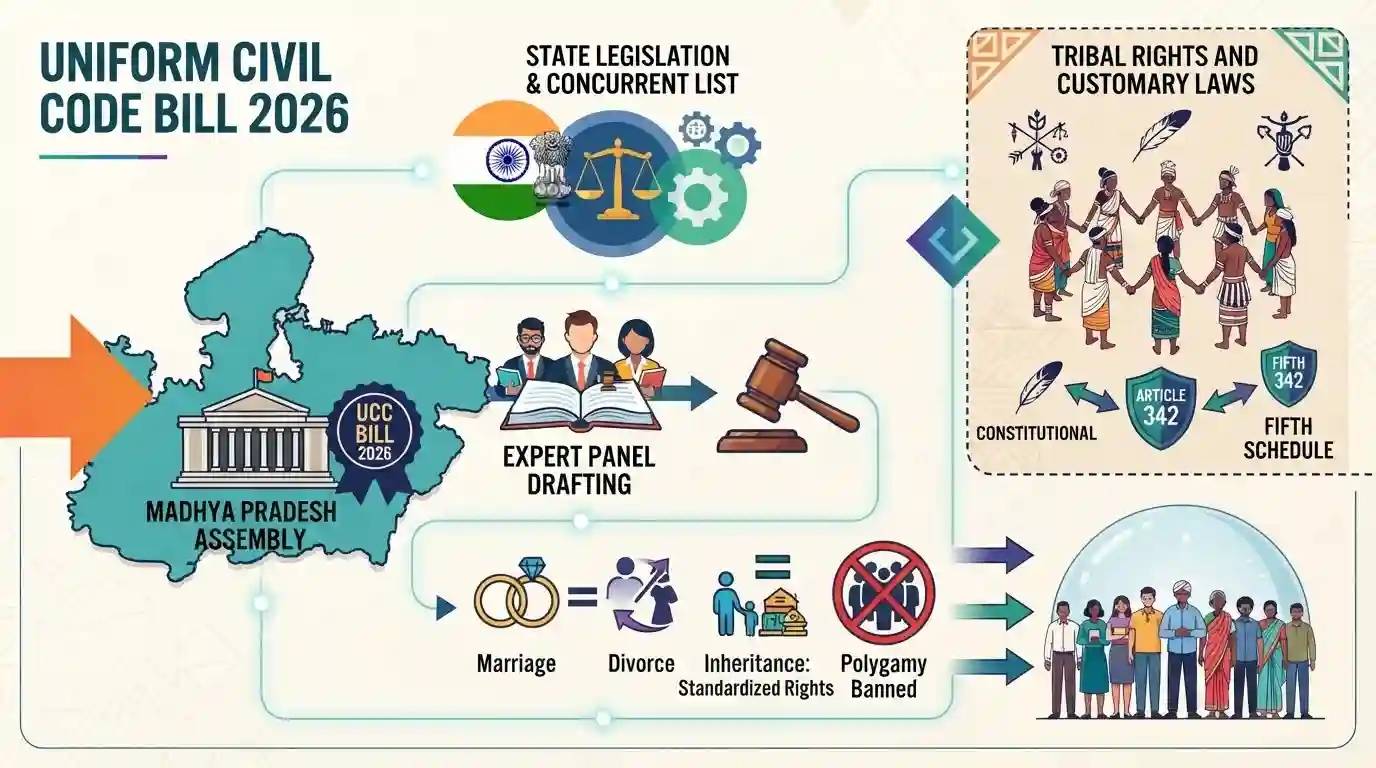
The introduction of the UCC in Madhya Pradesh highlights the evolving federal dynamics of implementing Article 44, balancing the push for uniform civil laws with the constitutional protections afforded to Scheduled Tribes under Article 342 and the Fifth Schedule.
Summary
The Madhya Pradesh government has introduced the Uniform Civil Code (UCC) Bill 2026 in the state assembly to establish uniform laws governing marriage, divorce, inheritance, and adoption for all citizens. Drafted by an expert panel headed by retired Justice Ranjana Prakash Desai, the legislation bans polygamy and standardizes inheritance rights but specifically exempts Scheduled Tribes to protect their constitutional rights and customary practices under Article 342 and the Fifth Schedule.
Key Points
- Madhya Pradesh has introduced the Uniform Civil Code (UCC) Bill 2026, drafted by a panel led by retired Justice Ranjana Prakash Desai.
- The Bill enforces monogamy by banning polygamy, triple talaq, and nikah halala, and mandates equal inheritance rights for men and women across all communities.
- It requires compulsory registration of marriages, divorces, and live-in relationships, conferring legal recognition and rights to children born from live-in arrangements.
- Scheduled Tribes notified under Article 342 are exempted from the Bill to safeguard their customary laws and traditions protected under the Fifth Schedule.
- The legislative push aligns with Article 44 of the Directive Principles of State Policy and relies on Entry 5 of the Concurrent List, which covers marriage, divorce, and succession.
Important Terms
Uniform Civil Code Bill 2026

A state-level legislation passed by Madhya Pradesh to establish common civil laws governing marriage, divorce, inheritance, and live-in relationships for all communities, while explicitly exempting Scheduled Tribes.
UPSC context
GS Paper II: Polity & Governance; tests knowledge of state-level implementation of Uniform Civil Code (Article 44 DPSP) and tribal exemptions.
Muslim Women (Protection of Rights on Marriage) Act, 2019
A federal law criminalizing instant triple talaq (talaq-e-biddat), making it void and punishable by up to three years' imprisonment, while securing subsistence allowance and child custody rights for affected women.
UPSC context
GS Paper II: Social Justice & Vulnerable Sections; tests comprehension of gender justice, minority personal laws, and judicial-legislative interactions.
Hindu Succession Act
A 1956 central legislation codifying intestate succession for Hindus, Buddhists, Jains, and Sikhs. Amended in 2005, it guarantees daughters equal coparcenary (birthrights) in ancestral property, serving as a baseline for gender-equal inheritance.
UPSC context
GS Paper II: Social Justice & Law; tests understanding of women's property rights, coparcenary, and personal law reforms.
Hindu Adoptions and Maintenance Act, 1956
An Act codifying laws on adoption and maintenance for Hindus, Buddhists, Jains, and Sikhs. It standardizes procedures for adopting children and guarantees maintenance rights for wives, children, and aged parents.
UPSC context
GS Paper II: Social Justice & Governance; tests knowledge of personal laws, adoption systems, and rights of dependants.
All India Muslim Personal Law Board
A non-governmental organization founded in 1973 to protect, defend, and ensure the continued applicability of Muslim Personal Law (Shariat) in India, particularly regarding marriage, divorce, and inheritance.
UPSC context
GS Paper I & II: Indian Society & Polity; tests awareness of civil society dynamics, minority rights, and debates surrounding secularism and UCC.
Supreme Court
The highest judicial forum and final court of appeal under the Constitution of India, possessing the power of judicial review and serving as the ultimate guardian of fundamental rights.
UPSC context
GS Paper II: Judiciary & Constitutional Bodies; tests knowledge of judicial activism, landmark judgments on personal laws, and constitutional interpretation.
Prelims Trap
Only the Parliament of India has the legislative competence to enact a Uniform Civil Code since Article 44 covers the entire territory.
False. Entry 5 of the Concurrent List gives state legislatures concurrent power over marriage, succession, and adoption, enabling state-level UCC enactments.
Static Concepts Connected
What constitutional provisions govern the legislative jurisdiction for a state-level UCC?
- Article 44: Directs the State to secure a Uniform Civil Code for all citizens throughout India.
- Concurrent List: Entry 5 of List III grants joint jurisdiction over marriage, divorce, adoption, and succession.
- Article 254(2): Allows a state law on concurrent subjects to override conflicting central laws via Presidential assent.
How does the Indian Constitution safeguard tribal customary laws from uniform legislation?
- Articles 371A & 371G: Protect customary laws of Nagas and Mizos from central laws unless state assemblies consent.
- Fifth & Sixth Schedules: Grant administrative autonomy and recognize tribal customary councils to settle local disputes.
- Article 342: Empowers the President to specify Scheduled Tribes, whose customary practices enjoy judicial and legislative protection.
Cross-Topic Patterns
Asymmetric Federalism vs. Uniformity
State-by-state UCC implementation creates a patchwork of civil laws, challenging the ideal of a single national civil code under Article 44.
Gender Equality vs. Freedom of Religion
Balances Article 14 and 15 (gender equality) with Articles 25 and 26 (religious freedom and personal laws), a persistent judicial tug-of-war.

State-level UCC bills, Concurrent List Entry 5, and the scope of tribal exemptions will likely be tested as a conceptual MCQ in Prelims.
Linked PYQs · 2
Linked PYQs · 2
- 2023MPPSC_PRELIMSGS1
The Directive Principles of State Policy are explained in Part IV of the Indian Constitution. This system has been taken from the Constitution of which country ?
- 2025MPPSC_PRELIMSGS1
Under which Article of the Indian Constitution does the President issue a public notification for the Scheduled Tribes for a specific state?
