Madhya Pradesh government transfers 32 IAS officers
Source:indianmasterminds ↗
Why It Matters
Understanding the hierarchy, roles (such as Municipal Commissioners and Zila Panchayat CEOs), and functions of the state bureaucracy and local self-government institutions is an integral part of the MPPSC Prelims Polity and Governance syllabus. Administrative reshuffles highlight the execution of executive powers at the state level.
Summary
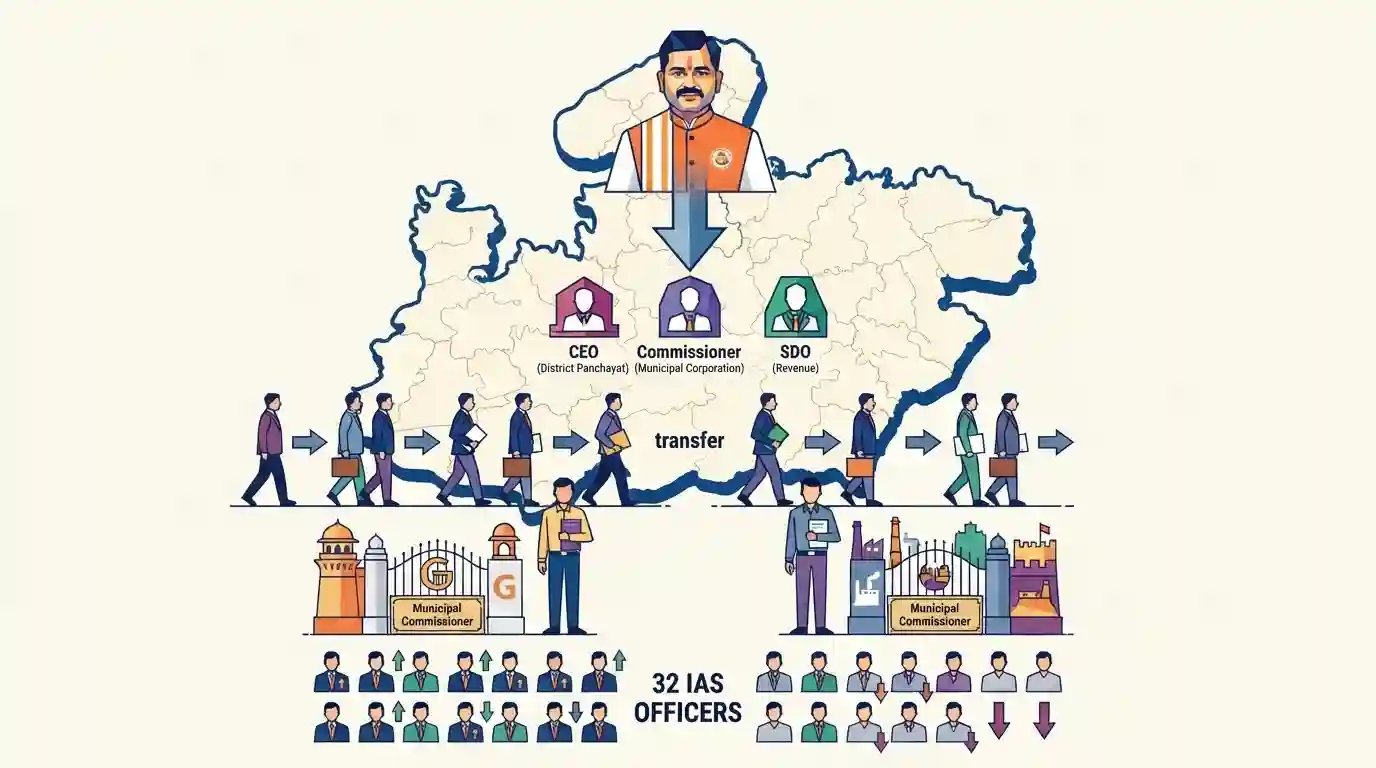
The Government of Madhya Pradesh, under Chief Minister Mohan Yadav, executed a significant administrative reshuffle by transferring 32 Indian Administrative Service (IAS) officers. The reshuffle affects various levels of local governance and state administration, involving key appointments such as Chief Executive Officers (CEOs) of District Panchayats, Commissioners of Municipal Corporations, and Sub-Divisional Officers (SDO Revenue) across multiple districts. Notably, Abhishek Chaudhary and Dr. Nagarjun B Gowda were appointed as Commissioners of the Gwalior and Satna Municipal Corporations, respectively.
Key Points
- The Madhya Pradesh government transferred 32 IAS officers in a major administrative reshuffle.
- The transfers involved key postings across local governance, including District Panchayat CEOs and Municipal Corporation Commissioners.
- Abhishek Chaudhary was appointed as the Commissioner of Gwalior Municipal Corporation.
- Dr. Nagarjun B Gowda took charge as the Commissioner of Satna Municipal Corporation.
Important Terms
Indian Administrative Service (IAS)

The premier All-India civil service whose officers manage government administration and policy implementation. They serve at sub-divisional, district, state, and central levels, typically acting as District Collectors or department heads.
UPSC context
Essential for GS Paper 2 (Polity). Tests knowledge of executive structures, civil services, and state administration.
Municipal Corporation
A local self-government body constituted under the MP Municipal Corporation Act, 1956, to administer larger urban areas. It is administered by an IAS officer serving as the Municipal Commissioner.
UPSC context
Crucial for GS Paper 2 (Local Self-Government). Tests understanding of urban local bodies and the 74th Amendment.
District Panchayat CEO
The chief administrative officer of a Zila Panchayat in Madhya Pradesh, often an IAS officer. They execute rural development schemes, manage funds, and supervise grassroots Panchayati Raj institutions district-wide.
UPSC context
Key for GS Paper 2 (Panchayati Raj). Assesses knowledge of the 73rd Amendment, rural development, and executive control in local bodies.
Sub-Divisional Officer (SDO Revenue)
A state administrative officer heading a sub-division. Under the MP Land Revenue Code, 1959, the SDO manages land records, collects revenue, and exercises specific powers delegated by the District Collector.
UPSC context
Important for GS Paper 2 (State Administration). Tests knowledge of the district revenue hierarchy and the Madhya Pradesh Land Revenue Code.
Prelims Trap
Intra-state transfers and postings of IAS officers are strictly controlled by the Union Ministry of Personnel (DoPT).
Intra-state postings are exclusively managed by the State Government. The Centre (DoPT) only handles ultimate disciplinary control and inter-cadre deputations.
Static Concepts Connected
What is the dual control mechanism for All India Services (IAS)?
- Immediate Control: Exercised by the State Government, which dictates specific postings, intra-state transfers, and immediate disciplinary actions.
- Ultimate Control: Rests with the Central Government (President/DoPT), which retains the sole power to dismiss or permanently remove an officer.
- Constitutional Basis: Article 312 empowers Parliament to create All India Services, provided the Rajya Sabha passes a resolution by a two-thirds majority.
What are the historical and statutory roots of MP's Urban Local Bodies?
- First Corporation: Jabalpur was established as the first Municipal Corporation in the region in 1864, marking the start of organized urban administration.
- Statutory Backing: Municipal Corporations in the state are governed by the Madhya Pradesh Municipal Corporation Act, 1956.
- Executive Head: Administratively headed by a Municipal Commissioner, generally an IAS officer, who executes the council's decisions.
Cross-Topic Patterns
Local Bodies vs. Bureaucracy
The executive authority in local bodies rests with state-appointed bureaucrats (CEO, Commissioner), highlighting the functional separation between elected mayors/chairpersons and administrators in decentralised governance.
Urban Administration & State Schemes
Routine reshuffles of SDOs and Municipal Commissioners are critical for executing state-level urban development and revenue schemes, directly impacting governance indices evaluated by MPPSC.

Expect MP GK questions on the first Municipal Corporation (Jabalpur 1864) or the constitutional basis of All India Services (Article 312).
Linked PYQs · 5
Linked PYQs · 5
- 2020MPPSC_PRELIMSGS1
The Madhya Pradesh State Election Commission was constituted on
- 2021MPPSC_PRELIMSGS1
Who among the following Chief Ministers of Madhya Pradesh has not held the office of the leader of the house in Madhya Pradesh Legislative Assembly during his tenure ?
- 2021MPPSC_PRELIMSGS1
Who will preside the meeting of the Gram Sabha in absence of the sarpanch and up-sarpanch in Madhya Pradesh ?
- 2021MPPSC_PRELIMSGS1
The Madhya Pradesh Public Service Commission shall consist of maximum
- 2022MPPSC_PRELIMSGS1
What is the minimum population required for the declaration of a Gram Panchayat in Madhya Pradesh?
