Madhya Pradesh Tops India in Horticulture Development
Source:indianmasterminds ↗
Why It Matters
The article is highly relevant for MPPSC State Service Prelims as it covers crucial state-specific data on agriculture and horticulture, government schemes regarding MSP and millet promotion, and major regional infrastructure initiatives like the Tapti Basin Mega Recharge Project. Questions on major crops, production ranks, and irrigation sources are recurrent in the exam.
Summary
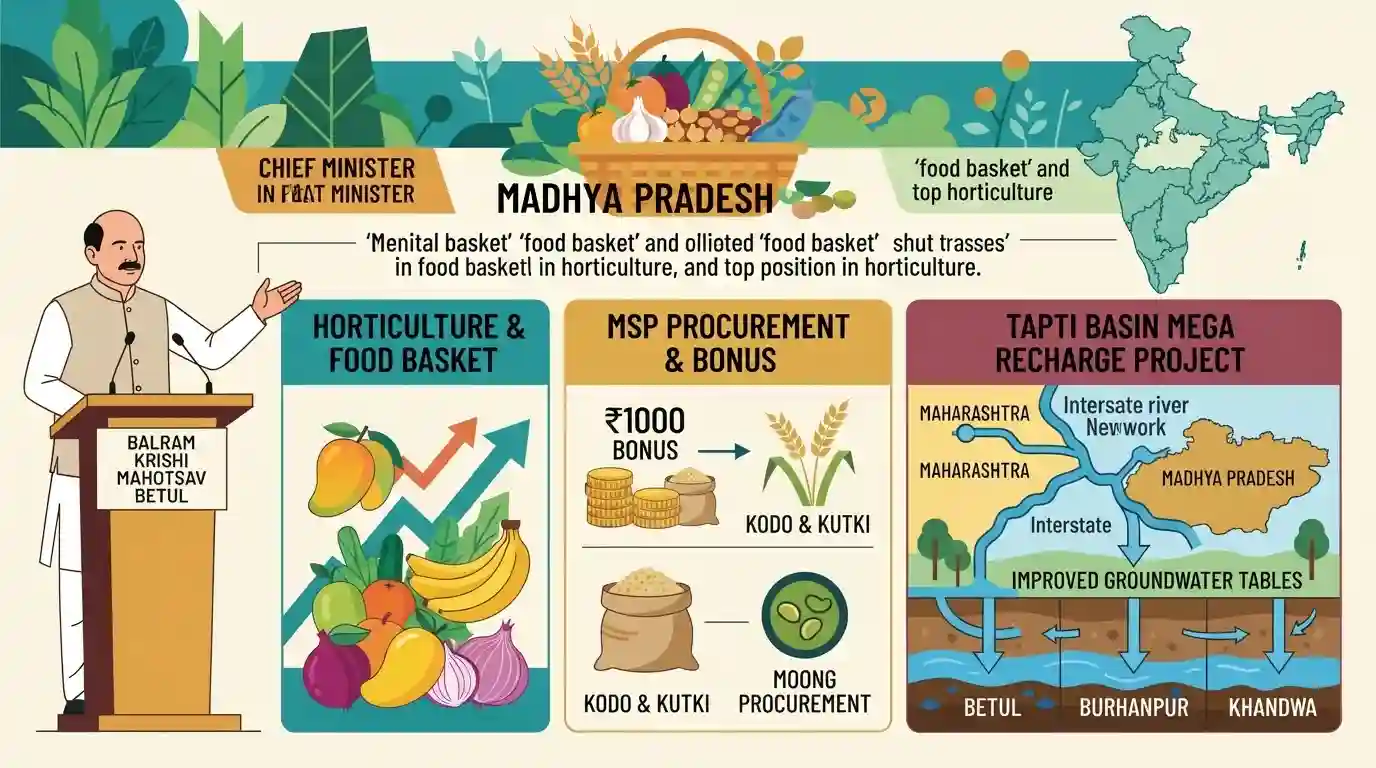
Madhya Pradesh has achieved the top position in India for horticulture development. During the Balram Krishi Mahotsav in Betul, Chief Minister Mohan Yadav highlighted the state's status as India's 'food basket', leading in the production of wheat, pulses, gram, and garlic. Key announcements included the procurement of Moong at Minimum Support Price (MSP) and a Rs 1,000 per quintal bonus for farmers cultivating millets like Kodo and Kutki. Furthermore, the CM highlighted the Tapti Basin Mega Recharge Project, a joint venture with Maharashtra, designed to significantly improve groundwater tables in the districts of Betul, Burhanpur, and Khandwa.
Key Points
- Madhya Pradesh currently leads India in horticulture development and is recognized as the 'food basket' of the nation.
- Chief Minister Mohan Yadav announced the government's decision to procure Moong on Minimum Support Price (MSP).
- Farmers producing millets (Sri Anna), specifically Kodo and Kutki, will receive an additional bonus of Rs 1,000 per quintal to promote millet cultivation.
- The Tapti Basin Mega Recharge Project, an interstate initiative between Madhya Pradesh and Maharashtra, aims to replenish groundwater levels in Betul, Burhanpur, and Khandwa.
- Madhya Pradesh holds top national rankings in the production of wheat, gram, pulses, and garlic.
Important Terms
Tapti Basin Mega Recharge Project

A joint groundwater recharge initiative between Madhya Pradesh and Maharashtra. It channels Tapti River water into aquifers to raise groundwater levels and support irrigation in historically dry, water-stressed regions without displacing local communities.
UPSC context
GS Paper I (Drainage systems) and GS Paper III (Irrigation and water management).
Minimum Support Price (MSP) scheme
A market intervention by the Government of India that acts as a price assurance mechanism, guaranteeing a minimum price for select crops before sowing to shield farmers from market fluctuations and distress sales.
UPSC context
GS Paper III (Agriculture, farm subsidies, and food security).
UNNATI (Agri-GIS) Project
A technology-driven platform under Madhya Pradesh’s Krishi-Unnati concept. It uses satellite remote sensing and GIS technology to enable data-driven agricultural planning, soil nutrient mapping, and monitoring of watershed and crop management.
UPSC context
GS Paper III (E-technology in aid of farmers and digital agriculture).
Balram Krishi Mahotsav
A state-wide six-month agricultural welfare campaign in Madhya Pradesh. It focuses on promoting modern farming techniques, crop diversification, daytime power supply for irrigation, and raising farmer incomes through allied sectors.
UPSC context
GS Paper III (Agricultural growth, irrigation practices, and farmer welfare schemes).
Prelims Trap
"The Tapti river basin is shared exclusively between Madhya Pradesh and Maharashtra."
While the Tapti Basin Mega Recharge Project is a bilateral initiative between MP and Maharashtra, the actual Tapti River basin also extends into Gujarat.
Static Concepts Connected
What are the key geographical characteristics of the Tapti River?
- Origin: It rises from Multai in the Betul district of Madhya Pradesh, situated in the Satpura range.
- Drainage Pattern: It is a major west-flowing river that runs through a rift valley, flowing parallel to the Narmada River.
- Basin States: Its drainage basin spans across Madhya Pradesh, Maharashtra, and Gujarat before emptying into the Arabian Sea (Gulf of Khambhat).
How is MSP coverage structured for pulse crops in India?
- Mandated Crops: The central government mandates MSP for five major pulse crops: Gram, Tur (Arhar), Moong, Urad, and Lentil (Masur).
- Procurement Agencies: Procurement is heavily supported by central nodal agencies like NAFED and SFAC under the Price Support Scheme (PSS) of PM-AASHA.
- Pricing Authority: Prices are recommended by the Commission for Agricultural Costs and Prices (CACP) and finally approved by the CCEA.
Cross-Topic Patterns
Decentralized Millet Promotion
State-level financial bonuses for minor millets (like MP's Kodo/Kutki push or Odisha's Millet Mission) serve as crucial GS3 case studies for crop diversification and nutritional security in rainfed regions.
Shift to Groundwater Cooperation
The MP-MH Tapti recharge project highlights cooperative federalism, shifting the typical UPSC focus from interstate surface-water disputes (Article 262) to collaborative, cross-border aquifer management.

Expect a 2026 Prelims question pairing minor millets (Kodo, Kutki) with their specific climate resilience or primary producing states.
Linked PYQs · 5
Linked PYQs · 5
- 2020MPPSC_PRELIMSGS1
Main crop of Madhya Pradesh is
- 2024MPPSC_PRELIMSGS1
According to 2021 - 22, the area and production of wheat occupies which place among cereals, in Madhya Pradesh?
- 2024MPPSC_PRELIMSGS1
UNNATI (Agri-GISl project of Madhya Pradesh Government is for :
- 2022MPPSC_PRELIMSGS1
Which of the following is a major source of irrigation in Madhya Pradesh?
- 2025MPPSC_PRELIMSGS1
In Madhya Pradesh, which vegetable recorded the highest productivity in 2023-24?
