Madhya Pradesh Increases Summer Moong Procurement Cap to Sixty Percent
Source:thehindu ↗
Why It Matters
Understanding MSP and state vs. central procurement policies is crucial for agricultural economics questions. The issue highlights challenges in agricultural marketing, the financial dynamics of procurement, and the significance of pulse crops like moong in Madhya Pradesh's agrarian economy.
Summary
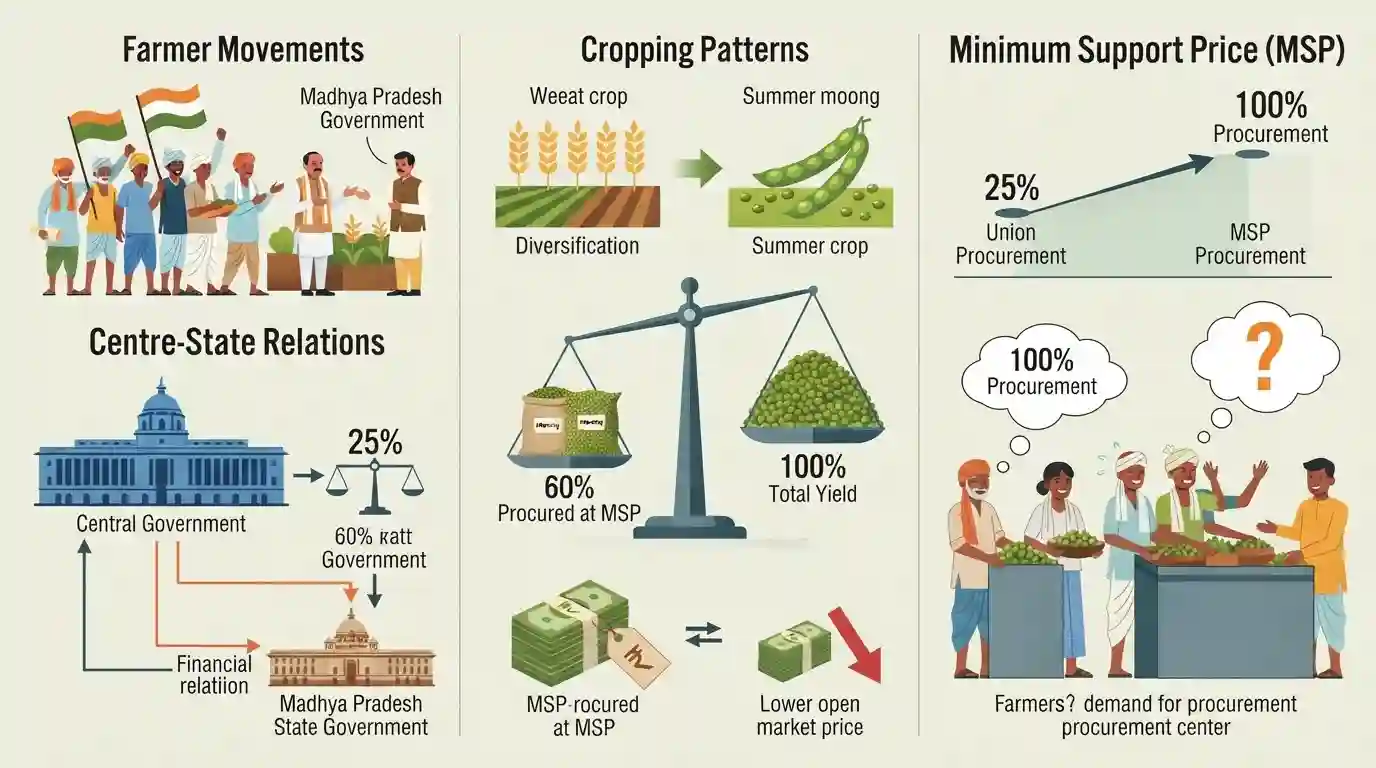
Following widespread protests by farmers associated with the Samyukta Kisan Morcha (SKM) in Bhopal, the Madhya Pradesh government has announced an increase in the procurement limit for the summer moong (green gram) crop. The cap has been raised from 25% to 60% of a farmer's total production. Farmers have been demanding 100% procurement at the Minimum Support Price (MSP) of ₹8,780 per quintal as open market prices have fallen significantly. The Union Government sets a 25% procurement limit, shifting the financial responsibility of additional procurement to state governments.
Key Points
- The Madhya Pradesh government raised the moong (green gram) procurement cap from 25% to 60% of total production in response to farmers' protests.
- Farmers, led by the Samyukta Kisan Morcha (SKM), protested in Bhopal demanding 100% procurement of their moong crop at Minimum Support Price (MSP).
- The Union Government had previously capped procurement at 25% per farmer under its scheme, leaving the financial burden of further procurement on the state.
- The current MSP for moong is fixed at ₹8,780 per quintal, while open market prices have plummeted, prompting distress sales among farmers.
Important Terms
Minimum Support Price (MSP)

The guaranteed floor price set by the Union Government (based on CACP recommendations) at which it buys designated crops directly from farmers to shield them from market volatility.
UPSC context
GS Paper III (Agriculture & Economy): Tests understanding of agricultural pricing, farm subsidies, procurement issues, and crop diversification.
Price Support Scheme
A market intervention scheme under PM-AASHA where central agencies physically procure notified pulses, oilseeds, and copra at MSP when market prices fall below the floor price.
UPSC context
GS Paper III (Agriculture & Subsidies): Tests knowledge of government procurement mechanisms, price stabilization tools, and challenges like procurement caps.
Samyukta Kisan Morcha (SKM)
An umbrella coalition of over 400 Indian farmer unions formed in 2020 to coordinate collective protests demanding a legal guarantee for MSP and pro-farmer agricultural policies.
UPSC context
GS Paper II & III (Polity & Economy): Examines pressure groups, agricultural policy negotiations, and the dynamics of state-society relations.
Prelims Trap
The Central Government is legally obligated to procure 100% of all MSP-notified pulses offered by farmers under the PM-AASHA scheme.
Central procurement under the Price Support Scheme (PSS) of PM-AASHA is capped at 25% of production; procuring beyond that requires states to bear the fiscal burden.
Static Concepts Connected
How is the Minimum Support Price (MSP) determined and approved in India?
- CACP Recommendation: Recommends MSPs based on cost of production (A2+FL), market price trends, inter-crop price parity, and demand-supply balance.
- CCEA Approval: The Cabinet Committee on Economic Affairs, chaired by the Prime Minister, provides final executive approval for MSPs.
- Coverage: Covers 22 mandated crops including 5 pulses (Gram, Tur, Urad, Moong, Masur) and FRP for sugarcane.
What are the key production characteristics of pulses in India?
- Global Position: India is the world's largest producer, consumer, and importer of pulses, reflecting domestic demand-supply gaps.
- Crop Distribution: Gram (chickpea) dominates with nearly 50% of total pulse production, whereas Moong accounts for roughly 10%.
- Cropping Seasons: Unlike single-season crops, Moong is versatile and cultivated during Kharif, Rabi, and Zaid (summer) seasons.
Cross-Topic Patterns
Agrarian Pressure Groups & Policy Reform
Protests by groups like SKM show how non-party political formations successfully reshape state budget allocations and agriculture procurement limits.
Fiscal Federalism & Agriculture Support
Shifting the procurement burden past 25% to states exposes fiscal asymmetric decentralization in implementing PM-AASHA scheme components.

Expect questions linking PM-AASHA procurement caps, state-level fiscal burdens, and the geographical requirements of Zaid/summer crops.
Linked PYQs · 3
Linked PYQs · 3
- 2024MPPSC_PRELIMSGS1
UNNATI (Agri-GISl project of Madhya Pradesh Government is for :
- 2025MPPSC_PRELIMSGS1
India is the largest producer of which agricultural products?
- 2020MPPSC_PRELIMSGS1
Main crop of Madhya Pradesh is
