Moong Procurement Cap Hiked by Madhya Pradesh Government
Source:thehindu ↗
Why It Matters
Highlighting the state and central dynamics in agricultural crop procurement, this issue underscores the challenges of the Minimum Support Price (MSP) system and its impact on farmers' incomes and state finances in Madhya Pradesh.
Summary
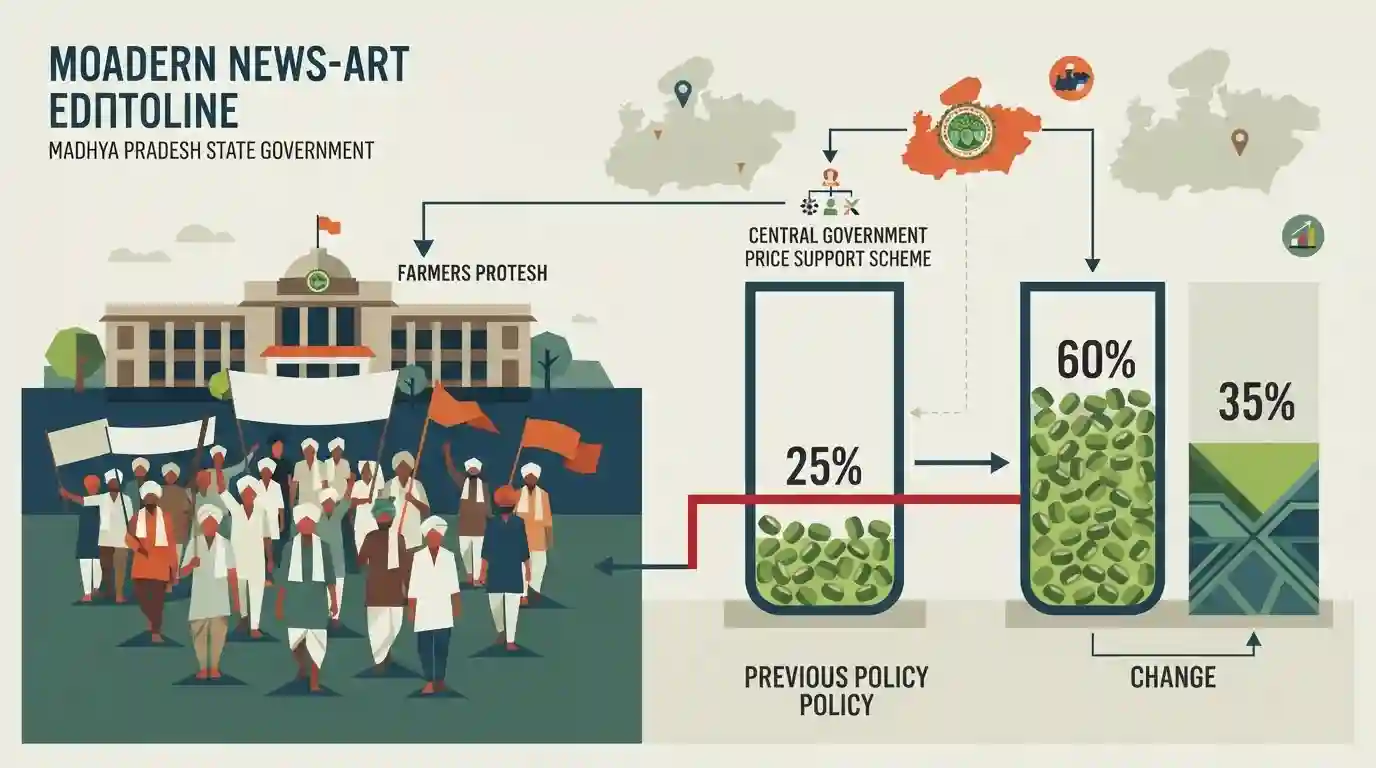
In response to massive protests by farmers led by the Samyukta Kisan Morcha in Bhopal, the Madhya Pradesh government has hiked the procurement cap for moong (green gram) from 25% to 60%. The farmers were demanding 100% procurement of their crops. Under the central government's Price Support Scheme, procurement is capped at 25% of the total produce, meaning the state government will bear the responsibility and cost for procuring the additional 35% through its own agencies.
Key Points
- The Madhya Pradesh government has increased the procurement limit for moong (green gram) from 25% to 60%.
- Farmers under the Samyukta Kisan Morcha (SKM) held significant protests in Bhopal, demanding 100% crop procurement.
- According to central guidelines under the Price Support Scheme, the Centre caps procurement at 25%, leaving states to manage and fund any additional procurement.
- Chief Minister Mohan Yadav announced that state agencies will handle the additional procurement to safeguard farmers' interests.
Important Terms
Price Support Scheme (PSS)

A central government market intervention policy under PM-AASHA. Central nodal agencies physically procure designated pulses, oilseeds, and copra directly from farmers when open market prices fall below the government-declared minimum support price.
UPSC context
UPSC GS-III (Agriculture): Tested on agricultural pricing policy, PM-AASHA components, market intervention mechanisms, and federal sharing of procurement costs.
Samyukta Kisan Morcha (SKM)
A coalition of over 400 Indian farmers' unions formed in November 2020. It coordinated non-violent protests against the three central farm laws, ultimately securing their repeal, and continues to advocate for a legal MSP guarantee.
UPSC context
UPSC GS-II (Governance): Relevant as an agrarian pressure group influencing public policy and demonstrating mass mobilization and democratic participation.
Minimum Support Price (MSP)
A minimum price guaranteed by the Indian government for 23 mandated agricultural crops. Recommended by the CACP, it acts as a safety net to protect farmers from sharp price drops during bumper harvests or market gluts.
UPSC context
UPSC GS-III (Agriculture): High-yield topic regarding farm subsidies, CACP calculation methods (A2+FL, C2), food security, and WTO agricultural compliance.
Prelims Trap
Procurement of pulses at Minimum Support Price by the Centre is open-ended, similar to wheat and paddy.
While wheat and paddy enjoy open-ended procurement by FCI, pulses under the Price Support Scheme (PM-AASHA) are centrally capped at 25% of national production.
Static Concepts Connected
How does procurement of pulses differ from major cereals in India?
- Procurement Limits: Wheat and paddy enjoy open-ended procurement. Pulses and oilseeds are capped at 25% of production under the Price Support Scheme.
- Procuring Agencies: Cereals are primarily procured by FCI, whereas pulses are procured by central nodal agencies like NAFED and NCCF.
- Fiscal Burden: If states wish to procure pulses beyond the 25% central limit, the State Government must bear the additional financial and logistical costs.
What are the three components of the PM-AASHA scheme?
- Price Support Scheme: Physical procurement of pulses, oilseeds, and copra by central agencies (NAFED/NCCF) up to 25% of production.
- Price Deficiency Payment: Covers oilseeds. Farmers are paid the difference between MSP and market price directly into bank accounts without physical procurement.
- Private Procurement: A pilot scheme allowing private sector participation in the procurement of oilseeds at MSP.
Cross-Topic Patterns
MSP caps hinder Crop Diversification
Procurement limits on pulses discourage farmers from abandoning water-intensive, open-ended procured crops like paddy, directly countering national ecological and crop diversification goals.
Entry 33 vs Entry 14 conflicts
Highlights Centre-State federal friction: 'Agriculture' is a State subject (Entry 14), but central foodstuff pricing and procurement interventions are driven via the Concurrent List (Entry 33).

Expect a 2026 question contrasting open-ended FCI cereal procurement with capped NAFED pulse procurement under the PM-AASHA framework.
Linked PYQs · 2
Linked PYQs · 2
- 2020MPPSC_PRELIMSGS1
Main crop of Madhya Pradesh is
- 2023MPPSC_PRELIMSGS1
Which of the following is not an E–procurement portal?
