Madhya Pradesh High Court Vacates Stay on State Service Exam Mains
Source:The Hindu ↗
Why It Matters
This news touches upon several critical themes of the MPPSC Prelims syllabus, including State Public Service Commissions (Articles 315-323), judicial mechanisms (interim stays and writ jurisdiction of High Courts under Article 226), and constitutional debates regarding reservations and migration of reserved category candidates to open categories in public employment.
Summary
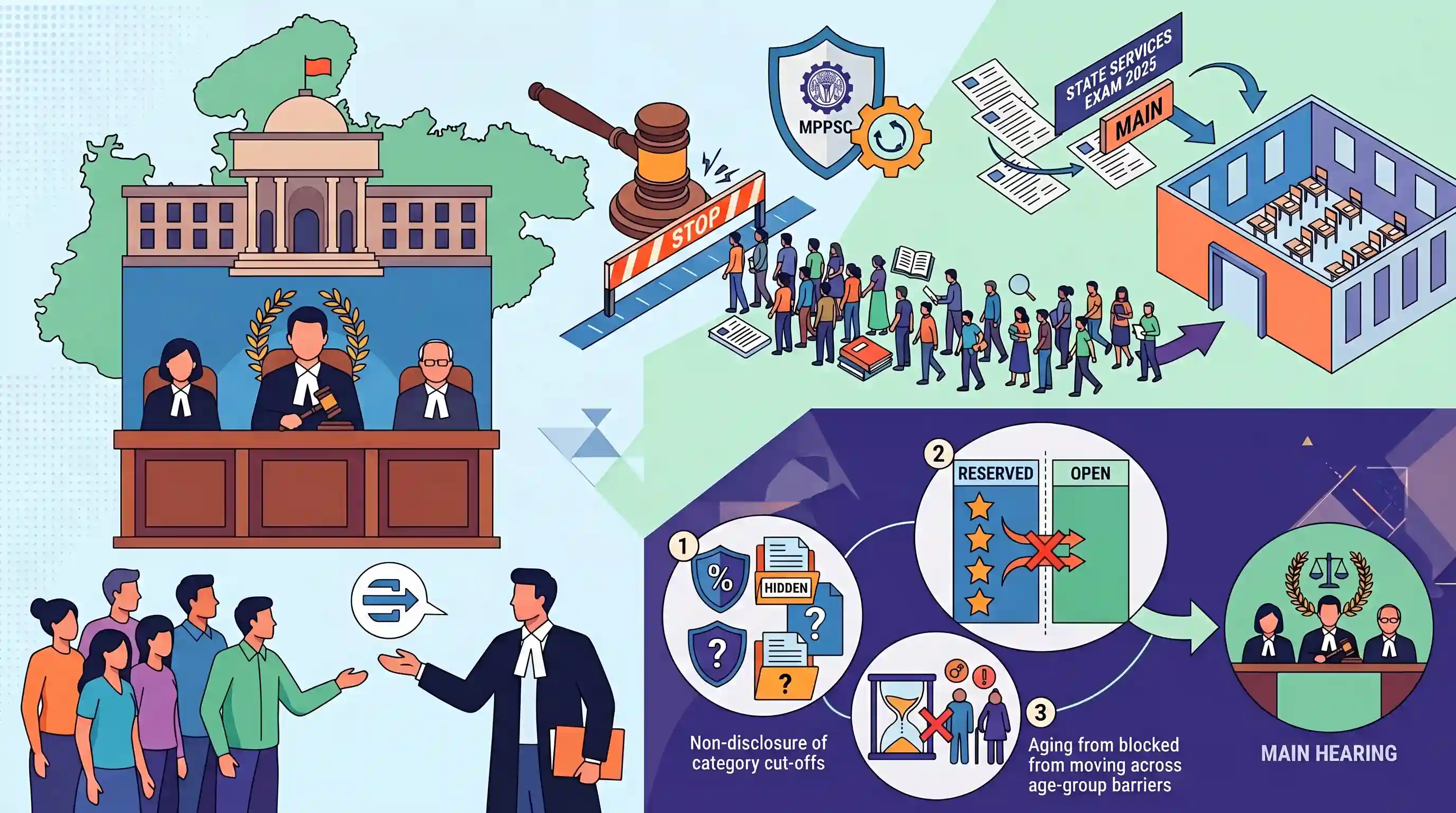
The Madhya Pradesh High Court (Jabalpur) has vacated an interim stay on holding the MPPSC State Services Examination (SSE) 2025 main exam, allowing the recruitment process for around 4,000 candidates to resume. The division Bench of Acting Chief Justice Vivek Rusia and Justice Pradeep Mittal lifted the stay upon a request from the petitioners' counsel, while scheduling the main hearing on the legal challenges—concerning non-disclosure of category-wise cut-offs, non-selection of meritorious reserved category candidates under open-category seats, and the non-migration of candidates who availed age relaxation—for July 17.
Key Points
- The Madhya Pradesh High Court vacated its interim stay (originally ordered on April 2, 2025) on conducting the State Services Examination (SSE) 2025 main exam.
- This decision clears the path for approximately 4,000 candidates who cleared the preliminary test to take the mains examination for recruitment to positions such as Deputy Collector, Deputy Superintendent of Police, and Tehsildar.
- The division Bench that delivered the order on June 18, 2026, was comprised of Acting Chief Justice Vivek Rusia and Justice Pradeep Mittal.
- The underlying petitions challenged the constitutional validity of non-disclosure of category-wise cut-off marks in the preliminary exams, the alleged non-selection of meritorious reserved candidates on unreserved posts, and the non-migration of candidates who had availed age relaxation or other concessions.
- During the proceedings, MPPSC submitted the category-wise cut-off marks to the High Court in a sealed cover, and the court set the next hearing on the core legal challenges for July 17.
Important Terms
State Public Service Commission (SPSC)

An independent constitutional body established under Articles 315–323, responsible for conducting recruitment examinations and advising the state government on personnel management and disciplinary matters.
UPSC context
GS Paper II (Polity). Crucial for questions on constitutional bodies, civil services, and center-state recruitment structures.
Acting Chief Justice (High Court)
A Judge appointed by the President of India under Article 223 of the Constitution to temporarily perform the duties of the Chief Justice of a High Court.
UPSC context
GS Paper II (Judiciary). Tests knowledge of constitutional provisions concerning the structure, appointment, and functioning of State High Courts.
Article 16 (Constitution of India)
A Fundamental Right under Part III guaranteeing equality of opportunity in public employment while permitting affirmative actions or reservations for underrepresented backward classes.
UPSC context
GS Paper II (Fundamental Rights). Key for analysis of reservation policies, social justice, and constitutional equality.
High Court (India)
The highest judicial institution at the state level under Articles 214–231, possessing original, appellate, and supervisory jurisdiction over subordinate courts.
UPSC context
GS Paper II (Judiciary). Important for judicial structures, federalism, writs jurisdiction, and constitutional disputes.
Prelims Trap
The Governor of a State has the constitutional power to remove the Chairman or members of a State Public Service Commission.
While the Governor appoints SPSC members, they can only be removed by the President under Article 317, following a mandatory Supreme Court inquiry. The Governor can only suspend them pending inquiry.
Static Concepts Connected
How are State Public Service Commission (SPSC) members removed and suspended?
- Removal Authority: Appointed by the state Governor, but can only be removed by the President of India.
- Grounds of Misbehaviour: Can be removed on grounds of misbehaviour only after an inquiry and recommendation by the Supreme Court of India.
- Suspension Power: The Governor can suspend the Chairman or a member from office pending the Supreme Court's inquiry report.
What is the judicial doctrine regarding Meritorious Reserved Category (MRC) candidates?
- Migration Rule: Reserved category candidates who qualify on their own merit without relaxations are adjusted against unreserved (open) category quotas.
- Concession Exception: If a candidate avails age or fee concessions, they may not be allowed to migrate to the open category, depending on specific state recruitment rules.
Cross-Topic Patterns
Judicial Activism vs Executive Efficiency
Judicial stays on public exams clash with the right to livelihood (Art 21) and efficient administration (Art 335), forcing courts to balance equity against administrative delays.
Asymmetric Federalism in SPSC Governance
The administrative friction in state recruitments highlights the federal asymmetry where state-level officers (SPSC) are appointed by Governors but shielded by Presidential removal powers.

SPSC member removal processes and Governor's suspension powers will likely be tested alongside Article 16 reservation limits in 2026.
Linked PYQs · 4
Linked PYQs · 4
- 2022MPPSC_PRELIMSGS1
In which Article of the Constitution is there the provision of Public Service Commissions for the Union and the States?
- 2023MPPSC_PRELIMSGS1
Which of the following Article of the Constitution of India is related to expenses of Public Service Commissions?
- 2022MPPSC_PRELIMSGS1
According to which Article of the Indian Constitution, can the President of India (in consultation with the Chief Justice) transfer a Judge of a High Court from one court to another?
- 2023MPPSC_PRELIMSGS1
What is the maximum age limit of a High Court Judge?
