High Court Intervenes Over Schoolchildren Crossing Betwa River Pillars
Source:etvbharat ↗
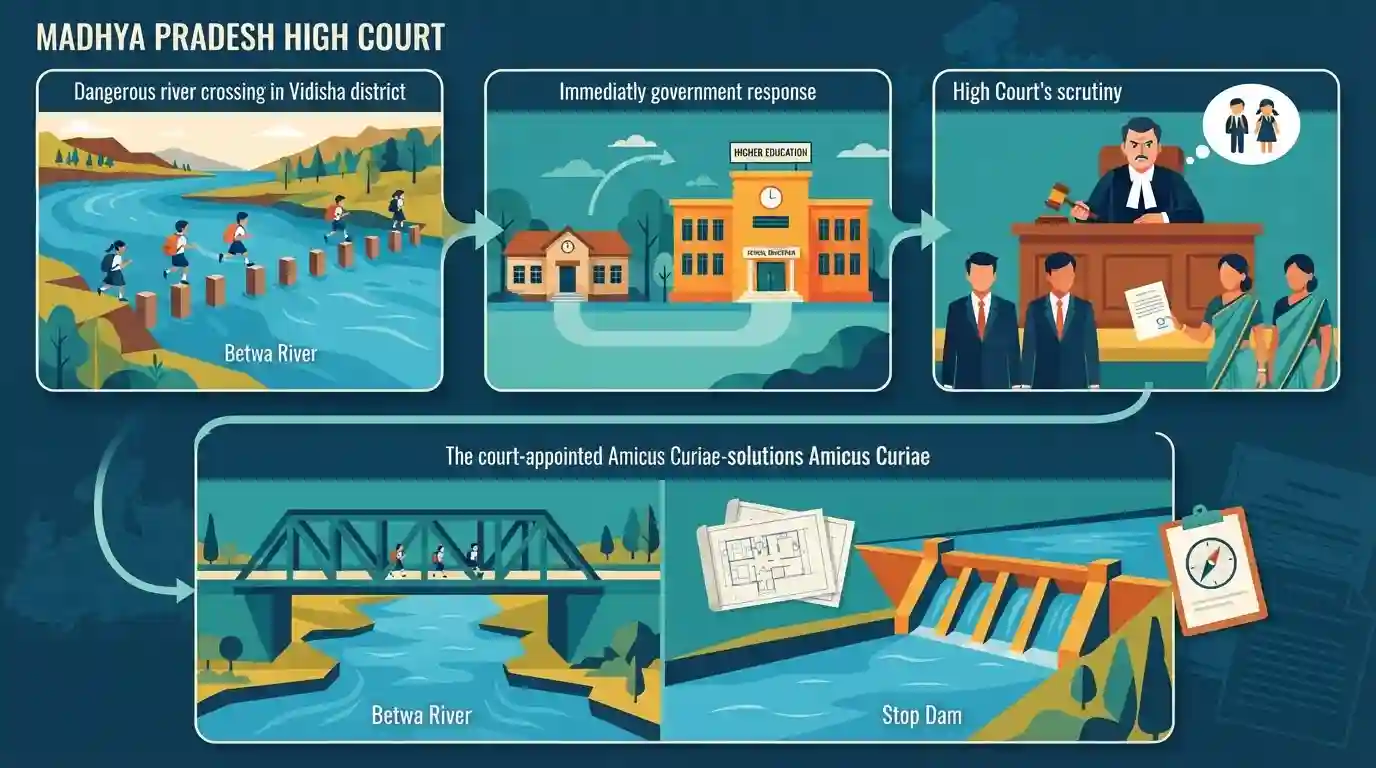
Why It Matters
The article bridges MP geography (Betwa River) and polity (judicial activism, PILs) while highlighting challenges in rural education infrastructure. Both the geography of the Betwa River and basic concepts of judicial intervention are frequently tested in MPPSC Prelims.
Summary
The Madhya Pradesh High Court has intervened after a viral video showed schoolchildren dangerously crossing the swollen Betwa river by jumping across pillars in Vidisha district. In response to the court's scrutiny, the state government upgraded a local middle school to a high school to prevent students from needing to cross the river. However, the court expressed dissatisfaction over the appointment of only two teachers for the school. An Amicus Curiae was appointed to propose permanent infrastructure solutions, such as building a bridge or a stop dam, and notices were issued to top state officials.
Key Points
- The Madhya Pradesh High Court took cognizance of a video showing students dangerously crossing the flooded Betwa river in Vidisha to attend school.
- The state government responded by temporarily upgrading a local middle school to a high school and installing barricades.
- The High Court criticized the state for appointing only two teachers for the newly upgraded high school, highlighting gaps in education infrastructure.
- An Amicus Curiae was appointed to assess the feasibility of constructing a bridge or stop dam across the Betwa River.
- The incident highlights the geographical significance of the Betwa River, a major tributary of the Yamuna originating in the Vindhyan range.
Important Terms
Public Interest Litigation (PIL)

Legal proceedings initiated in a court of law to protect public interest where the rights of a class or community are affected, relaxing the traditional rule of locus standi.
UPSC context
GS Paper II: Polity; tests judicial activism, judicial review, and mechanisms for safeguarding marginalized rights.
Amicus Curiae
A Latin term meaning 'friend of the court,' referring to a neutral individual or organization appointed by a court to provide expert assistance or objective perspectives.
UPSC context
GS Paper II: Judiciary; tests understanding of judicial procedures, legal terminology, and the court's advisory powers.
Betwa River
A major tributary of the Yamuna River originating in the Vindhya Range of Madhya Pradesh, central to the Ken-Betwa river interlinking project.
UPSC context
GS Paper I: Geography; tests knowledge of peninsular river systems, drainage basins, and water resources.
Stop Dam
A small, low-height barrier constructed across a seasonal stream or river to obstruct water flow, conserve surface runoff, and recharge groundwater tables.
UPSC context
GS Paper III: Infrastructure & Water Management; tests water conservation, rural development, and environmental sustainability.
Public Works Department (PWD)
A state government department responsible for the planning, designing, constructing, and maintaining of public infrastructure assets like roads, bridges, and public buildings.
UPSC context
GS Paper II: Governance; tests administrative structures, infrastructure policy, and execution of public works.
Prelims Trap
The Ken-Betwa Link Project transfers surplus water from the Betwa basin to the water-deficit Ken basin.
The transfer is actually from the Ken River (surplus) to the Betwa River (deficit). Aspirants often invert the flow direction of India's first major river-interlinking project.
Static Concepts Connected
How does High Court writ jurisdiction (Article 226) differ from the Supreme Court (Article 32)?
- Substantive Scope: High Courts can issue writs for enforcing fundamental rights as well as ordinary legal rights, whereas the SC is restricted only to fundamental rights.
- Discretionary Nature: Article 32 is itself a fundamental right, making the SC's remedy mandatory; Article 226 is discretionary, meaning the HC can refuse to exercise it if alternative remedies exist.
- Territorial Limit: SC writ jurisdiction extends throughout India, while HC jurisdiction is limited to its territorial state borders or cause of action arising therein.
What is the significance of the Ken-Betwa River Interlinking Project?
- Pioneer Status: It is India's first major river interlinking project aiming to irrigate the drought-prone Bundelkhand region spanning MP and UP.
- Ecological Impact: The project involves building the Daudhan Dam on the Ken River, which will submerge core areas of the Panna Tiger Reserve in Madhya Pradesh.
- River Basin Geography: Both Ken and Betwa rivers originate in Madhya Pradesh and are key right-bank tributaries of the Yamuna River.
Cross-Topic Patterns
RTE Article 21A vs Rural Infrastructure Connectivity
The constitutional guarantee under Article 21A remains unfulfilled without physical infrastructure (bridges, roads) ensuring safe, all-weather access to schooling in flood-prone terrains.
Suo Motu PILs and Separation of Powers
Courts issuing detailed administrative directives (appointing teachers, suggesting dams) highlights the growing role of judicial activism in addressing executive execution deficits.

UPSC may link Ken-Betwa geographical features (Panna Tiger Reserve) with the comparative writ jurisdictions of Article 32 and 226.
Linked PYQs · 3
Linked PYQs · 3
- 2020MPPSC_PRELIMSGS1
Betwa river originate from
- 2021MPPSC_PRELIMSGS1
| List-I (Tributaries) | List-II (Rivers) | |---------------------|----------------| | A. Betwa | ii. Yamuna | | B. Kshipra | iii. Narmada | | C. Vainganga | iv. Godavari | | D. Tawa | i. Chambal | Codes:
- 2013MPPSC_PRELIMSGS1
PIL is
