Madhya Pradesh High Court Summons for Cyber Fraud Coordination
Source:lawtrend ↗
Why It Matters
Highlights the jurisdictional and operational challenges in combating cybercrime in India, emphasizing the crucial need for real-time inter-state and central agency coordination. It also underscores the proactive role of the judiciary in bridging administrative gaps in modern law enforcement.
Summary
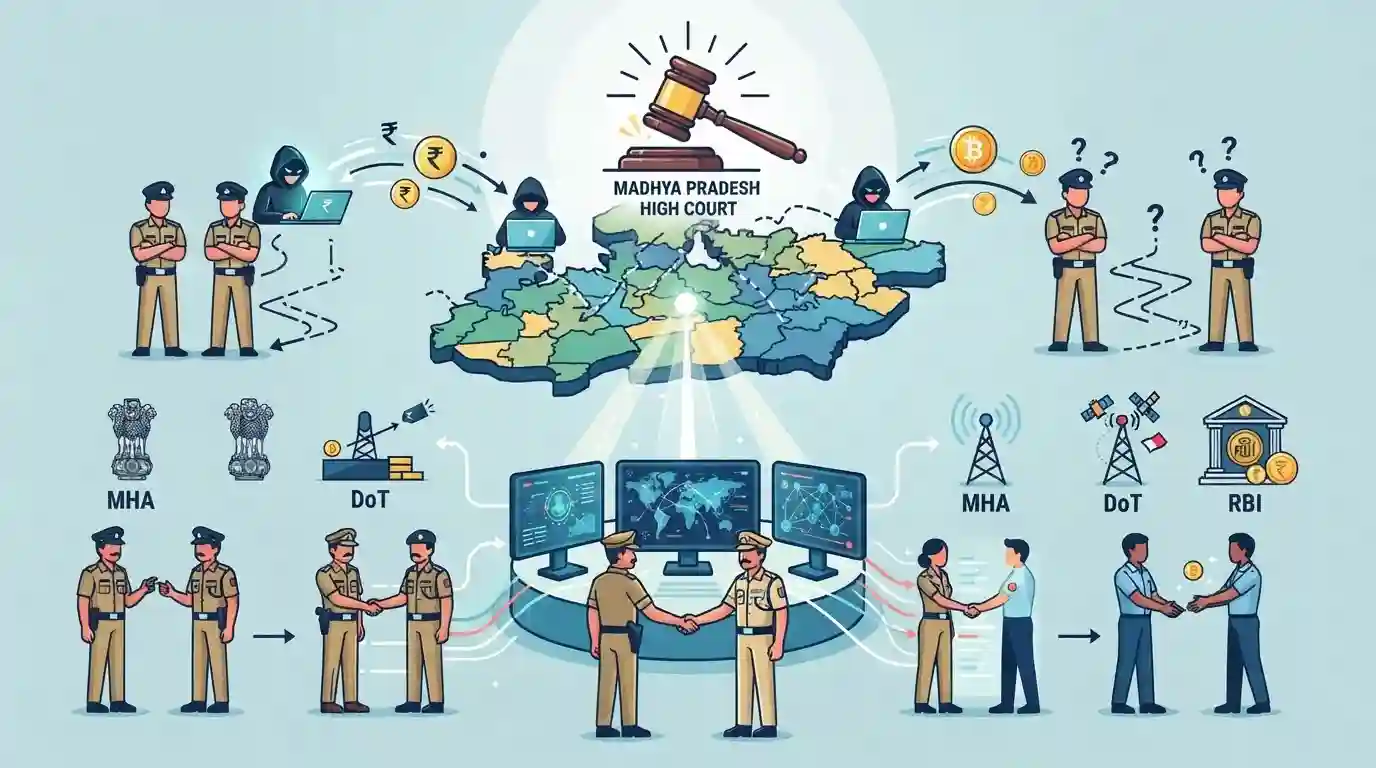
The Madhya Pradesh High Court has intervened to address systemic delays and coordination issues in the investigation of cybercrimes in India. Acknowledging that cybercriminals frequently transfer stolen funds to accounts in different states or convert them to cryptocurrencies, the Court observed that local police face significant hurdles in recovering the money promptly. In a bid to establish a centralized, real-time response mechanism, the High Court issued summons to top police officials from several states, as well as key central bodies including the Ministry of Home Affairs (MHA), the Department of Telecommunications (DoT), and the Reserve Bank of India (RBI).
Key Points
- The Madhya Pradesh High Court took suo motu cognizance of delays and lack of coordination in tackling cyber frauds across states.
- The court noted that fraudsters exploit geographical boundaries by transferring stolen money to out-of-state bank accounts or converting it into cryptocurrency.
- To address this, the High Court summoned the Directors General of Police (DGPs) from multiple states, including MP, Delhi, Maharashtra, and West Bengal.
- Central authorities like the Ministry of Home Affairs, Department of Telecommunications, and the RBI were also summoned to assist in creating a unified, real-time mechanism for tracking and freezing defrauded funds.
Important Terms
Reserve Bank of India (RBI)

India's central bank and financial regulator. It oversees banking systems, digital payment networks, and formulates standard operating procedures to mitigate banking frauds and track illegal fund transfers.
UPSC context
GS Paper 3 (Economy & Cybersecurity). Tests knowledge of regulatory frameworks for financial institutions and digital fraud prevention.
Ministry of Home Affairs (MHA)
The nodal Union ministry for India's internal security. It coordinates interstate law enforcement and combats cyber threats nationwide through bodies like the Indian Cyber Crime Coordination Centre (I4C).
UPSC context
GS Paper 3 (Internal Security). Relevant for analyzing Centre-State coordination mechanisms and national cybercrime response frameworks.
Department of Telecommunications (DoT)
A department under the Ministry of Communications responsible for telecom policy, licensing, and regulating the communication networks often exploited by cybercriminals for coordinated frauds.
UPSC context
GS Paper 3 (Internal Security). Tests the role of telecom regulation in preventing cyber fraud and enhancing digital safety.
Cryptocurrency
A digital or virtual currency secured by cryptography. Its decentralized nature is increasingly exploited by cybercriminals to quickly launder stolen funds across borders without central oversight.
UPSC context
GS Paper 3 (Internal Security & Tech). Tests understanding of digital assets, money laundering risks, and challenges in cyber policing.
Prelims Trap
"Cybercrime investigation is under the exclusive jurisdiction of Union agencies because digital networks cross state lines."
"Police" and "Public Order" remain State subjects (Seventh Schedule). Central bodies like I4C only coordinate; primary investigation lies with State police.
Static Concepts Connected
How does the Constitution divide jurisdiction for cybercrimes between the Centre and States?
- State Subject: 'Police' and 'Public Order' are State List entries, meaning state police are primarily responsible for investigating cybercrimes.
- Union Legislation: The Information Technology (IT) Act, 2000 was enacted using Union residuary powers to provide a uniform legal framework for cyber offenses.
- Central Nodal Agencies: Agencies like the Indian Cyber Crime Coordination Centre (I4C) facilitate inter-state operations but lack original law enforcement powers.
What are the key central initiatives to tackle financial cyber frauds?
- I4C: A nodal initiative under the MHA to provide a centralized framework for Law Enforcement Agencies (LEAs) across India.
- CFCFRMS: The Citizen Financial Cyber Fraud Reporting and Management System (CFCFRMS) integrates LEAs, banks, and RBI to freeze defrauded funds.
- Sanchar Saathi: A Department of Telecommunications portal featuring 'Chakshu' to report suspected fraudulent calls and texts, and CEIR to block lost phones.
Cross-Topic Patterns
Cooperative Federalism vs. Borderless Crimes
The borderless nature of cyber frauds exposes the limitations of state-siloed policing, highlighting a pressing internal security need for cooperative federal mechanisms like I4C.
Cryptocurrency as an AML/CFT Threat
Fraudsters converting stolen fiat into digital tokens connects local policing hurdles directly to broader macroeconomic concerns and FATF guidelines on Virtual Asset Service Providers (VASPs).

Prelims 2026: Multi-statement Q on I4C, CERT-In, and Sanchar Saathi portal, specifically testing their nodal vs statutory policing powers.
Linked PYQs · 5
Linked PYQs · 5
- 2023MPPSC_PRELIMSGS1
Which of the following is a type of cyber attack that involves tricking users into revealing sensitive information?
- 2024MPPSC_PRELIMSGS1
A _________attack comes in the form of deceptive emails or text messages that may ask you to install software or divulge personal information.
- 2022MPPSC_PRELIMSGS1
The feature(s) of cyber security is/are:
- 2019MPPSC_PRELIMSGS1
Which of the following is not a cybercrime?
- 2018MPPSC_PRELIMSGS1
Which of the following are the two essential features of cyber crime ?
