Madhya Pradesh High Court seeks report on Bandhavgarh tiger deaths
Source:indiatimes.com ↗
Why It Matters
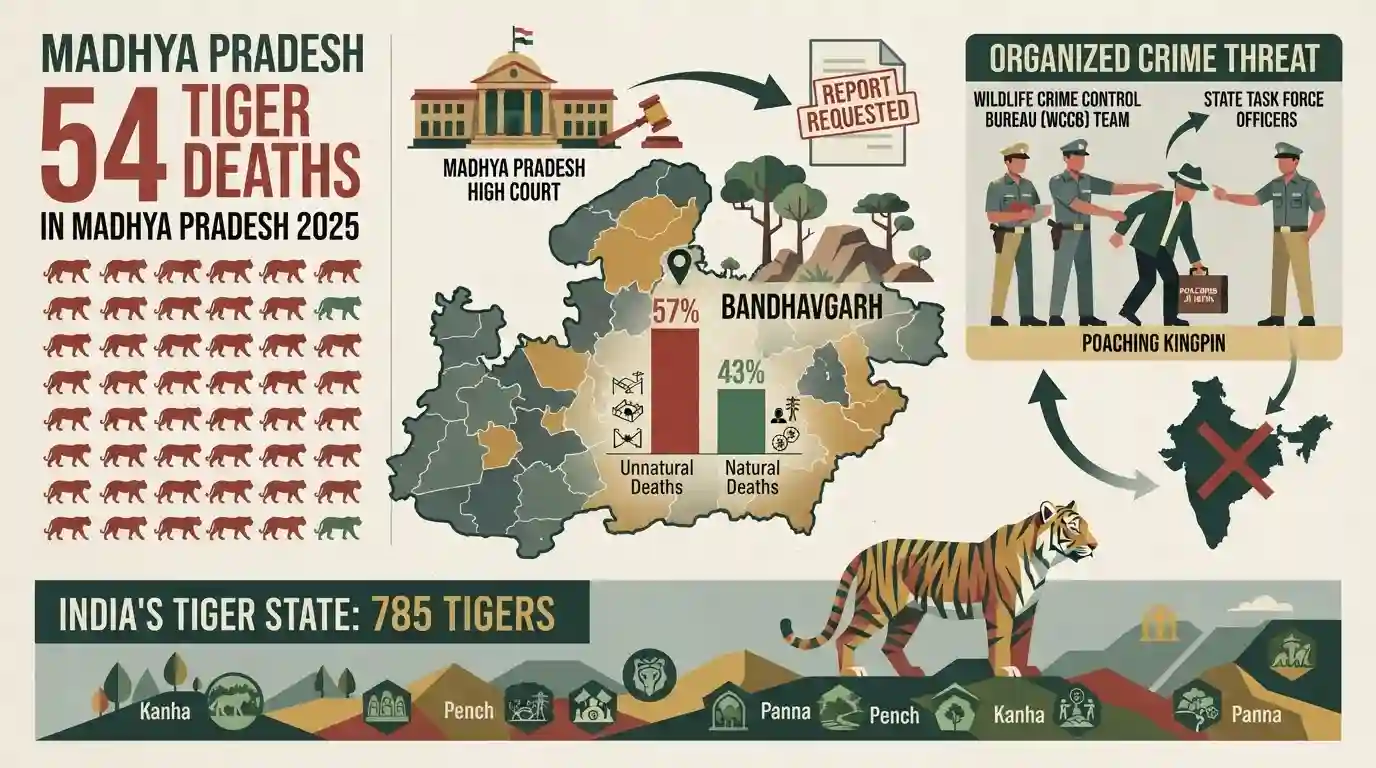
Madhya Pradesh is India's 'Tiger State', making the conservation and protection of its tiger population (785 tigers) a crucial environmental priority. Knowledge of Bandhavgarh Tiger Reserve, wildlife crime enforcement mechanisms (like the WCCB), and threats such as poaching and electrocution are frequently tested in state administrative exams.
Summary
The Madhya Pradesh High Court has directed state authorities to submit a detailed report concerning the unnatural deaths of tigers in the Bandhavgarh Tiger Reserve. A public interest litigation highlighted that 54 tiger deaths occurred in Madhya Pradesh in 2025, raising serious concerns over poaching and electrocution. Official data indicates that 57% of recent tiger deaths in Bandhavgarh were unnatural. Recently, the Wildlife Crime Control Bureau and state task forces arrested an international poaching kingpin, underscoring the severe threat that organized wildlife crime poses to Madhya Pradesh, which is recognized as India's 'Tiger State' with a population of 785 tigers.
Key Points
- The Madhya Pradesh High Court has sought a detailed report from state authorities regarding tiger deaths in the Bandhavgarh Tiger Reserve following a PIL.
- Activist Ajay Dubey highlighted that 54 tiger deaths were recorded in Madhya Pradesh in 2025, jeopardizing its 'Tiger State' status.
- Official data from Bandhavgarh reveals that 57% of recent tiger deaths were unnatural, largely caused by poaching and electrocution.
- An international poaching kingpin, Yangchen Lachungpa, was recently arrested by the MP State Tiger Strike Force and Wildlife Crime Control Bureau near the Sikkim-Bhutan border.
- Madhya Pradesh currently holds the highest number of tigers in India (785), but organized poaching syndicates remain a significant threat.
Important Terms
Madhya Pradesh High Court

The highest judicial authority in Madhya Pradesh, headquartered in Jabalpur with permanent benches in Indore and Gwalior. It oversees state-level appeals and public interest litigations.
UPSC context
Important for MPPSC Paper 2 (Polity); tests the state's constitutional framework, judiciary structure, and PIL mechanisms.
Wildlife Crime Control Bureau (WCCB)
A statutory multi-disciplinary body under the Ministry of Environment, Forest and Climate Change. Established in 2007 under the Wildlife Protection Act, it coordinates intelligence and enforcement against organized wildlife crime.
UPSC context
Crucial for MPPSC Paper 3 (Environment); tests knowledge of India's institutional mechanisms to combat wildlife trafficking.
MP State Tiger Strike Force
A specialized multi-disciplinary enforcement unit constituted by the Madhya Pradesh Forest Department. Formed to prevent poaching, monitor wildlife, and dismantle inter-state wildlife smuggling networks.
UPSC context
Vital for MPPSC Paper 3 (Biodiversity); emphasizes state-specific conservation efforts to protect MP's wildlife.
Bandhavgarh Tiger Reserve
A premier tiger reserve located in MP's Umaria district across the Vindhyan and Satpura ranges. Known for one of the highest densities of Royal Bengal Tigers globally, it joined Project Tiger in 1993.
UPSC context
Essential for MPPSC Paper 1 (Geography of MP) and Paper 3; covers MP's protected areas and ecology.
Tiger State
A title awarded to the Indian state with the highest tiger population. Madhya Pradesh currently holds this status, with an estimated population of 785 big cats according to the latest tiger census.
UPSC context
Important for MPPSC Prelims and Paper 3; highlights MP's conservation successes, national ranking, and geographic prestige.
Prelims Trap
Wildlife Crime Control Bureau (WCCB) is a statutory body under the Environment (Protection) Act, 1986.
WCCB is actually constituted under the Wildlife (Protection) Act, 1972. Examiners frequently swap the parent acts of environmental bodies to confuse aspirants.
Static Concepts Connected
What are the key geographical features of Bandhavgarh Tiger Reserve?
- Location: Located in the Vindhya Hills of Umaria district, Madhya Pradesh.
- Flora: Characterized by tropical moist deciduous forests, with Sal and mixed forests dominating the landscape.
- Hydrology: The Charan Ganga river, a tributary of the Son River, originates from the Bandhavgarh Fort and flows through the reserve.
- Tiger Density: Historically famous for the discovery of the first white tiger (Mohan) and maintains one of the highest densities of Bengal Tigers globally.
What is the statutory mandate of the Wildlife Crime Control Bureau (WCCB)?
- Statutory Status: Created via a 2006 amendment to the Wildlife (Protection) Act, 1972, making it a statutory multi-disciplinary body.
- Nodal Ministry: Functions under the Ministry of Environment, Forest and Climate Change (MoEFCC).
- Core Functions: Collects intelligence on organized wildlife crime, assists states in prosecutions, and implements CITES provisions in India.
Cross-Topic Patterns
Wildlife poaching + Internal Security
The arrest of a kingpin near the Sikkim-Bhutan border links MP's local conservation efforts directly to border management and transnational organized crime networks.
Judicial Activism + Conservation
The MP High Court taking cognizance via PIL demonstrates judicial oversight in enforcing statutory environmental duties when executive protection measures falter.

Expect a multi-statement question combining Bandhavgarh's geography, WCCB's statutory status, and MP's tiger census figures.
Linked PYQs · 2
Linked PYQs · 2
- 2022MPPSC_PRELIMSGS1
Which of the following National Parks is the first in India to officially introduce a mascot named "Bhoorsingh the Barasingha"?
- 2016MPPSC_PRELIMSGS1
In which year was the wildlife protection act enforced in India?
