Madhya Pradesh High Court Invokes Political Philosophy in Quota Case
Source:Indian Express ↗
কেন এটি গুরুত্বপূর্ণ
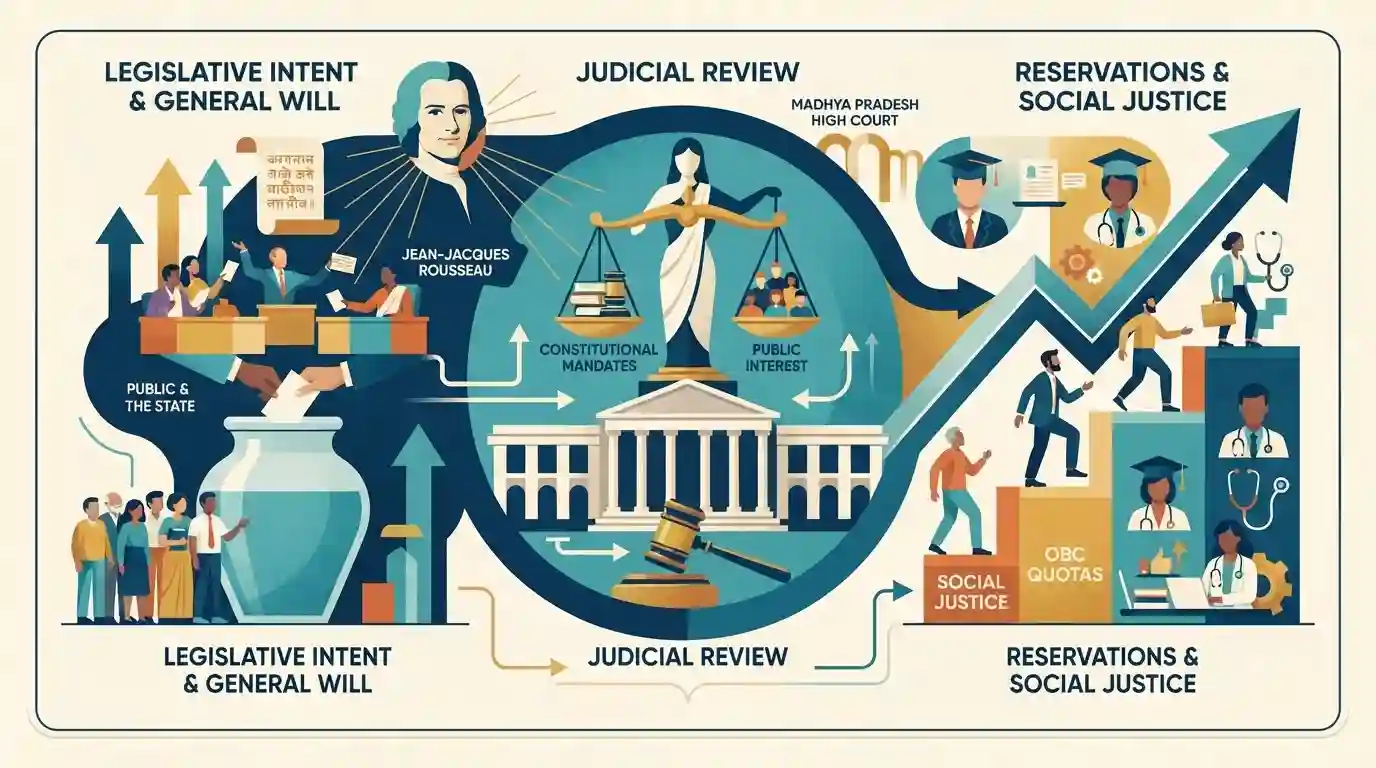
It demonstrates how the judiciary occasionally incorporates political philosophy and social contract theories into constitutional jurisprudence while adjudicating sensitive issues like reservations.
সারসংক্ষেপ
The Madhya Pradesh High Court recently referenced political philosopher Jean-Jacques Rousseau's concept of the 'general will' in the context of ongoing litigations concerning OBC reservation quotas in the state. The case brings to light the delicate balance courts must maintain between democratic legislative intent, public interest, and constitutional mandates regarding affirmative action.
মূল বিষয়
- The Madhya Pradesh High Court invoked political philosopher Jean-Jacques Rousseau's concept of the 'general will' while dealing with complex legal issues surrounding Other Backward Classes (OBC) reservation quotas.
- The case highlights the ongoing judicial scrutiny of reservation policies, state legislations, and the balance between constitutional equality, adequate representation, and legislative intent.
- The invocation of philosophical concepts like the 'social contract' and 'general will' in judicial discourse underlines the intersection of political theory and constitutional law in India.
গুরুত্বপূর্ণ শব্দ
Indira Sawhney case

A landmark 1992 Supreme Court verdict that upheld the 27% OBC reservation in central government jobs, introduced the 'creamy layer' concept, and capped total reservations at 50%.
UPSC context
GS Paper II: Polity & Governance, Social Justice. Tests understanding of affirmative action limits and constitutional equality provisions.
Madhya Pradesh High Court
The constitutional court having territorial jurisdiction over the state of Madhya Pradesh, which recently adjudicated matters concerning state-level OBC reservation quotas.
UPSC context
GS Paper II: Polity & Governance. Relevant for studying the role and writ jurisdiction of High Courts in federal and state administrative disputes.
Supreme Court of India
The apex judicial tribunal of India established under Article 124 of the Constitution, possessing final authority on constitutional interpretation, judicial review, and the limits of affirmative action.
UPSC context
GS Paper II: Polity & Governance. Essential for questions on the judiciary's structure, powers, judicial review, and enforcement of fundamental rights.
প্রিলিমস ফাঁদ
State legislatures have unfettered authority under constitutional provisions to increase reservation quotas for backward classes based solely on demographic proportions.
Aspirants often assume state legislatures have absolute autonomy to alter reservation percentages beyond the 50% limit based on population data, overlooking the constitutional requirement for extraordinary circumstances and judicial review.
সংযুক্ত স্থির ধারণা
What are the constitutional provisions and judicial benchmarks governing reservations in India?
- Article 16(4):: Enshrines equality of opportunity in public employment and empowers the state to make reservations for any backward class of citizens not adequately represented.
- Indira Sawhney (1992):: Established the 50% cap on total reservations except in extraordinary circumstances, while validating the creamy layer exclusion for OBCs.
- Article 15(6) & 16(6):: Added by the 103rd Amendment, enabling up to 10% reservation for Economically Weaker Sections (EWS) over and above the existing caps.
আন্তঃবিষয় প্যাটার্ন
Reservation Quotas + Judicial Review Jurisprudence
Judicial review of state-level affirmative action amendments regularly intersects with the 50% overall ceiling established in landmark constitutional jurisprudence.
Political Theory + Constitutional Interpretation
Courts increasingly draw upon classical political philosophy and social contract theory when adjudicating the boundaries of legislative intent versus fundamental rights.

Expect statement-based questions combining constitutional limits on reservations (50% ceiling) with landmark doctrines like Indira Sawhney.
সংযুক্ত PYQ · 2
সংযুক্ত PYQ · 2
- 2021MainsGS2
Discuss the desirability of greater representation to women in the higher judiciary to ensure diversity, equity and inclusiveness.
- 2023PrelimsGS1
Consider the following statements: Statement-I: The Supreme Court of India has held in some judgements that the reservation policies made under Article 16(4) of the Constitution of India would be limited by Article 335 for maintenance of efficiency of administration. Statement-II: Article 335 of the Constitution of India defines the term 'efficiency of administration'. Which one of the following is correct in respect of the above statements?
