Madhya Pradesh High Court Directs Gram Panchayat to Improve School
Source:livelaw.in ↗
Why It Matters
The ruling highlights the intersection of local self-government duties (under the 73rd Amendment and MP Panchayat Raj Act) and the fundamental Right to Education. It establishes a judicial precedent prioritizing functional educational access over punitive technical closures in rural areas, directly linking rural administration with human capital development.
Summary
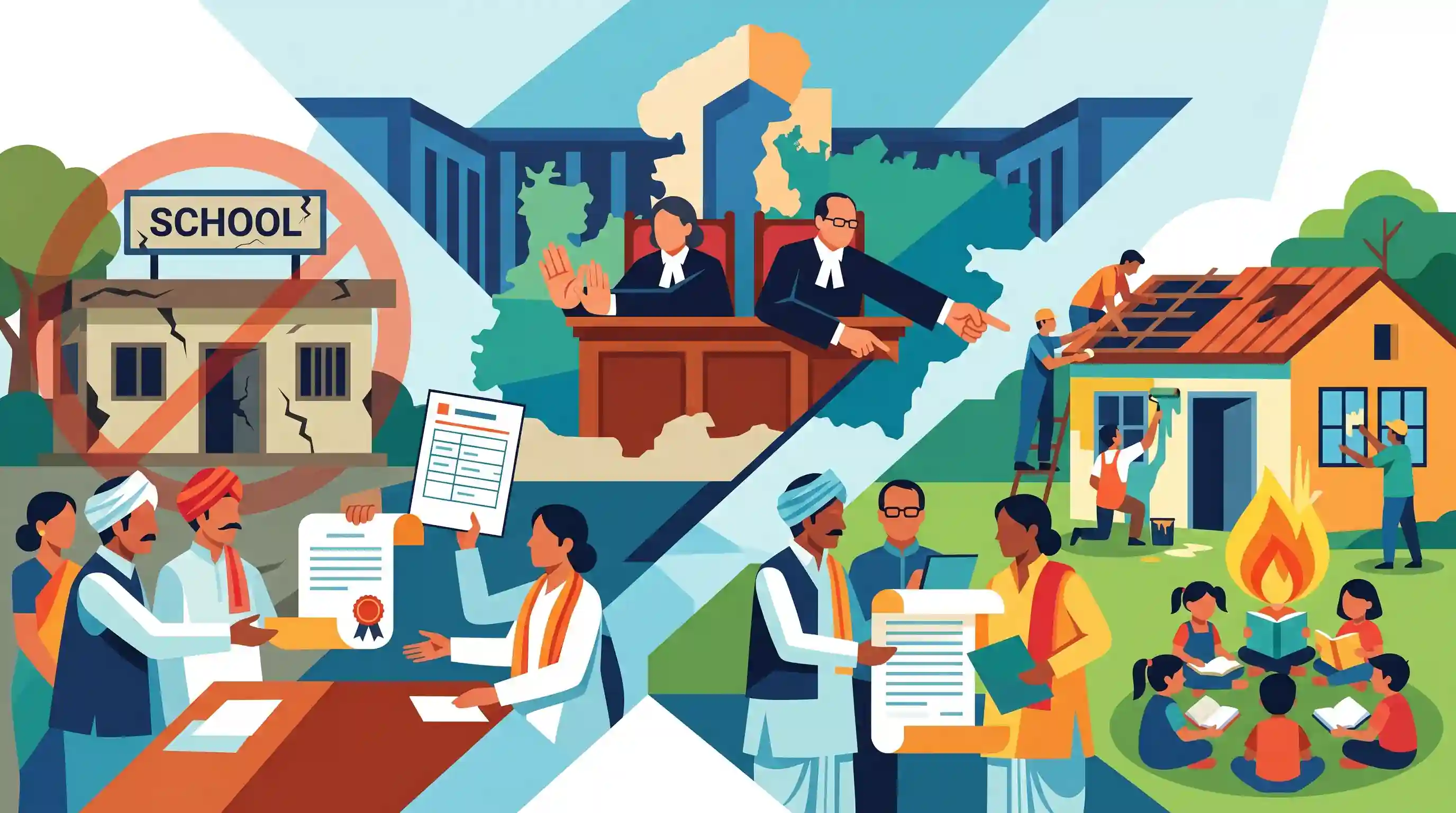
The Madhya Pradesh High Court refused to close the only operating school in Kotari village, Umaria district, despite certain infrastructure deficiencies. Rejecting a petition filed by the village's Sarpanch and Up-Sarpanch seeking cancellation of the school's recognition, the Division Bench of Acting Chief Justice Vivek Rusia and Justice Pradeep Mittal reminded the local representatives of their civic duties. The court directed the Gram Panchayat to pass a resolution to actively resolve and mitigate the school's structural deficiencies, ensuring that the local children's fundamental Right to Education is not compromised.
Key Points
- The Madhya Pradesh High Court (Jabalpur Bench) refused to cancel the recognition of Devarsi High School, the only operational school in Kotari village (Umaria district), noting that shutting it down would severely impact children's education in the absence of an alternative government school.
- The court directed the Gram Panchayat, led by the petitioners (Sarpanch and Up-Sarpanch), to pass a resolution in its general body meeting to constructively assist in removing the infrastructural deficiencies of the school instead of seeking its closure.
- The division bench consisting of Acting Chief Justice Vivek Rusia and Justice Pradeep Mittal emphasized that local public representatives under the Panchayati Raj system owe a public duty to facilitate education and secure basic civic amenities.
- This case underscores the judicial balancing between statutory infrastructure norms and the fundamental Right to Education (Article 21A) in rural, underserved areas.
Important Terms
Right of Children to Free and Compulsory Education (RTE) Act, 2009

A landmark Central legislation operationalizing Article 21A, guaranteeing free and compulsory elementary education to children aged 6–14 and specifying minimum infrastructure and teacher-pupil norms for all schools.
UPSC context
GS Paper II: Social Justice & Education. Tests legislation, policies, and welfare mechanisms designed to safeguard vulnerable sections.
86th Constitutional Amendment Act, 2002
A constitutional amendment that inserted Article 21A, declaring education a Fundamental Right for children aged 6–14, revised Article 45 (DPSP), and added the 11th Fundamental Duty under Article 51A(k).
UPSC context
GS Paper II: Polity & Constitution. Tests significant amendments, the interplay of DPSPs and Fundamental Rights, and basic structures.
Madhya Pradesh Panchayat Raj Avam Gram Swaraj Adhiniyam, 1993
State legislation enacted to implement the 73rd Constitutional Amendment Act, establishing a three-tier Panchayati Raj system, outlining administrative structures, and defining the civic duties of Gram Panchayats in MP.
UPSC context
GS Paper II: Local Self-Government & PRIs. Tests decentralization, powers, and implementation of local governance structures at the state level.
Madhya Pradesh High Court
The highest court of judicature in Madhya Pradesh, established in 1956, headquartered in Jabalpur with Benches in Indore and Gwalior, exercising constitutional jurisdiction under Article 226.
UPSC context
GS Paper II: Judiciary. Tests writ jurisdiction, power of judicial review, and state-level judicial activism in enforcing civic/fundamental rights.
Prelims Trap
Gram Panchayats have no binding statutory duties under the RTE Act, 2009, acting only as voluntary advisory bodies for rural schools.
Sections 8 and 9 of the RTE Act, 2009 explicitly define local authorities (including Panchayats) as duty-bearers with statutory obligations to provide infrastructure, not merely advisory bodies.
Static Concepts Connected
What is the constitutional and statutory framework of the Right to Education (RTE) in India?
- Constitutional basis: Article 21A (added by the 86th Amendment, 2002) mandates free and compulsory education for children aged 6 to 14 years as a Fundamental Right.
- Judicial origin: The Supreme Court in Unni Krishnan v. State of AP (1993) held that the Right to Life (Article 21) encompasses the right to primary education.
- Statutory backing: The Right of Children to Free and Compulsory Education (RTE) Act, 2009 provides the statutory framework to enforce this right, outlining standards and local body roles.
How does the 11th Schedule link Panchayati Raj Institutions (PRIs) with education?
- Constitutional devolution: Article 243G of the Constitution, via the 11th Schedule, lists 29 subjects that can be devolved to Panchayats.
- Entry 17 linkage: Entry 17 specifically covers 'Education, including primary and secondary schools', making rural education a direct functional domain of PRIs.
- RTE Act integration: Sections 8 and 9 of the RTE Act explicitly mandate 'local authorities' to establish schools, monitor attendance, and secure necessary infrastructure.
Cross-Topic Patterns
Judicial realism vs statutory standards
This case shows how courts use Article 21A to override rigid bureaucratic norms (like standard physical infrastructure requirements) to prevent the complete deprivation of education in remote regions.
PRI devolution and fiscal capacity
Highlights the deep structural gap between the statutory mandates given to Gram Panchayats under the RTE Act and their actual fiscal and functional devolution to repair rural public assets.

The intersection of Article 21A, the 11th Schedule (Entry 17), and the statutory duties of local bodies under RTE is prime for a 2026 MCQ.
Linked PYQs · 4
Linked PYQs · 4
- 2021MPPSC_PRELIMSGS1
Who will preside the meeting of the Gram Sabha in absence of the sarpanch and up-sarpanch in Madhya Pradesh ?
- 2023MPPSC_PRELIMSGS1
Through Which Amendment of the Constitution has the Right to Education became a Fundamental Right?
- 2019MPPSC_PRELIMSGS1
The scope of the Article 21 of the Constitution was expanded to include Right to Education, because of the decision of Supreme Court in the case
- 2015MPPSC_PRELIMSGS1
State who has first implemented 73 constitutional amendment?
