Madhya Pradesh Targets 10,000 Medical Seats to Boost Health Education
Source:indian-masterminds ↗
Why It Matters
Enhancing medical education capacity and building new hospitals under the PPP model are critical steps toward addressing the shortage of healthcare professionals and improving medical accessibility in underserved districts of Madhya Pradesh.
Summary
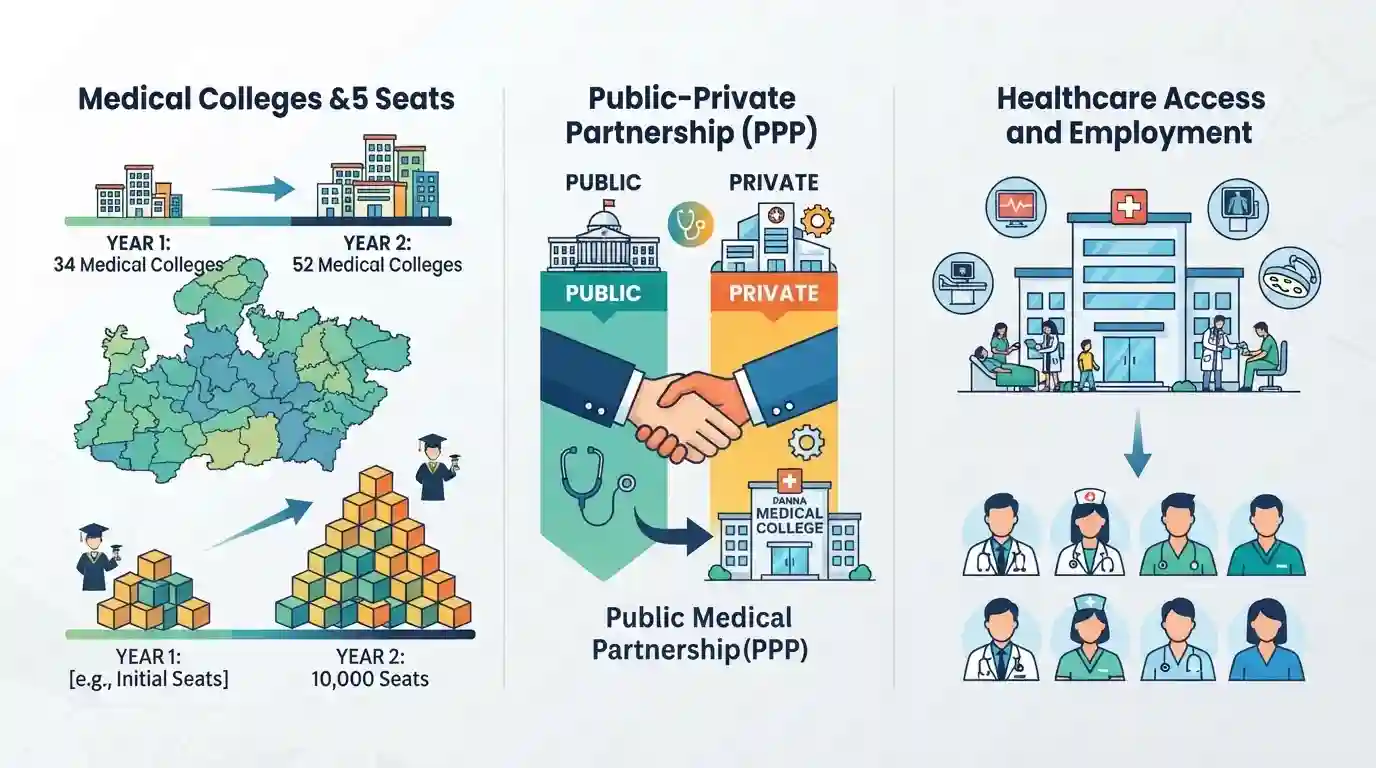
The Madhya Pradesh government aims to significantly expand its medical education and healthcare infrastructure by increasing medical college seats to 10,000 and raising the number of medical colleges from 34 to 52 within two years. Chief Minister Mohan Yadav highlighted that the upcoming Panna Medical College will be launched next year under the Public-Private Partnership (PPP) model, improving local access to specialized medical care and generating employment.
Key Points
- Madhya Pradesh Chief Minister Dr. Mohan Yadav announced a target to increase medical college seats to 10,000 in the next two years.
- The state plans to expand the number of medical colleges from 34 to 52.
- Panna Medical College will be inaugurated next year and will operate under the Public-Private Partnership (PPP) model.
- The expansion aims to provide specialized localized treatment, reducing the need for residents in districts like Panna to travel to Satna or Chhatarpur, while also boosting local employment.
Important Terms
Public-Private Partnership (PPP)

A long-term collaborative arrangement where the government partners with private sector entities to finance, build, and operate public projects or services, sharing risks and resources.
UPSC context
GS Paper 3 (Investment Models). Tests understanding of infrastructure financing, resource allocation, and governance challenges.
Panna District
A district in the Bundelkhand region of Madhya Pradesh, geographically renowned for housing India's only active, mechanized diamond-producing mines.
UPSC context
GS Paper 1 (Economic Geography) and Prelims. Tests knowledge of India's mineral resources and regional development.
Public Health Infrastructure
The foundational physical and organizational structures, including hospitals, clinics, and medical colleges, required to deliver healthcare services and train professionals for a population.
UPSC context
GS Paper 2 (Social Justice - Health). Highlights state capacity, public service delivery, and human capital development.
Medical Education Infrastructure
The specialized network of institutions, such as medical colleges and teaching hospitals, tasked with training future healthcare professionals to address national doctor-population ratios.
UPSC context
GS Paper 2 (Education and Human Resources). Focuses on human capital, equitable healthcare access, and demographic dividends.
Prelims Trap
State governments hold the final statutory authority to approve the expansion of seats in state-run medical colleges.
False. The National Medical Commission (NMC), established in 2019 to replace the MCI, is the sole statutory body responsible for approving medical seat expansions nationwide.
Static Concepts Connected
How does the NITI Aayog PPP model for medical colleges function?
- Hospital Integration: Links new private medical colleges with existing government district or referral hospitals to utilize existing infrastructure.
- Viability Gap Funding: Backed by Viability Gap Funding (VGF) to make economically unviable but socially vital tier-2/3 hospital projects feasible for private players.
What is the statutory framework governing medical education in India?
- Apex Body: The National Medical Commission (NMC), created via the NMC Act 2019, functions as the apex regulatory body, replacing the dissolved Medical Council of India (MCI).
- Four Autonomous Boards: Operates through four autonomous boards governing Undergraduate education, Postgraduate education, Medical Assessment and Rating, and Ethics and Medical Registration.
Cross-Topic Patterns
Health Infrastructure & Demographic Dividend
Bridging the WHO 1:1000 doctor-population ratio transforms youth bulges in states like MP from a healthcare liability into a resilient human capital dividend.
Fiscal Federalism in Health CSS
Establishing district hospital medical colleges reflects fiscal federalism through Centrally Sponsored Schemes (CSS), typically utilizing a 60:40 Centre-State fund sharing ratio for general category states.

NITI Aayog's PPP guidelines for district hospitals and NMC regulatory powers will likely merge into a 2026 Prelims health infrastructure Q.
Linked PYQs · 1
Linked PYQs · 1
- 2025MPPSC_PRELIMSGS1
In which city of Madhya Pradesh is ICMR - National Institute of Research in Tribal Health (NIRTH) located?
