Cough Syrup Sales Banned Following Child Renal Failure Deaths
Source:The Hindu ↗
Why It Matters
The recurring issue of toxic adulterants like diethylene glycol (DEG) in cough syrups exposes systemic flaws in India's drug regulatory framework (CDSCO and State FDAs). For UPSC aspirants, this highlights the necessity of robust regulatory institutions, Centre-State coordination in health governance, and the broader implications for public health and India's reputation as the 'pharmacy of the world'.
Summary
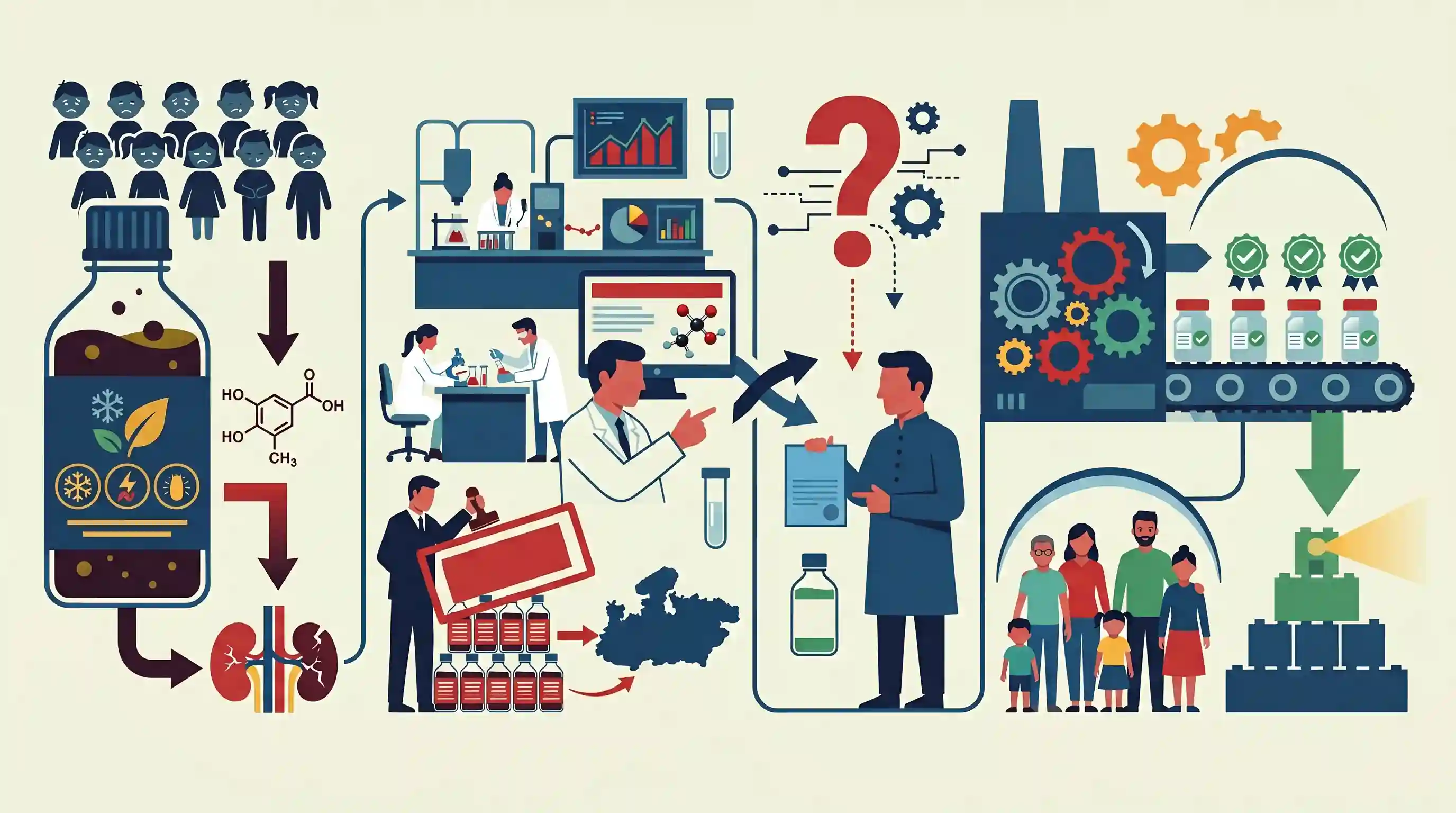
The Madhya Pradesh government has banned the sale of 'Coldrif Syrup' following the deaths of 11 children from suspected renal failure across Madhya Pradesh and Rajasthan. The syrup, produced by Sresan Pharmaceuticals in Tamil Nadu, was found by a Tamil Nadu state lab to contain 48.6% diethylene glycol (DEG), a lethal adulterant. However, the Union Health Ministry has disputed these findings, claiming no contamination was present. The conflicting reports expose serious gaps in Centre-State coordination regarding drug regulation and underscore the critical need for stringent quality control measures to prevent toxic adulterants in the pharmaceutical supply chain.
Key Points
- The Madhya Pradesh government banned 'Coldrif Syrup' after it was linked to the deaths of nine children in Chhindwara and two in Rajasthan due to suspected renal failure.
- A Tamil Nadu government laboratory found a batch of the syrup, manufactured by Tamil Nadu-based Sresan Pharmaceuticals, to be heavily adulterated with toxic diethylene glycol (DEG).
- The Union Health Ministry has contradicted the state lab's findings, ruling out DEG or EG contamination, highlighting a lack of coordination in India's drug regulatory framework.
- The incident underscores persistent vulnerabilities in pharmaceutical quality control and the dangers of adulterants in pediatric medicines.
Important Terms
Diethylene Glycol (DEG)

A toxic, colorless, and odorless industrial solvent used in antifreeze and brake fluids. In pharmaceuticals, it is a lethal adulterant often illegally substituted for glycerin to reduce costs, causing acute renal failure.
UPSC context
GS Paper 2 (Health) and GS Paper 3 (Science). Tests knowledge of drug safety, adulteration, and public health crises.
Central Drugs Standard Control Organisation (CDSCO)
India's national regulatory body for pharmaceuticals and medical devices, operating under the Ministry of Health. It handles drug approvals, clinical trial regulation, and coordinates with state authorities for quality control.
UPSC context
GS Paper 2 (Governance). Tests understanding of statutory regulatory bodies and their role in social sector management.
Drugs and Cosmetics Act, 1940
The primary legislation regulating the import, manufacture, distribution, and sale of drugs in India. It aims to ensure that all medications meet national standards of safety, efficacy, and quality.
UPSC context
GS Paper 2 (Statutory Provisions). Critical for questions on India's health legislative framework and drug regulatory reforms.
Schedule M
A part of the Drugs and Cosmetics Rules that prescribes Good Manufacturing Practices (GMP) for pharmaceutical units. Recent revisions aim to align Indian standards with global WHO-GMP norms.
UPSC context
GS Paper 3 (Economy/Industry). Relevant for pharmaceutical quality control, global trade reputation, and Ease of Doing Business.
Tamil Nadu Drugs Control Department
The state-level executive body responsible for licensing manufacturing facilities and conducting market sampling. It plays a primary role in post-market surveillance and taking action against adulterated drugs.
UPSC context
GS Paper 2 (Federalism/Governance). Highlights the dual regulatory mechanism and the challenges of Centre-State coordination in public health.
Sresan Pharmaceuticals
A Tamil Nadu-based pharmaceutical company whose 'Coldrif' syrup was linked to mass pediatric deaths. It faced license cancellation following reports of severe violations of manufacturing safety standards.
UPSC context
GS Paper 4 (Ethics). Serves as a case study on corporate negligence, regulatory failure, and the ethical responsibility of pharmaceutical firms.
Prelims Trap
The Central Drugs Standard Control Organisation (CDSCO) is the sole authority issuing manufacturing licenses for drugs.
Drug regulation is under the Concurrent List. CDSCO regulates new drugs and imports, but State Licensing Authorities (SLAs) independently grant manufacturing licenses.
Static Concepts Connected
How is pharmaceutical regulation divided between the Centre and States in India?
- Concurrent List: Drugs and poisons fall under Entry 19 of the Concurrent List, resulting in dual regulatory control under the Drugs and Cosmetics Act, 1940.
- Central Role (CDSCO): The Central Drugs Standard Control Organisation (CDSCO) handles the approval of new drugs, clinical trials, and control over imported pharmaceuticals.
- State Role (SLAs): State Licensing Authorities (SLAs) independently grant manufacturing and sales licenses, and enforce quality control through local factory inspections and drug testing.
Why are Diethylene Glycol (DEG) and Ethylene Glycol (EG) found in cough syrups?
- Economic Adulteration: Unscrupulous manufacturers illegally substitute pharmaceutical-grade solvents like Propylene Glycol or Glycerin with DEG/EG because they are significantly cheaper.
- Industrial Solvents: DEG and EG are highly toxic industrial solvents typically used in products like antifreeze, brake fluids, and cosmetics.
- Health Impact: Ingestion metabolizes into toxic compounds causing severe central nervous system depression, leading to acute and often fatal renal (kidney) failure, especially in children.
Cross-Topic Patterns
CDSCO fragmentation vs Mashelkar Committee
Recurrent DEG poisoning cases revive the Mashelkar Committee's (2003) core recommendation: India needs a centralized National Drug Authority to replace fragmented state-level licensing.
Schedule M & Global Pharma Exports
Domestic drug quality failures directly threaten India's 'Pharmacy of the World' image, prompting recent mandatory enforcement of revised Schedule M (GMP) standards for MSMEs.

Expect a multi-statement question on CDSCO vs SLA jurisdiction combined with the toxicity mechanism of DEG/EG in cough syrups.
Linked PYQs · 4
Linked PYQs · 4
- 2015MainsGS2
For achieving the desired objectives, it is necessary to ensure that the regulatory institutions remain independent and autonomous. Discuss in the light of the experiences in recent past.
- 2024MainsGS2
In a crucial domain like the public healthcare system the Indian State should play a vital role to contain the adverse impact of marketisation of the system. Suggest some measures through which the State can enhance the reach of public healthcare at the grassroots level.
- 2021PrelimsGS1
'Triclosan', considered harmful when exposed to high levels for a long time, is most likely present in which of the following?
- 2024PrelimsGS1
In which of the following are hydrogels used? 1. Controlled drug delivery in patients 2. Mobile air-conditioning systems 3. Preparation of industrial lubricants Select the correct answer using the code given below:
