Fiscal Discipline Measures Implemented by Madhya Pradesh Government
Source:etv-bharat ↗
Why It Matters
Provides direct context to the state's financial management, expenditure controls, and governance initiatives. State budget allocations, economic indicators, and public finance mechanisms in Madhya Pradesh are highly tested topics in MPPSC Prelims (e.g., questions on state budget expenditure and economic progress).
Summary
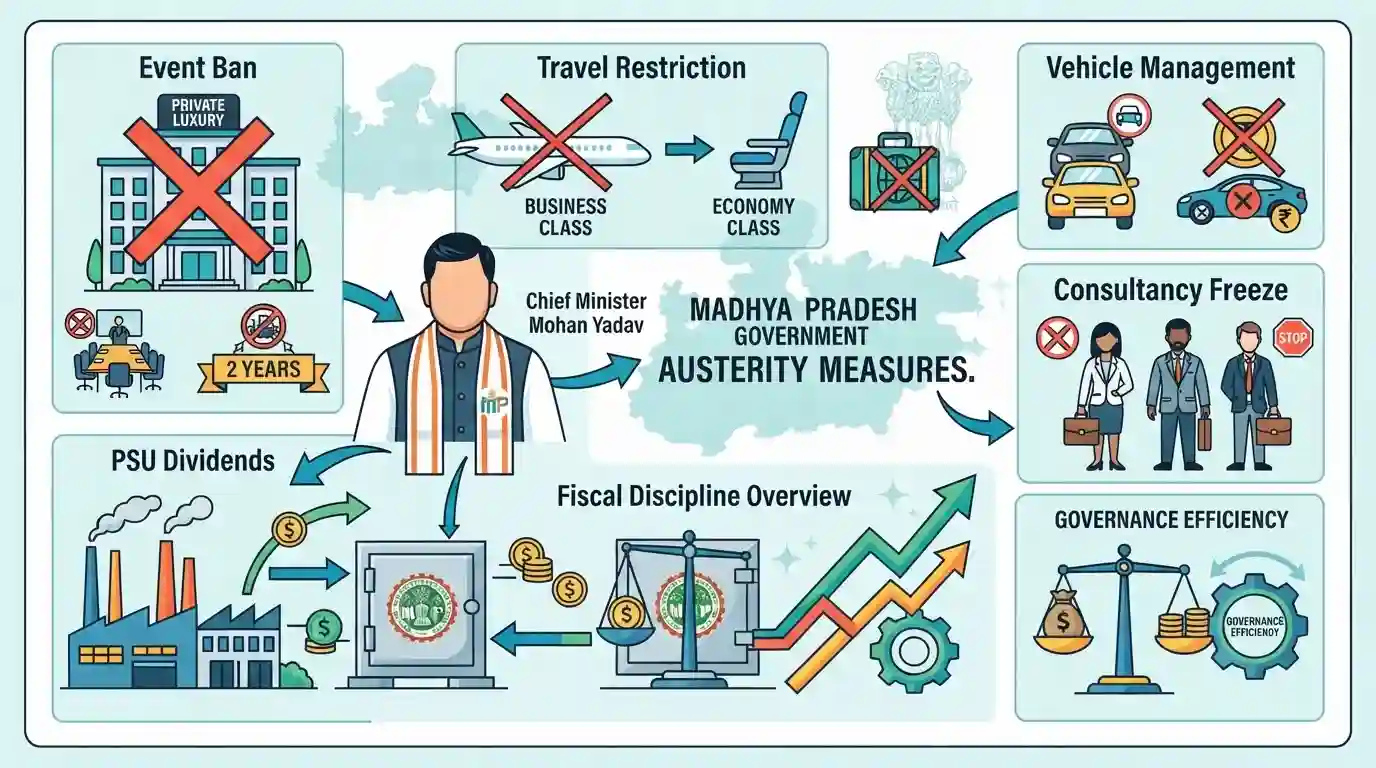
The Madhya Pradesh government, led by Chief Minister Mohan Yadav, has introduced rigorous austerity measures aimed at curbing non-essential expenditures and enforcing fiscal discipline. Key steps include a total ban on hosting official events in private hotels for two years, restricting officers to economy-class travel, and prohibiting foreign trips. The state is also pushing for car-pooling, stopping the purchase of new vehicles, and restricting new consultancy hires. Furthermore, state-owned public sector enterprises have been instructed to transfer maximum dividends to the state's main account to strengthen state finances.
Key Points
- The Madhya Pradesh government under CM Mohan Yadav announced strict austerity measures to instill fiscal discipline and cut unnecessary administrative costs.
- Key restrictions include a two-year ban on holding government workshops, meetings, and training programs in private hotels or business centers.
- Government officers and ministers are restricted to economy class for air travel, and official foreign tours are banned.
- Following PM Modi's recommendation, a car-pooling system will be implemented for officials, and procurement of new vehicles is prohibited.
- Bans have been imposed on office renovations, hiring new external consultancies, and the creation of unnecessary project-specific posts.
- State-run corporations and boards have been directed to deposit their maximum dividend amounts into the state government's main account to consolidate revenue.
Important Terms
Government of Madhya Pradesh

The subnational administrative authority governing Madhya Pradesh, headed by the Chief Minister. It oversees state-level policy, governance, and public administration.
UPSC context
Relevant to GS-2 (State Executive) regarding the functioning, financial management, and constitutional responsibilities of state governments.
Fiscal Discipline
The practice of maintaining balanced government finances by limiting non-essential revenue expenditure, keeping deficits in check, and ensuring sustainable long-term fiscal health.
UPSC context
A core GS-3 (Indian Economy) concept, heavily tested regarding FRBM Act guidelines and state-level fiscal consolidation.
Austerity Measures
Strict economic policies implemented by a government to reduce public expenditure and shrink budget deficits, often achieved through cuts to administrative and non-developmental spending.
UPSC context
Pertinent to GS-2 (Governance) and GS-3 (Economy), reflecting on public resource optimization, financial accountability, and checking profligate spending.
Revenue Expenditure
Government spending on day-to-day operational functioning, such as salaries, travel, hospitality, and office maintenance, which does not directly create any productive capital assets.
UPSC context
Important for GS-3 (Government Budgeting); checking its growth is vital for reducing the revenue deficit and improving capital outlays.
State Public Sector Enterprises (SPSEs)
Commercial undertakings wholly or majority-owned by a state government, established to promote regional economic development and generate non-tax revenues through dividends.
UPSC context
Relevant to GS-3 (Resource Mobilization). Their financial health and dividend contributions directly impact state exchequer revenues and fiscal space.
Prelims Trap
State governments possess an absolute constitutional autonomy to borrow from open markets without Central Government consent under Article 293.
Under Article 293(3), a state cannot raise any open-market loans without the Centre's consent if it has any outstanding liabilities or unpaid loans due to the Central Government.
Static Concepts Connected
What are the constitutional limits on State borrowing under Article 293?
- Article 293(1) limits: Empowers State Legislatures to set limits on how much the state executive can borrow within India upon the security of the Consolidated Fund of the State.
- Article 293(3) consent: Mandates that a State cannot raise any loan without the Central Government's consent if there is still outstanding any part of a loan given/guaranteed to the State by the Centre.
- Article 293(4) conditions: The Union can impose conditions it deems fit when giving consent to a state's request for fresh borrowing.
How are State Public Sector Enterprise (SPSE) dividends treated under public finance?
- Revenue Classification: Dividends are classified as Non-Tax Revenue, not capital receipts, meaning they directly reduce the state's revenue deficit.
- Article 266(1) flow: All such dividends must be credited directly to the Consolidated Fund of the State under Article 266(1).
Cross-Topic Patterns
Fiscal Federalism + Article 293 constraints
Strict Central oversight on state borrowing limits under Article 293 forces states to resort to severe administrative austerity or aggressively extract dividends from SPSEs to manage their deficits.
Consultocracy vs State Capacity
Over-reliance on external management consultancies hollows out the permanent civil services. Restricting external hires represents a conscious push to rebuild internal public administrative capacity.

Article 293(3) limitations combined with off-budget borrowing crackdowns will likely feature as a core Fiscal Federalism question in 2026.
Linked PYQs · 3
Linked PYQs · 3
- 2025MPPSC_PRELIMSGS1
What percentage of the Madhya Pradesh government's total expenditure budget was allocated to education in 2023-24?
- 2025MPPSC_PRELIMSGS1
How much has the per capita income of Madhya Pradesh, at current Prices, increased from financial year 2011-12 to financial year 2023-24?
- 2024MPPSC_PRELIMSGS1
In the year 2022-23, on comparing the per capita income of Madhya Pradesh and that of India on the basis of advanced estimates at constant (2011-12) prices, we find that
