Madhya Pradesh Eyes KfW Support for Green Energy Infrastructure
Source:indianmasterminds ↗
Why It Matters
Understanding international funding in state-level infrastructure (like Germany's KfW bank assistance in Madhya Pradesh) is highly relevant for MPPSC Prelims, where questions on major solar projects (e.g. Omkareshwar floating solar project) and state-specific economic growth factors are frequently asked.
Summary
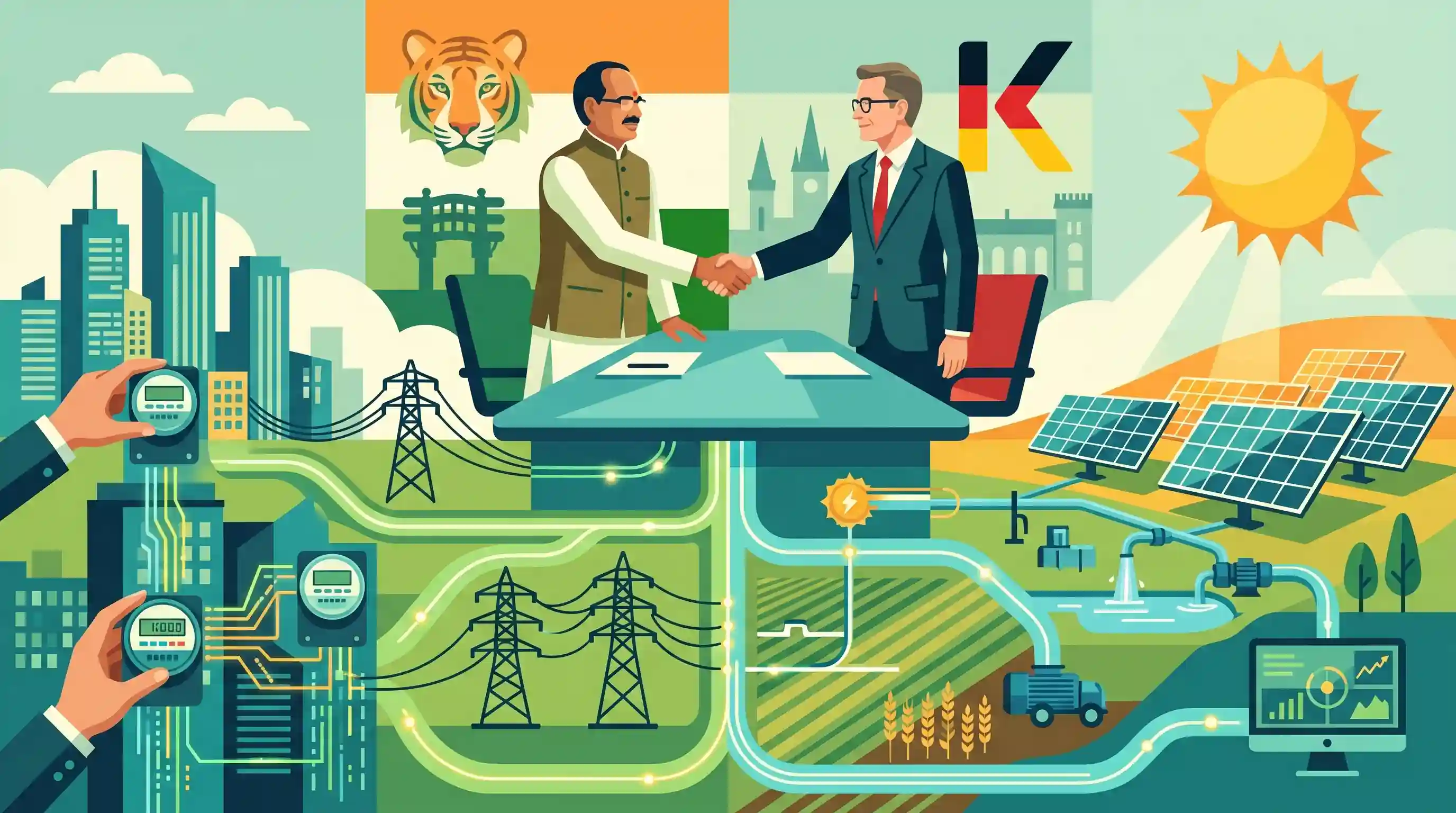
Madhya Pradesh Chief Minister Dr. Mohan Yadav met a high-level German delegation led by KfW Development Bank's CEO Dr. Christiane Laibach in Bhopal [1.1]. The discussions focused on bolstering Madhya Pradesh's energy infrastructure and green transition, highlighting KfW's current ₹1,120 crore assistance for smart metering and feeder separation, alongside a proposed €200 million investment under the Energy Reform Phase-2 initiative to promote clean, solar-based agricultural power and grid modernization [1.1].
Key Points
- Madhya Pradesh Chief Minister Dr. Mohan Yadav held a high-level meeting with a four-member German delegation in Bhopal to deepen bilateral ties in the energy and infrastructure sectors [1.1].
- The German delegation was led by Dr. Christiane Laibach, Executive Board Member and CEO of Germany's KfW Development Bank [1.1].
- Currently, KfW Bank is supporting MP's Energy Reform Programme with a funding of around ₹1,120 crore, which is utilized for installing smart meters in power distribution companies (discoms) and implementing feeder separation projects [1.1].
- KfW Bank expressed key interest in investing approximately €200 million under the proposed Energy Reform Phase-2 initiative [1.1].
- The proposed Phase-2 funding aims to strengthen the state's electricity distribution infrastructure, support solar-hour based agricultural feeder supply systems, and modernize the power sector [1.1].
Important Terms
KfW Development Bank

A German state-owned development bank that finances global development projects, with a strong focus on sustainable energy transitions, infrastructure modernization, and environmental protection under bilateral partnerships.
UPSC context
GS Paper II (International Relations) & GS Paper III (Infrastructure/Energy funding); tests bilateral developmental cooperation and foreign aid.
Feeder Separation Programme
A distribution reform that physically separates rural agricultural power lines from domestic ones, enabling round-the-clock household electricity and regulated, quality power for irrigation to reduce technical and commercial losses.
UPSC context
GS Paper III (Infrastructure: Energy and Agriculture); tests grid modernization, Discom viability, and rural development policies.
Energy Reform Programme
A collaborative initiative between India and Germany (KfW) to modernize Madhya Pradesh's power sector through smart metering, Advanced Metering Infrastructure, and agricultural feeder separation.
UPSC context
GS Paper III (Infrastructure: Energy and Mobilization of Resources); tests central-state implementation of foreign-funded development projects.
Energy Reform Phase-2
The subsequent phase of Madhya Pradesh's energy collaboration with Germany, focusing on solar-hour-based agricultural power feeders, grid modernization, and clean energy transition.
UPSC context
GS Paper III (Renewable Energy and Government Policies); tests state-level initiatives towards achieving India's net-zero transition goals.
Advanced Metering Infrastructure
An integrated system of smart meters, communication networks, and data management systems enabling two-way communication between distribution companies and consumers to optimize billing and reduce losses.
UPSC context
GS Paper III (Infrastructure and Technology); tests technological solutions in power sector reforms and public utility efficiency.
Prelims Trap
State governments in India can directly secure sovereign-backed external loans from bilateral agencies like KfW without Union Government mediation.
Under Article 293 of the Constitution, state governments cannot borrow directly from external sources; all external development loans must be routed through the Union Government.
Static Concepts Connected
What is Agricultural Feeder Separation?
- Physical segregation: Separating transmission lines for agricultural pumps from domestic and commercial loads in rural areas.
- Supply regulation: Enables scheduled power supply to farms during daytime solar hours while maintaining 24x7 supply to rural households.
- Financial benefits: Helps discoms precisely measure agricultural consumption, reduce AT&C losses, and streamline subsidy accounting.
How do floating solar PV systems work?
- Water conservation: Covering water bodies with PV panels significantly reduces evaporation losses from reservoirs.
- Efficiency gains: Water's natural cooling effect keeps panel temperatures low, boosting power generation efficiency by 10-15%.
- Land preservation: Bypasses complex land acquisition issues by utilizing existing reservoirs of dams or artificial lakes.
Cross-Topic Patterns
Article 293 and State External Debt
State-level green projects funded by external agencies like KfW require Central government sovereign guarantees and routing through the Department of Economic Affairs under Article 293.
Floating Solar and Water-Energy Nexus
Large-scale floating solar installations like Omkareshwar address agricultural land constraints while simultaneously conserving reservoir water and improving solar power generation efficiency.

Mains questions may analyze how external bilateral funding acts as a catalyst for sub-national green energy transitions in India.
Linked PYQs · 1
Linked PYQs · 1
- 2021MPPSC_PRELIMSGS1
In which region of Madhya Pradesh Solar Floating Project of 600 MW capacity is proposed?
