Destination Cabinet Initiative and MP Cultural Heritage
Source:swadesh-news ↗
Why It Matters
This flagship administrative initiative intersects heavily with MPPSC Prelims' focus on local history and culture. By directly highlighting figures like Dost Mohammad Khan, Rani Durgavati, and Ahilyabai Holkar alongside tribal deities, the initiative signals highly probable topics for questions on MP's medieval history, tribal heritage, and geography.
Summary
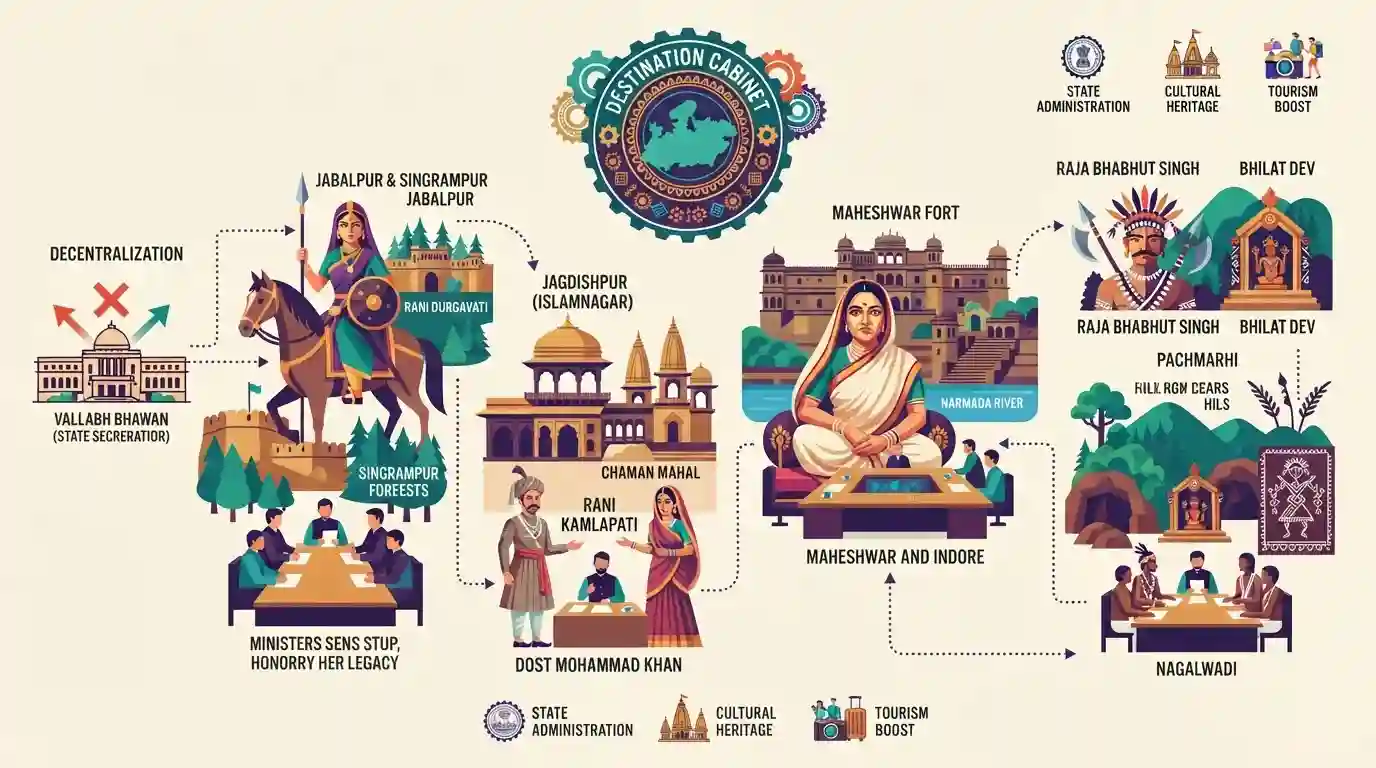
Madhya Pradesh Chief Minister Dr. Mohan Yadav has introduced the 'Destination Cabinet' initiative, shifting official government cabinet meetings from Bhopal's Vallabh Bhawan to significant historical and cultural sites across the state. The initiative began in Jabalpur and Singrampur to honour Rani Durgavati and continued to Jagdishpur (Islamnagar) to highlight its layered history involving Dost Mohammad Khan and Rani Kamlapati. Future meetings are planned for Maheshwar and Indore to celebrate Ahilyabai Holkar, as well as sites like Pachmarhi and Nagalwadi to recognize tribal leaders and deities such as Raja Bhabhut Singh and Bhilat Dev. This decentralization of governance aims to integrate regional heritage directly into state policymaking and boost local tourism.
Key Points
- The Madhya Pradesh government has launched the 'Destination Cabinet' initiative, holding cabinet meetings at historic and cultural locations outside the state capital's Vallabh Bhawan.
- Early meetings were held in Jabalpur and Singrampur to honour Gond queen Rani Durgavati, and in Jagdishpur (formerly Islamnagar) to commemorate its Rajput, Gond (Rani Kamlapati), and Afghan (Dost Mohammad Khan) heritage.
- Upcoming meetings are scheduled at Maheshwar and Indore's Rajwada to mark Ahilyabai Holkar’s 300th birth anniversary.
- The initiative places strong emphasis on tribal history, honoring figures like Raja Bhabhut Singh in Pachmarhi and planning a future meeting at the tribal cultural center of Nagalwadi for Bhilat Dev.
Important Terms
Destination Cabinet Initiative

An innovative governance model in Madhya Pradesh where official cabinet meetings are held at historical, cultural, or natural sites outside the state capital, aiming to decentralize administration and promote regional heritage.
UPSC context
GS Paper II (Governance); tests decentralized state administration, policy implementation, and innovative heritage-promotion methods.
Rani Durgavati
A heroic 16th-century ruling queen of Gondwana (Garha-Katanga) belonging to the Chandela Rajput dynasty who bravely sacrificed her life resisting the invading Mughal forces under Emperor Akbar's commander Asaf Khan in 1564.
UPSC context
GS Paper I (Medieval Indian History); tests regional resistance, medieval polities, and contributions of women rulers.
Ahilyabai Holkar
An iconic 18th-century Maratha queen of the Holkar dynasty who ruled Malwa from Maheshwar, celebrated for her benevolent administration, support for the handloom industry, and nationwide reconstruction of major Hindu temples.
UPSC context
GS Paper I (Modern History & Culture); tests post-Maratha polities, benevolent administration, and temple reconstruction.
Raja Bhabhut Singh
A revered 19th-century Gond tribal leader and freedom fighter of Pachmarhi who waged a fierce guerrilla campaign against British forces in the Satpura hills during the Indian Rebellion of 1857.
UPSC context
GS Paper I (Freedom Struggle); tests tribal resistance movements and regional anti-colonial uprisings.
Archaeological Survey of India (ASI)
Established in 1861, a premier statutory organization under the Ministry of Culture responsible for archaeological research, excavation, and the conservation, protection, and preservation of centrally protected monuments and sites.
UPSC context
GS Paper I (Art & Culture); tests statutory bodies safeguarding India's tangible cultural heritage.
UNESCO
A specialized UN agency that designates World Heritage Sites of outstanding universal cultural or natural value, playing a key role in supporting the global conservation and preservation of historic monuments and ecosystems.
UPSC context
GS Paper I & II (Art-Culture & International Bodies); tests global preservation mechanisms and international bodies safeguarding heritage.
Prelims Trap
Dost Mohammad Khan established the Bhopal State by launching a direct military conquest to defeat Gond Queen Rani Kamlapati.
Dost Mohammad Khan did not militarily defeat Rani Kamlapati; rather, he was hired by her as a mercenary ally. He seized control of Bhopal only after her death, capitalizing on the resulting power vacuum.
Static Concepts Connected
What were the key cultural and administrative achievements of Ahilyabai Holkar?
- Capital Shift: Shifted the capital of the Holkar state from Indore to Maheshwar on the banks of the Narmada River.
- Temple Restorations: Rebuilt and restored desecrated Hindu pilgrimage sites across India, most notably the Kashi Vishwanath Temple in Varanasi in 1780.
- Economic Patronage: Patronized local artisans and established the famous Maheshwari handloom weaving industry, securing sustainable livelihoods.
What was the role of Raja Bhabhut Singh in the 1857 Revolt?
- Tribal Leadership: He was a prominent Gond tribal chief from the Satpura (Pachmarhi) region who organized tribal resistance.
- Tactical Resistance: Waged highly effective guerrilla warfare against the British East India Company forces in the Narmadachal region.
- Historical Title: Revered locally as the 'Shivaji of Narmadachal' for his strategic military maneuvers in difficult terrains before his capture.
Cross-Topic Patterns
Heritage-driven governance & decentralization
Using historical landmarks for active cabinet meets merges administrative decentralization with cultural diplomacy, accelerating local heritage tourism and tribal integration.
Maratha administration & textile GIs
The economic and trade statecraft of 18th-century Maratha rulers directly shaped modern geographical indications (GIs), such as the Maheshwari sari handloom cluster.

Tribal leaders of 1857 (e.g. Bhabhut Singh) and Gond rulers are highly likely to feature in match-the-following Prelims questions.
Linked PYQs · 4
Linked PYQs · 4
- 2020MPPSC_PRELIMSGS1
Who was the original founder of Bhopal State?
- 2015MPPSC_PRELIMSGS1
Rani Durgavati ruled which region of M.P.?
- 2009MPPSC_PRELIMSGS1
Rani Durgawati is associated with
- 2025MPPSC_PRELIMSGS1
The Madhya Pradesh Government has undertaken several initiatives to commemorate the 500th birth anniversary of Rani Durgavati. Which of the following is/are correct? 1. Rani Durgavati Anna Protsahan Yojana 2. Formation of Rani Durgavati Memorial and Garden in Jabalpur 3. Establishment of Madhya Pradesh Tribal Women Welfare Board 4. Declaration of a public holiday on Rani Durgavati's birth anniversary
