Meenakshi Natarajan Challenges Rajya Sabha Nomination Rejection
Source:deccan-chronicle ↗
Why It Matters
The article highlights the legal mechanisms for addressing election disputes, specifically the process of challenging the rejection of nomination papers through an election petition in the High Court, emphasizing the strict requirements for disclosures in election affidavits.
Summary
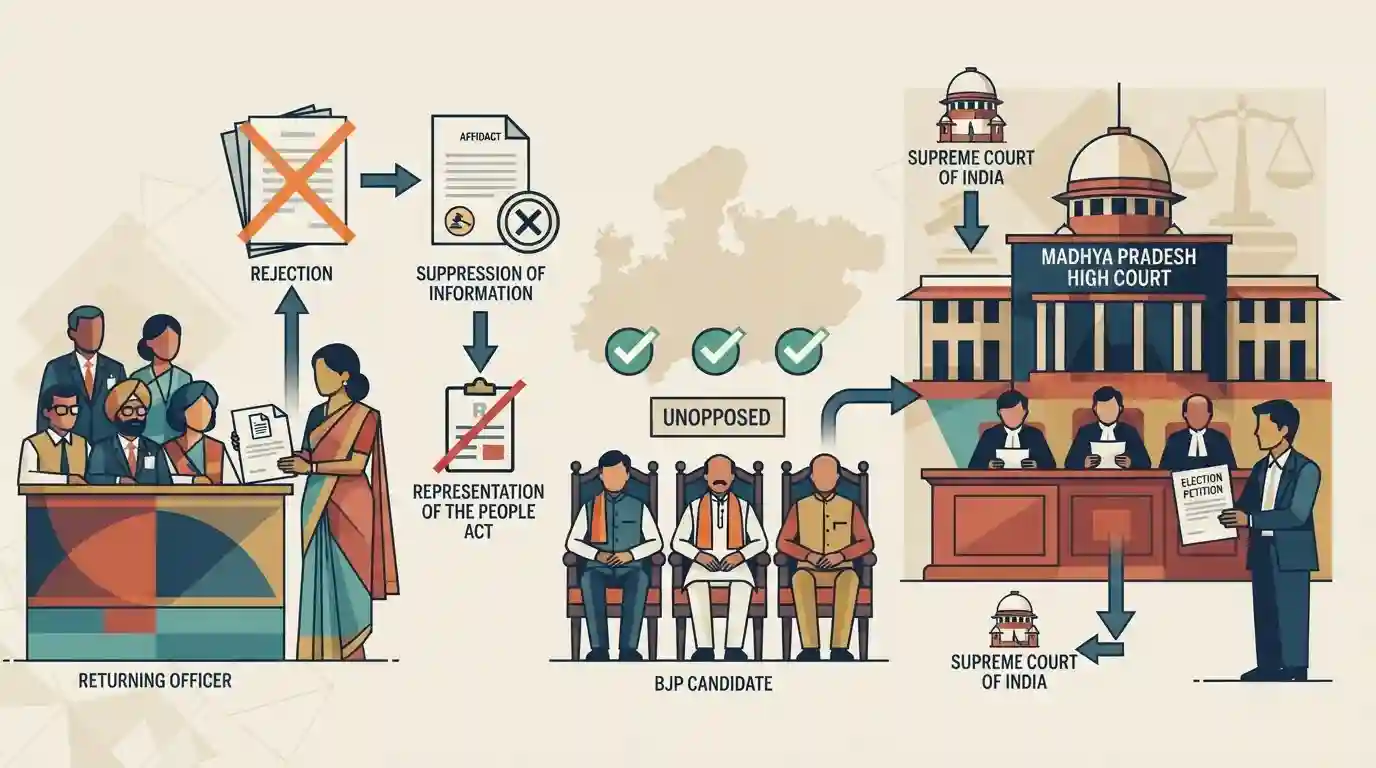
Congress leader and former Lok Sabha MP Meenakshi Natarajan has approached the Madhya Pradesh High Court challenging the rejection of her Rajya Sabha nomination by the Returning Officer. Her nomination was invalidated due to alleged suppression of information in her affidavit regarding a summons from a Telangana court. As a result of this rejection, three BJP candidates from Madhya Pradesh were elected unopposed to the Rajya Sabha. The Supreme Court had previously directed Natarajan to file an election petition, prompting her move to the High Court.
Key Points
- Congress leader Meenakshi Natarajan filed an election petition in the Madhya Pradesh High Court challenging the rejection of her Rajya Sabha nomination.
- The Returning Officer rejected her nomination on June 9 for allegedly concealing information in her election affidavit about a summons from a Telangana court.
- Following the rejection of her nomination, three BJP candidates from Madhya Pradesh were elected to the Rajya Sabha unopposed.
- Natarajan had initially approached the Supreme Court, which directed her to seek relief by filing an election petition in the High Court.
Important Terms
Representation of the People Act, 1951

An act of Parliament regulating the conduct of elections in India, detailing candidate qualifications, disqualifications, the electoral process, and the mandatory disclosure of criminal antecedents.
UPSC context
GS Paper 2 (Salient features of RPA). Tests knowledge on election processes, candidate disclosures, and electoral disputes.
Election Commission of India
A permanent constitutional body established under Article 324 to superintend, direct, and control the conduct of elections to Parliament, state legislatures, and the offices of the President and Vice-President.
UPSC context
GS Paper 2 (Constitutional Bodies). Frequently tested on its powers, autonomy, and role in preserving democratic elections.
Supreme Court of India
The apex judicial body in India and highest court of appeal. Established under the Constitution, it serves as the guardian of fundamental rights and the final interpreter of laws.
UPSC context
GS Paper 2 (Judiciary). Questions cover its jurisdiction, independence, power of judicial review, and limitations in electoral interventions.
Madhya Pradesh High Court
The highest judicial court in Madhya Pradesh. Under election law, High Courts exercise original jurisdiction to hear election petitions challenging the validity of elections to Parliament or State Legislatures.
UPSC context
GS Paper 2 (Judiciary, RPA). Highlights High Courts' exclusive role in resolving post-election disputes and adjudicating election petitions.
Prelims Trap
An election petition challenging a nomination rejection can be filed directly in the Supreme Court during the ongoing election process.
Under Article 329(b), courts cannot intervene during the electoral process. Challenges can only be made post-election via an election petition, for which the High Court has exclusive original jurisdiction.
Static Concepts Connected
What is the legal framework governing election petitions in India?
- Constitutional Bar: Article 329(b) bars courts from interfering in elections mid-process; disputes can only be challenged post-election via an election petition.
- Original Jurisdiction: Under Section 80A of RPA 1951, the High Court of the state holds exclusive original jurisdiction to try election petitions.
- Time Limit: An election petition must be filed within 45 days from the date of the election of the returned candidate.
Cross-Topic Patterns
Voter Information and Article 19(1)(a)
The mandatory disclosure of candidate antecedents in Form 26 directly stems from the Supreme Court's reading of Article 19(1)(a), recognizing the voter's right to know as a fundamental right.
Judicial Review vs Electoral Efficiency
Article 329(b) balances judicial review with administrative efficiency, ensuring democratic transitions are not stalled by endless interlocutory litigation during polling.

Expect questions in 2026 contrasting High Court's exclusive jurisdiction over election petitions with Article 329(b)'s bar on mid-poll intervention.
Linked PYQs · 4
Linked PYQs · 4
- 2024MPPSC_PRELIMSGS1
Which one of the following statements is not correct ?
- 2021MPPSC_PRELIMSGS1
The power of Supreme Court of India to decide the disputes between Centre and States falls under which Jurisdiction ?
- 2023MPPSC_PRELIMSGS1
The Parliament is formed by which of the following?
- 2023MPPSC_PRELIMSGS1
The Electoral College for the election of the President consists of:
