Madhya Pradesh Cabinet Portfolio Reallocation and Moong Procurement
Source:bignewsnetwork ↗
Why It Matters
This news highlights key constitutional powers of the State Chief Minister regarding portfolio allocation, MP's unique administrative innovations (Anand Department), agricultural procurement policies (moong crop guarantees), and major water resource management projects (Kundaliya Irrigation) critical for the MPPSC Prelims.
Summary
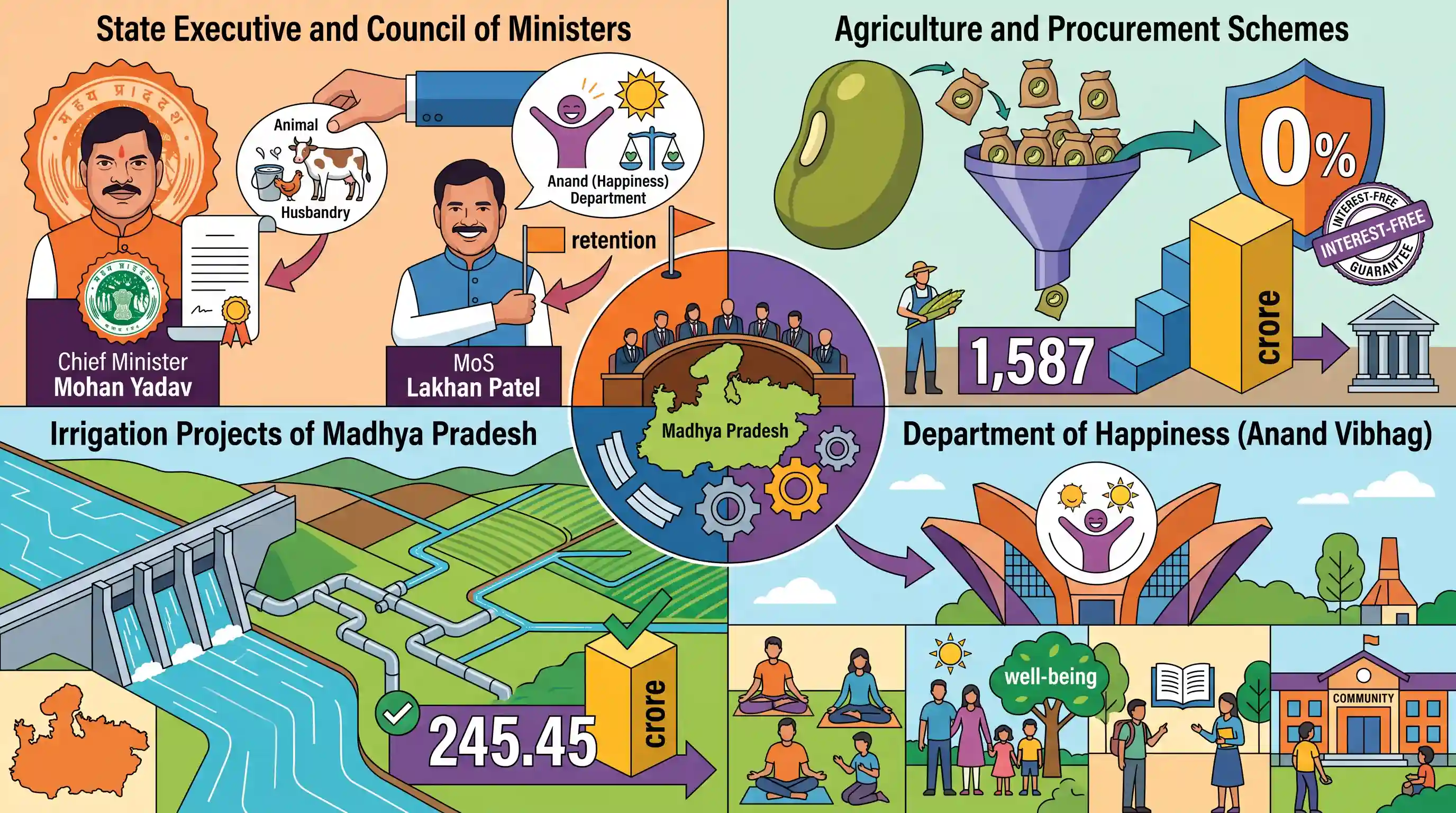
Madhya Pradesh Chief Minister Mohan Yadav withdrew the Animal Husbandry portfolio from MoS Lakhan Patel and assumed charge of the department himself. Patel retains charge of the Anand (Happiness) Department. Simultaneously, the state cabinet approved Rs 1,587 crore in interest-free guarantees for Moong procurement and sanctioned Rs 245.45 crore for the Kundaliya Major Irrigation Project on the Kali Sindh river.
Key Points
- Madhya Pradesh Chief Minister Dr. Mohan Yadav carried out a minor cabinet portfolio reallocation, taking over the Animal Husbandry Department after withdrawing it from Minister of State (Independent Charge) Lakhan Patel.
- Lakhan Patel continues to retain charge of the Anand Department (Department of Happiness), which was pioneered by Madhya Pradesh as the first state in India to establish such a department in 2016.
- The Cabinet approved an interest-free government guarantee of Rs 1,587 crore to facilitate the procurement of moong (green gram) beyond the central target for the Rabi Marketing Season 2024-25.
- A sanction of Rs 245.45 crore was approved for the Kundaliya Major Irrigation Project in Rajgarh district under the 16th Finance Commission period (2026-2031).
- The Kundaliya Major Irrigation Project on the Kali Sindh River aims to create over 1.39 lakh hectares of irrigation potential in the Rajgarh and Agar-Malwa districts through a micro-irrigation system.
Important Terms
Price Support Scheme

A market intervention scheme by the Government of India to protect growers of agricultural commodities from distress sales during bumper crops, ensuring procurement at the Minimum Support Price (MSP).
UPSC context
GS Paper III (Agriculture). Tests understanding of government procurement, price stabilization mechanisms, and agricultural marketing reforms.
Kundaliya Major Irrigation Project
A major multipurpose water infrastructure project on the Kali Sindh River in Madhya Pradesh, designed to create extensive micro-irrigation networks and supply drinking/industrial water.
UPSC context
GS Paper I (Geography) & GS Paper III (Infrastructure). Tests knowledge of key regional river-interlinking and water management projects.
Anand Department
India’s first-of-its-kind Department of Happiness established by Madhya Pradesh, tasked with promoting and implementing administrative initiatives that foster mental well-being and life satisfaction.
UPSC context
GS Paper II (Governance) & GS Paper IV (Ethics). Tests innovative administrative approaches to citizen welfare beyond traditional indices.
16th Finance Commission
A constitutional body constituted under Article 280 to recommend the distribution of tax revenues between the Union and the States for the period 2026–2031.
UPSC context
GS Paper II (Polity) & GS Paper III (Economy). Tests understanding of fiscal federalism and cooperative center-state financial relations.
Punjab National Bank
A premier Indian public sector bank that partners with state governments to provide credit limits and guarantees for essential agricultural procurement schemes.
UPSC context
GS Paper III (Economy). Tests knowledge of financial institutions and banking sector participation in priority-sector agricultural financing.
Prelims Trap
The Governor of a State has the discretionary constitutional power to reshuffle or withdraw portfolios of individual state ministers.
While ministers hold office during the Governor's pleasure (Art 164), the Governor cannot allocate or withdraw portfolios independently; they must act strictly on the advice of the Chief Minister.
Static Concepts Connected
What constitutional provisions govern the appointment of state ministers and portfolio allocation?
- Article 164(1): The Chief Minister is appointed by the Governor; other ministers are appointed by the Governor only on the advice of the Chief Minister.
- Pleasure of Governor: Ministers hold office during the Governor's pleasure, which constitutionally translates to the pleasure of the Chief Minister.
- Rules of Business: Under Article 166(3), the Governor makes rules for business allocation among ministers, acting strictly on the Chief Minister's advice.
What are the key geographical features of the Chambal river system and its tributaries?
- Origin and Basin: Chambal originates in the Vindhya Range (MP) and flows north-northeast to join the Yamuna, draining the semi-arid Malwa Plateau.
- Key Tributaries: Its major right-bank tributaries include Kali Sindh, Parbati, and Shipra, while the Banas is its main left-bank tributary.
- Interlinking Scheme: The Parbati-Kalisindh-Chambal (PKC) project diverts surplus water from these tributaries to address chronic water deficits in the basin.
Cross-Topic Patterns
Micro-irrigation and water-use efficiency
The Kundaliya project's pressurized underground pipelines showcase a shift from traditional canal flooding to micro-irrigation, supporting PMKSY's 'Per Drop More Crop' goals.
Gross National Happiness in governance
MP's Rajya Anand Sansthan bridges spiritual well-being and public administration, operationalizing Bhutan's GNH metrics within a standard state policy framework.

The Parbati-Kalisindh-Chambal link and pressurised micro-irrigation tech are highly probable GS-1/GS-3 topics for 2026.
Linked PYQs · 2
Linked PYQs · 2
- 2022MPPSC_PRELIMSGS1
Who among the following shall preside the meeting of Council of Ministers in Madhya Pradesh in the absence of the Chief Minister?
- 2018MPPSC_PRELIMSGS1
Bhavantar Bhugtan Yojana of Madhya Pradesh is related to which sector?
