AIGGPA and IIWM MoU: Public Policy Partnership in Madhya Pradesh
Source:indian-masterminds ↗
Why It Matters
This MoU highlights the state's efforts in policy-making and environmental governance. It is highly relevant for MPPSC Prelims, which frequently asks about key state institutions like AIGGPA (asked in 2024) and broader concepts of sustainable development.
Summary
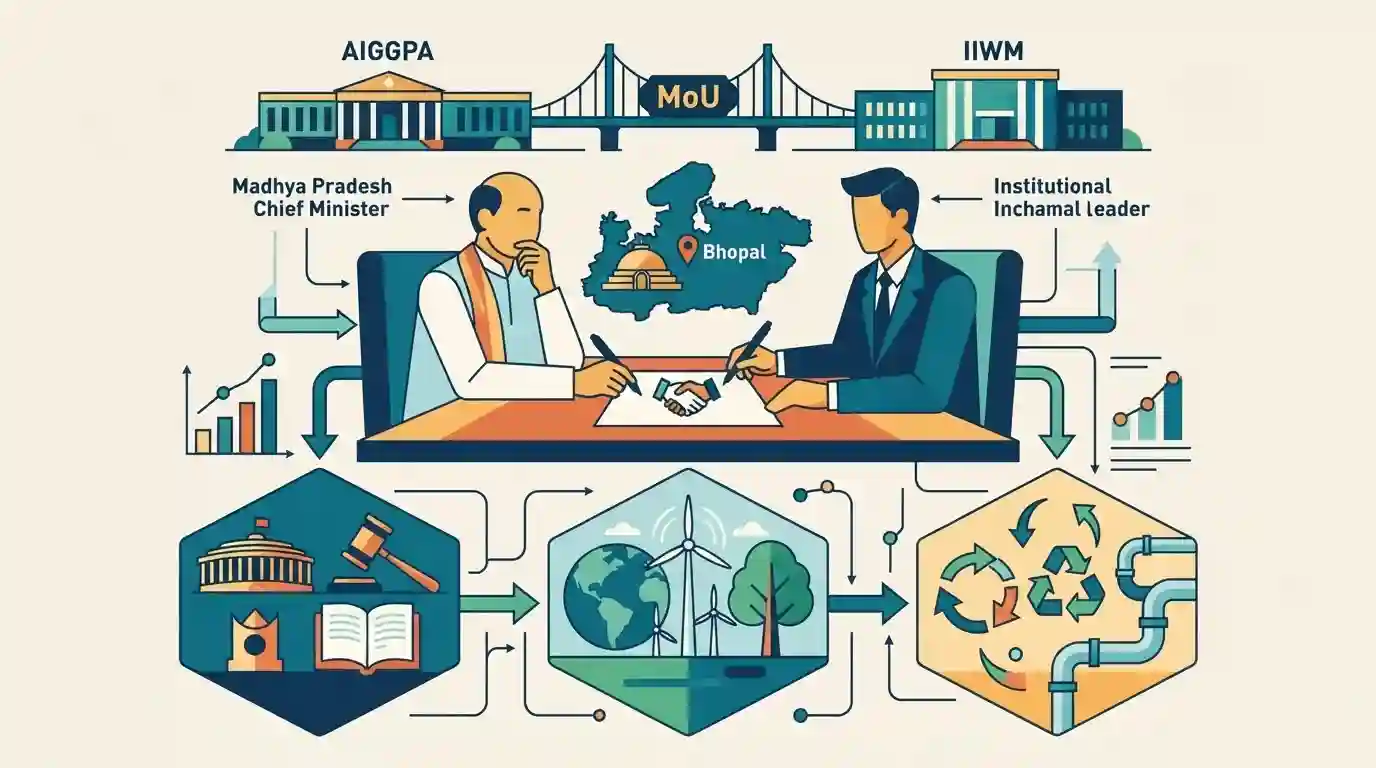
Madhya Pradesh Chief Minister Dr. Mohan Yadav attended the signing of an MoU between the Atal Bihari Vajpayee Institute of Good Governance and Policy Analysis (AIGGPA), Bhopal, and the International Institute of Waste Management (IIWM). The partnership aims to promote institutional cooperation in public policy, good governance, environmental protection, resource management, and sustainable development through joint research and capacity building.
Key Points
- An MoU was signed between AIGGPA, Bhopal, and IIWM to enhance institutional cooperation.
- The collaboration focuses on good governance, public policy, waste management, environmental protection, and sustainable development.
- The agreement involves joint research, training, and capacity-building initiatives in Madhya Pradesh.
Important Terms
Atal Bihari Vajpayee Institute of Good Governance and Policy Analysis (AIGGPA)

A premier think tank under the Madhya Pradesh government's Public Service Management Department. It leads evidence-based policy research, SDG indexing, and administrative capacity building to improve citizen service delivery.
UPSC context
GS Paper 2 (Governance). Illustrates state-level institutional mechanisms and think tanks contributing to public policy formulation and governance reforms.
International Institute of Waste Management (IIWM)
A non-profit organization established in 2009 as a Ministry of Science and Technology project. It collaborates with governments and industries on solid and liquid waste management, sanitation, and sustainable development.
UPSC context
GS Paper 3 (Environment). Highlights the role of non-governmental institutions in bridging policy gaps for environmental protection and resource management.
Good Governance
The transparent, accountable, and effective management of public affairs and resources. It emphasizes responsive service delivery, rule of law, and inclusive participation in executing public policy.
UPSC context
Core topic in GS Paper 2 (Governance) and GS Paper 4 (Ethics). Tests understanding of administrative transparency and effective citizen service delivery.
Prelims Trap
"The International Institute of Waste Management (IIWM) is a UN-affiliated specialized agency."
IIWM is an Indian organization established in Bhopal (backed by Vigyan Bharati), not a UN agency, despite the word "International" in its name.
Static Concepts Connected
What is NITI Aayog's State Support Mission (SSM)?
- NITI Aayog parallel: Encourages states to set up State Institutions for Transformation (SITs) to drive localized policy formulation.
- Capacity building: Aims to enhance state-level analytical capabilities and policy making, mirroring central think tanks.
- Cooperative federalism: Strengthens the state's role in achieving SDGs through targeted, data-driven governance and institutional cooperation.
What are the key governance mandates in the Solid Waste Management Rules, 2016?
- Source segregation: Mandates segregation of waste into wet, dry, and domestic hazardous waste at the generator level.
- EPR integration: Shifts the burden to manufacturers and brand owners for packaging waste disposal and management.
- Local body empowerment: Assigns clear duties to local authorities for establishing infrastructure, processing facilities, and capacity building.
Cross-Topic Patterns
Decentralization of Policy Think Tanks
State-level institutes like AIGGPA reflect NITI Aayog's "State Support Mission" to establish State Institutions for Transformation (SIT) for localized, data-driven governance.
Waste Management & Circular Economy
Institutional capacity building in waste management directly ties into India's LiFE (Lifestyle for Environment) mission and the push for a Circular Economy.

State-level think tanks (SITs) and decentralized institutional frameworks for waste management could feature as a GS-2/GS-3 Mains linkage.
Linked PYQs · 2
Linked PYQs · 2
- 2024MPPSC_PRELIMSGS1
The Atal Bihari Vajpayee Institute of Good Governance and Policy Analysis is in:
- 2015MPPSC_PRELIMSGS1
The base of sustainable development is
