Ujjain Jaora Greenfield Road Foundation Stone Laying Event
Source:freepressjournal ↗
Why It Matters
Infrastructure projects (highways/greenfield roads), state educational initiatives, and political personalities originating from Madhya Pradesh are highly critical topics frequently tested in the MPPSC State Service Prelims examination.
Summary
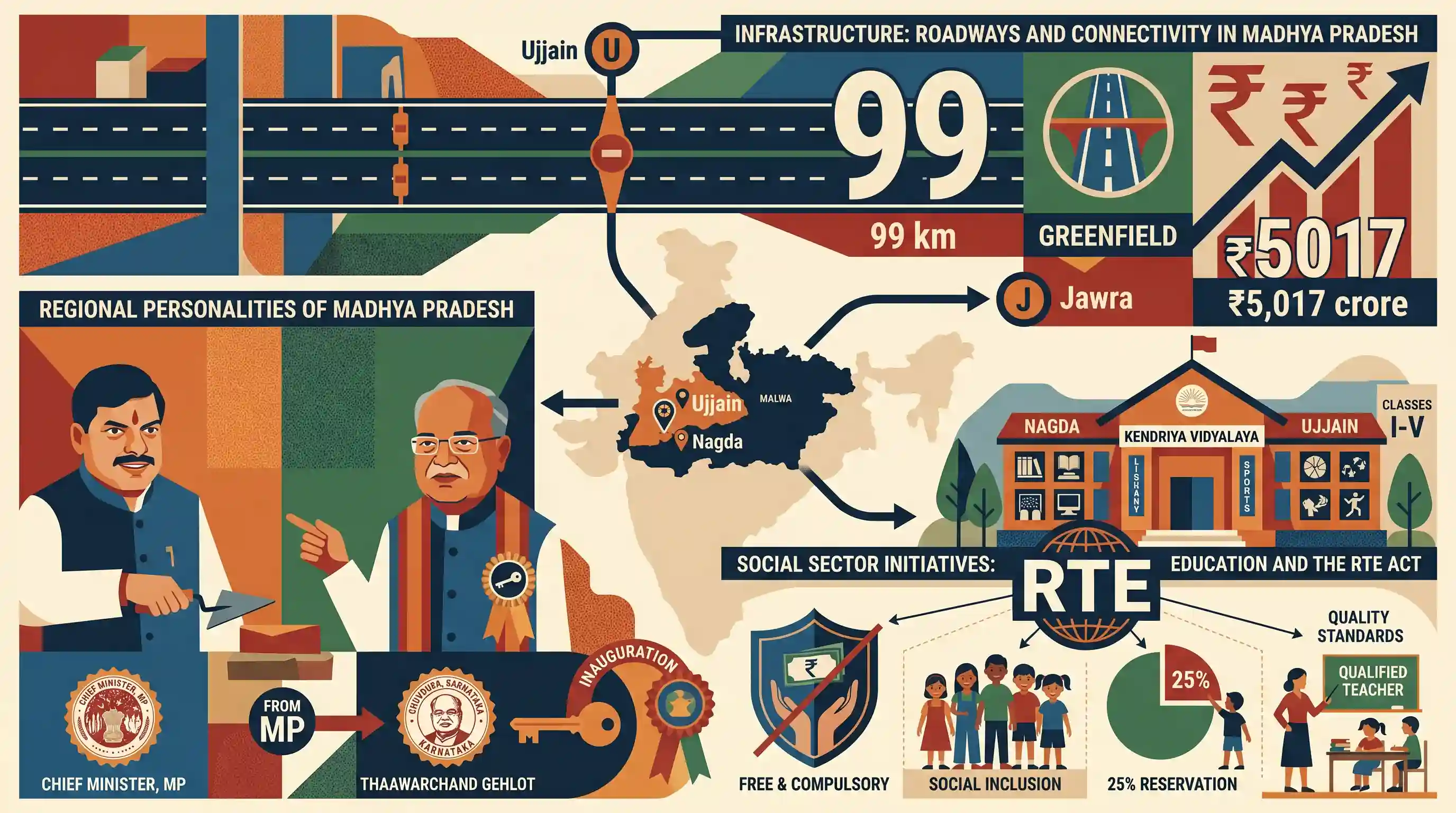
Madhya Pradesh Chief Minister Dr. Mohan Yadav laid the foundation stone for the ₹5,017 crore Ujjain-Jawra 4-lane Greenfield Road spanning 99 km. He also inaugurated a new Kendriya Vidyalaya in the industrial town of Nagda, Ujjain district. The events took place in the presence of Karnataka Governor Thaawarchand Gehlot, showcasing major infrastructure and educational upgrades in the Malwa region of Madhya Pradesh.
Key Points
- Madhya Pradesh Chief Minister Dr. Mohan Yadav laid the foundation stone of the Ujjain-Jawra 4-lane Greenfield Road (with paved shoulders) in Nagda, Ujjain district.
- The Greenfield road project spans 99 km in length and is valued at ₹5,017 crore, aiming to significantly enhance connectivity in western Madhya Pradesh.
- A new Kendriya Vidyalaya was inaugurated in Nagda by the Chief Minister, initially admitting 200 students across Classes 1 to 5.
- Under the Right to Education (RTE) Act, 25% of the seats at the newly established Kendriya Vidyalaya are reserved for eligible children from disadvantaged backgrounds.
- The foundation stone ceremony was held in the presence of Karnataka Governor Thaawarchand Gehlot, who is an eminent political figure native to the Ujjain region of Madhya Pradesh.
Important Terms
Right to Education (RTE) Act

A landmark 2009 legislation that operationalizes Article 21A of the Indian Constitution, making free and compulsory elementary education a fundamental right for all children aged 6 to 14 years.
UPSC context
GS Paper II: Social Justice and Education. Tests knowledge of fundamental rights, education policies, and social inclusion initiatives.
Kendriya Vidyalaya Sangathan
A premier system of central government schools in India, established in 1963 under the Ministry of Education, designed to provide uniform quality education to children of transferable central government employees.
UPSC context
GS Paper II: Governance and Education. Tests understanding of government-led educational institutions, administration, and public welfare schemes.
Greenfield Project
An infrastructure or industrial development built from scratch on previously unused land, free from the constraints, remodeling, or demolition requirements of any prior existing construction.
UPSC context
GS Paper III: Infrastructure and Indian Economy. Tests comprehension of investment models, project planning, and sustainable infrastructure development.
Malwa Plateau
A prominent physiographic region of west-central India of volcanic origin, characterized by black soil and fertile plains, primarily spanning western Madhya Pradesh and southeastern Rajasthan.
UPSC context
GS Paper I: Physical Geography of India. Tests identification of volcanic structures, drainage basins, and regional climate and crop patterns.
Government of Madhya Pradesh
The subnational governing authority of Madhya Pradesh, structured as a unicameral parliamentary system under the Indian Constitution, headed ceremonially by the Governor and executive-wise by the Chief Minister.
UPSC context
GS Paper II: Polity & Federalism. Tests understanding of state-level executive functions, legislative operations, and center-state relations.
Prelims Trap
The 25% seat reservation under Section 12(1)(c) of the RTE Act applies uniformly to all government, private, and minority-run schools.
Minority institutions (both aided and unaided) are constitutionally exempt from the RTE Act's 25% reservation mandate under Article 30(1), as affirmed by the Supreme Court.
Static Concepts Connected
What is the difference between Greenfield and Brownfield infrastructure projects?
- Greenfield: Built from scratch on previously undeveloped land without existing constraints, offering high design flexibility but facing high land acquisition hurdles.
- Brownfield: Involves upgrading, expanding, or retrofitting existing structures, posing lower land acquisition hurdles but facing operational and legacy design constraints.
What are the constitutional exemptions and scopes of the Right to Education (RTE) Act, 2009?
- Scope: Mandates free, compulsory education for ages 6-14 under Article 21A, requiring 25% reservation in entry-class for disadvantaged groups in non-minority schools.
- Exemptions: Explicitly excludes Vedic Pathshalas, Madrasas, and institutions primarily providing religious instruction, along with minority-administered schools under Article 30(1).
Cross-Topic Patterns
Greenfield Roadways vs. Fiscal Federalism
Balancing state-led Greenfield initiatives with PM GatiShakti shows how regional logistical corridors integrate with national master plans to resolve interstate economic disparities.
Industrial Clusters of Chambal Basin
Nagda's development on the Chambal river highlights the spatial relationship between water-intensive industries (like Viscose Staple Fiber) and regional infrastructure connectivity.

UPSC may test the constitutional boundaries of Article 21A, specifically contrasting RTE exemptions for minority institutions with public-funded schools.
Linked PYQs · 3
Linked PYQs · 3
- 2023MPPSC_PRELIMSGS1
Which of the following statements is not correct regarding the roadways of Madhya Pradesh according to Basic Road Statistics 2018-19?
- 2020MPPSC_PRELIMSGS1
Who among the following Governors of Madhya Pradesh has been the Chief Minister of Haryana?
- 2019MPPSC_PRELIMSGS1
The scope of the Article 21 of the Constitution was expanded to include Right to Education, because of the decision of Supreme Court in the case
