Self Help Groups in Madhya Pradesh Receive State Bank Loans
Source:aninews ↗
Why It Matters
The article details vital rural livelihood and women empowerment initiatives in Madhya Pradesh, specifically targeting the tribal-majority Jhabua district. Familiarity with state missions like MPSRLM, investments in AYUSH (Ayurvedic College), and local geographic knowledge (Jhabua, Padmavati River) is critical for MPPSC Prelims.
Summary
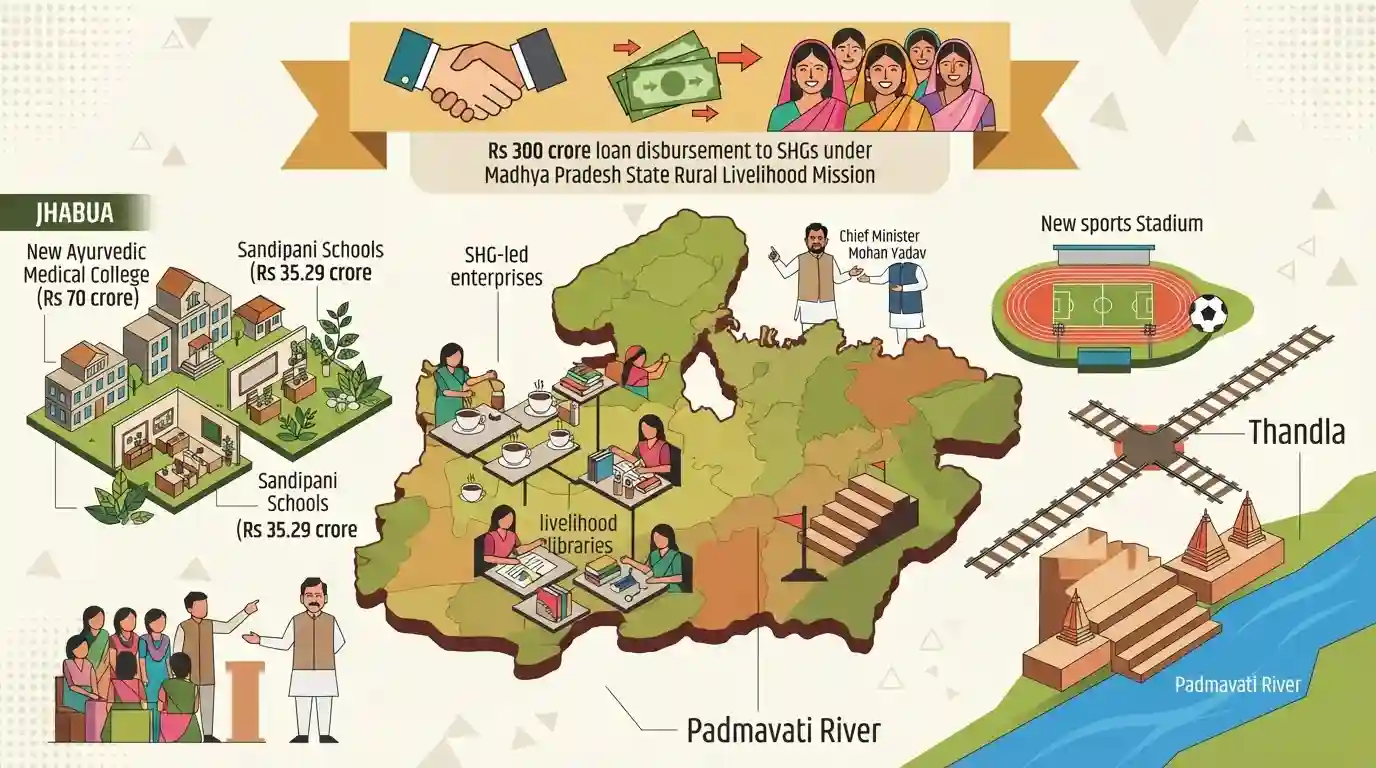
Madhya Pradesh Chief Minister Mohan Yadav disbursed Rs 300 crore in loans to Self-Help Groups (SHGs) statewide under the Madhya Pradesh State Rural Livelihood Mission. At an event in Jhabua district, he inaugurated and laid foundation stones for development projects worth over Rs 283 crore. Significant investments include Rs 70 crore for an Ayurvedic Medical College and Rs 35.29 crore for Sandipani Schools. The CM highlighted women's growing economic role through SHG-led enterprises like 'Didi Cafes' and livelihood libraries. Additional infrastructure developments in Jhabua encompass new sports stadiums, railway connectivity via Thandla, and the construction of ghats on the Padmavati River, modeled after Chhoti Kashi.
Key Points
- Madhya Pradesh CM Mohan Yadav disbursed Rs 300 crore in bank loans to Self-Help Groups (SHGs) across the state to boost women's economic independence.
- Development works worth Rs 283 crore were initiated in the tribal-dominated Jhabua district.
- Key projects include a new Ayurvedic Medical College (Rs 70 crore) and the establishment of Sandipani Schools (Rs 35.29 crore) in Jhabua.
- Women empowerment is being championed through initiatives like 'Didi Cafes' and livelihood libraries managed by SHG women.
- Infrastructure upgrades in Jhabua include sports stadiums, railway line connectivity through Thandla, and ghats on the Padmavati River akin to Chhoti Kashi.
Important Terms
Madhya Pradesh State Rural Livelihood Mission (MPSRLM)

A state-led poverty alleviation mission under DAY-NRLM that mobilizes rural poor households into Self-Help Groups (SHGs) to provide them with sustainable institutional support, microfinance, and skilled livelihood opportunities.
UPSC context
Highly relevant for GS-2 (Government Policies) and GS-3 (Employment), illustrating state-level execution of rural poverty reduction programs.
Self-Help Groups (SHGs)
Small, community-based collectives—predominantly comprising rural women—who pool their savings, access institutional credit, and manage micro-enterprises to achieve financial independence and socio-economic empowerment.
UPSC context
Directly maps to GS-2 (Role of SHGs). Tests knowledge of decentralized development, microfinance, and grassroots women's empowerment.
Didi Cafes
Canteens and public food outlets operated by rural women's SHGs, supported by the government to provide affordable meals while ensuring a stable, independent monthly income for the women managing them.
UPSC context
A prime case study for GS-2 and GS-3 showcasing state-supported SHG micro-enterprises and women's economic self-reliance.
Livelihood Libraries
Educational centers in rural areas run by women's SHGs. They provide local youth with study materials for competitive exams while simultaneously creating a non-farm source of income for the women.
UPSC context
Excellent GS-2 example for essays or answers on how SHGs can drive rural education infrastructure while diversifying livelihoods.
Prelims Trap
Loans extended to Self-Help Groups (SHGs) under the State/National Rural Livelihood Missions require physical collateral or third-party guarantees.
Under DAY-NRLM guidelines, loans to SHGs are completely collateral-free up to Rs 20 lakh (increased from Rs 10 lakh in 2021) to facilitate hassle-free credit.
Static Concepts Connected
What is the SHG-Bank Linkage Project (SBLP)?
- Origin and Initiator: Launched by NABARD in 1992 to link informal self-help groups with formal banking institutions.
- Collateral-free credit: Enables SHGs to secure bank credit without collateral, relying instead on mutual trust and group peer-pressure.
- NRLM Integration: Serves as the financial backbone of the Deendayal Antyodaya Yojana-National Rural Livelihoods Mission (DAY-NRLM).
How does the Fifth Schedule govern tribal-dominated districts?
- Scope and Application: Governs Scheduled Areas in ten states, including Madhya Pradesh, to protect tribal culture and economic interests.
- Governor's powers: Authorizes the Governor to modify or suspend central/state laws affecting Scheduled Areas and tribal land transfer.
- Tribes Advisory Council: Mandates establishing a Tribes Advisory Council to advise on welfare and advancement of Scheduled Tribes.
Cross-Topic Patterns
SHGs + Gender Budgeting
Financial support to SHGs reflects a shift from welfare to asset-building, strengthening women's decision-making and economic agency in rural households.
PESA + Tribal Economic Autonomy
Leveraging SHGs in Fifth Schedule areas integrates local trade with formal banking, reinforcing PESA's objective of tribal self-governance.

UPSC may frame a 2026 GS2 question analyzing how SHG financial integration bridges governance deficits in Fifth Schedule tribal areas.
Linked PYQs · 4
Linked PYQs · 4
- 2025MPPSC_PRELIMSGS1
The objective of "Mukhyamantri Ladli Behna Yojana" implemented in entire Madhya Pradesh, in addition to economic self-reliance is:
- 2022MPPSC_PRELIMSGS1
AYUSH is an acronym for
- 2018MPPSC_PRELIMSGS1
Which district of Madhya Pradesh has highest percentage of tribal population?
- 2018MPPSC_PRELIMSGS1
Which one of the following districts of Madhya Pradesh touches the State boundaries of Gujarat and Rajasthan?
