Contaminated Water and Malnutrition Allegations in Balaghat Villages
Source:indiatoday ↗
Why It Matters
This news directly pertains to the socio-economic conditions, geographical spread, and health challenges of Particularly Vulnerable Tribal Groups (PVTGs) in Madhya Pradesh. The Baiga tribe and issues of malnutrition in tribal areas are frequent topics in the MPPSC Prelims exam.
Summary
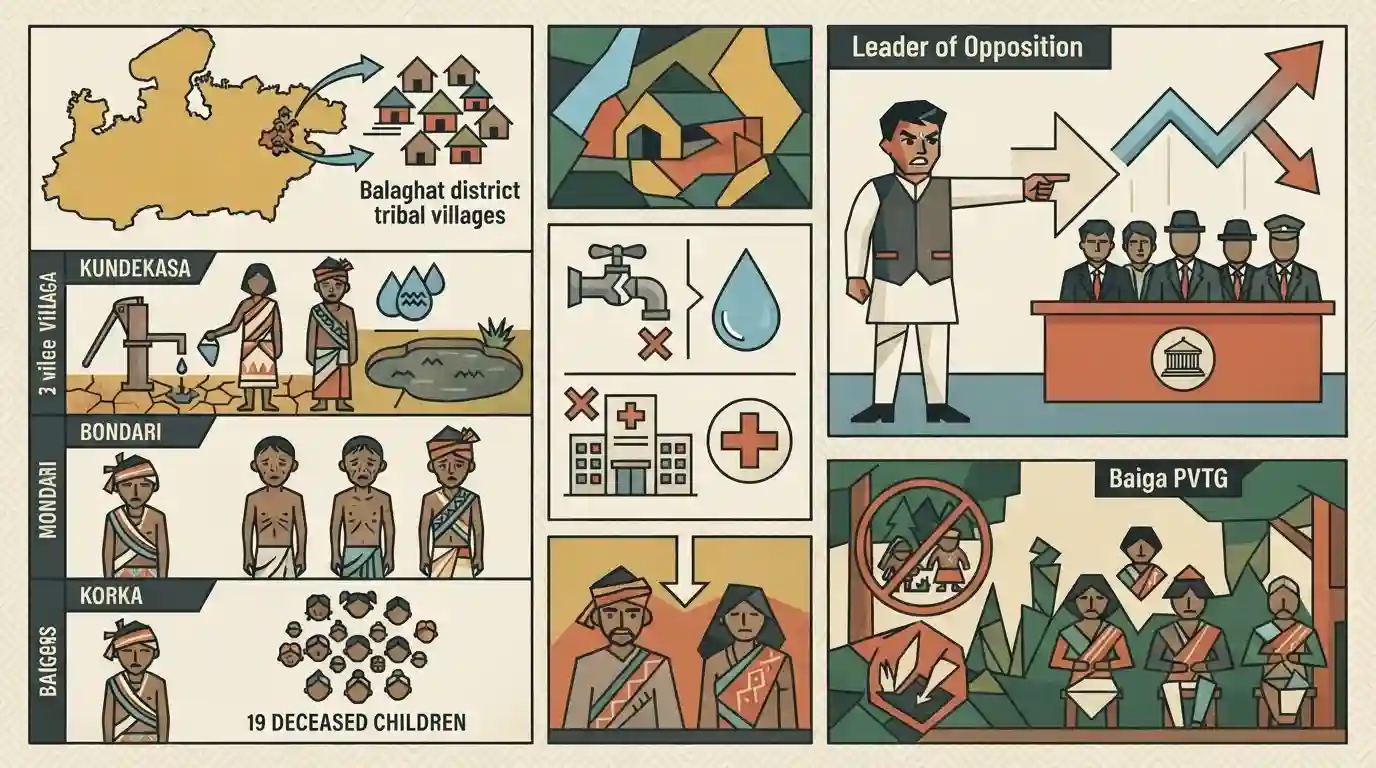
Madhya Pradesh Leader of Opposition Umang Singhar has alleged that 19 children died from suspected contaminated water and malnutrition in the tribal-dominated villages of Balaghat district. The affected villages, including Kundekasa, Bondari, and Korka, are primarily inhabited by the Baiga tribe, which is recognized as a Particularly Vulnerable Tribal Group (PVTG) in the state. The incident has drawn severe criticism against the local administration for inadequate healthcare infrastructure and failure to supply safe drinking water to remote tribal regions.
Key Points
- 19 children have allegedly died due to contaminated water and malnutrition in Balaghat district, Madhya Pradesh.
- The affected villages are predominantly inhabited by the Baiga tribe, one of the three Particularly Vulnerable Tribal Groups (PVTGs) in the state.
- Leader of Opposition Umang Singhar raised the issue, criticizing the state administration for failing to provide clean drinking water and healthcare.
- The incident highlights persistent vulnerabilities and malnutrition challenges among PVTGs in remote areas of Madhya Pradesh.
Prelims Trap
The Baiga, Gond, and Bhil tribes are the recognized Particularly Vulnerable Tribal Groups (PVTGs) of Madhya Pradesh.
Only Baiga, Bharia, and Sahariya are designated as PVTGs in MP. Major tribes like Bhil and Gond, despite their large population, are not classified as PVTGs.
Static Concepts Connected
What are the three PVTGs in MP and their primary geographic regions?
- Baiga Tribe: Resides mostly in the eastern and southeastern districts like Balaghat, Dindori, Mandla, and Shahdol.
- Bharia Tribe: Concentrated heavily in the geographically isolated Patalkot valley of Chhindwara district.
- Sahariya Tribe: Primarily found in the northwestern regions of MP, especially Gwalior, Shivpuri, Guna, and Sheopur.
What are the key features of Madhya Pradesh's Ahar Anudan Yojana?
- Target Beneficiaries: Exclusively targets families belonging to the three PVTGs (Baiga, Bharia, and Sahariya) to combat severe malnutrition.
- Financial Assistance: Provides a direct monthly cash transfer (initially ₹1000, later enhanced to ₹1500) for purchasing nutritious food.
- Women Empowerment: The financial grant is deposited directly into the bank accounts of the female head of the family.
Cross-Topic Patterns
PVTG geographic isolation and health governance
The physical isolation of Baiga regions like Balaghat compounds administrative challenges, linking MP's physical geography directly to gaps in public health delivery and persistent malnutrition.
Water sanitation and MP's Infant Mortality Rate
MP struggles with a high Infant Mortality Rate (IMR). Outbreaks of waterborne diseases in tribal pockets directly hinder the state's progress in NITI Aayog’s health and SDG indices.

Expect direct matching questions linking MP's three PVTGs (Baiga, Bharia, Sahariya) to their native districts and Ahar Anudan Yojana.
Linked PYQs · 3
Linked PYQs · 3
- 2025MPPSC_PRELIMSGS1
Which one of the following is not one of the Particularly Vulnerable Tribal Group (PVTG) of Madhya Pradesh?
- 2025MPPSC_PRELIMSGS1
Since the date 23.12.2017, 'Ahar Anudan Yojana' is a yojana to get rid of malnutrition of which tribal community?
- 2018MPPSC_PRELIMSGS1
Which district of Madhya Pradesh has highest percentage of tribal population?
