Kuno National Park Cheetah Release Under Project Cheetah
Source:newsonair ↗
Why It Matters
MPPSC frequently asks questions about national parks, wildlife sanctuaries, and their corresponding districts in Madhya Pradesh, as well as landmark state-led wildlife initiatives like Project Cheetah.
Summary
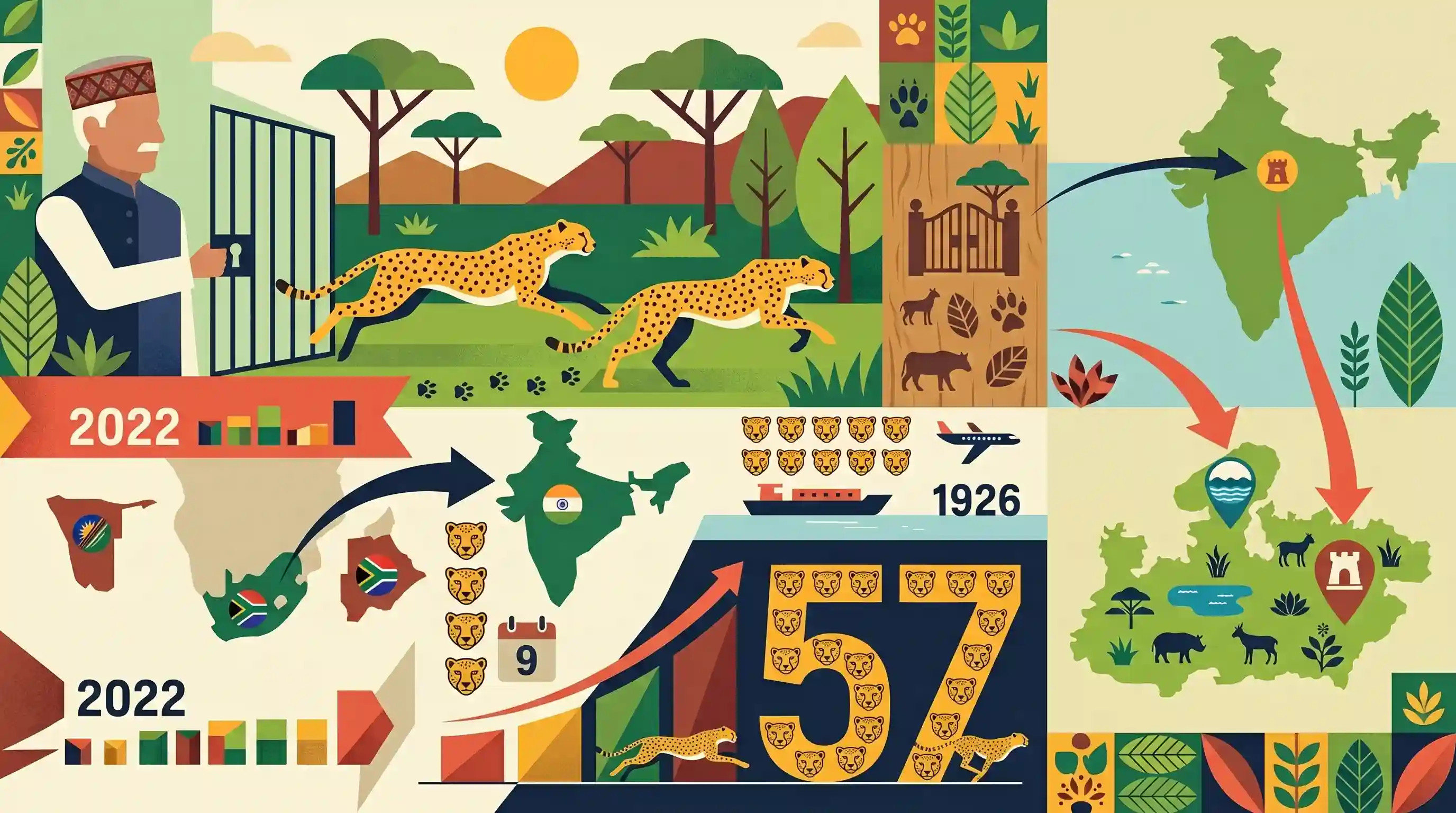
Madhya Pradesh Chief Minister Dr. Mohan Yadav released two female cheetahs into Kuno National Park, Sheopur. The cheetahs were part of a batch of nine cheetahs imported from Botswana in February 2026 under Project Cheetah, bringing the country's total cheetah population to 57. The initiative, launched in 2022, has seen three phases of imports from Namibia, South Africa, and Botswana, with future expansion planned for Gandhi Sagar and Nauradehi (Veerangana Durgavati) wildlife sanctuaries.
Key Points
- Madhya Pradesh CM Dr. Mohan Yadav released two female cheetahs into the wild at Kuno National Park in Sheopur district.
- The released cheetahs belong to a batch of nine cheetahs (6 female, 3 male) imported from Botswana in February 2026.
- With this release, the total cheetah population in India has reached 57.
- Project Cheetah was launched in September 2022 by PM Narendra Modi, starting with 8 Namibian cheetahs, followed by 12 from South Africa in February 2023, and 9 from Botswana in February 2026.
- Future plans include expanding cheetah habitats to Gandhi Sagar Sanctuary and Nauradehi (Veerangana Durgavati) Wildlife Sanctuary in Madhya Pradesh.
Important Terms
Project Cheetah

India's flagship wildlife initiative launched in 2022 to reintroduce cheetahs, which went extinct in the country in 1952. It is the world's first intercontinental wild carnivore translocation programme.
UPSC context
GS Paper III (Environment & Biodiversity); tests concepts of species reintroduction, conservation challenges, and wildlife management policies in India.
Kuno National Park
Located in Madhya Pradesh, it is a protected area and the primary reintroduction site under Project Cheetah, hosting translocated cheetahs from Namibia, South Africa, and Botswana.
UPSC context
GS Paper III (Environment); crucial for prelims map-based questions and mains analysis of national parks, grasslands, and ecosystem restoration.
Gandhi Sagar Wildlife Sanctuary
Situated in northwestern Madhya Pradesh bordering Rajasthan, it was developed as India's second cheetah habitat to reduce ecological pressure on Kuno National Park.
UPSC context
GS Paper III (Biodiversity & Conservation); tests knowledge of protected areas, Chambal river basin geography, and metapopulation wildlife strategies.
Nauradehi Sanctuary
The largest wildlife sanctuary in Madhya Pradesh, situated on the Vindhyan plateau. It forms a key conservation corridor and was recently integrated into the Veerangana Durgavati Tiger Reserve.
UPSC context
GS Paper III (Environment); relevant for geographic locations of protected areas, Central Indian biogeography, and wildlife corridors.
Veerangana Durgavati Wildlife Sanctuary
A protected area in Madhya Pradesh approved as India's third cheetah habitat, formed by combining the Nauradehi and Rani Durgavati wildlife sanctuaries.
UPSC context
GS Paper III (Ecology & Conservation); tests knowledge of new tiger reserves, wildlife translocations, and habitat suitability assessments.
Prelims Trap
India's Project Cheetah translocates the Critically Endangered Asiatic Cheetah to restore the exact subspecies that became extinct in 1952.
India is importing African Cheetahs (Vulnerable). The Asiatic Cheetah is Critically Endangered and exists only in Iran, which declined to share its surviving population.
Static Concepts Connected
How do Asiatic and African Cheetahs differ in conservation status and distribution?
- IUCN Status: Asiatic cheetah is Critically Endangered; African cheetah is listed as Vulnerable.
- Global Range: Asiatic cheetahs survive only in small pockets of Iran; African cheetahs range across sub-Saharan Africa.
- Physical Traits: Asiatic cheetahs are slightly smaller, have paler coats, and thicker fur than the African subspecies.
What are the key geographical features of Kuno National Park?
- Terrain and Vegetation: Located in the Vindhyan hills of Madhya Pradesh, dominated by dry deciduous forests and open grasslands.
- Hydrology: Bisected by the Kuno River, which is a major tributary of the Chambal River.
- Faunal Dynamics: Co-exists with co-predators like leopards, striped hyenas, and dholes, presenting unique ecological carrying capacity challenges.
Cross-Topic Patterns
Eco-restoration vs Indigenous Forest Rights
The relocation of Sahariya tribal villages from Kuno highlights the trade-off between megafauna conservation and the implementation of the Forest Rights Act (FRA), 2006.
Global Wildlife Trade and CITES
Intercontinental translocations under Project Cheetah must align with CITES Appendix I guidelines, showcasing how international environmental law regulates domestic biodiversity initiatives.

Expect 2026 prelims to link the three cheetah habitats to their exact river systems (Kuno, Chambal, Vyarma) and global source countries.
Linked PYQs · 2
Linked PYQs · 2
- 2024MPPSC_PRELIMSGS1
Which of the following pairs is false? Sanctuary District
- 2022MPPSC_PRELIMSGS1
Which of the following National Parks is the first in India to officially introduce a mascot named "Bhoorsingh the Barasingha"?
