Madhya Pradesh Cabinet Approves Uniform Civil Code Draft Bill
Source:The Hindu ↗
Why It Matters
The approval of the UCC Draft Bill by the MP Cabinet is a significant legislative event, positioning MP alongside Uttarakhand in pushing for codified civil laws. For MPPSC, the exemptions of specific tribes (Bhil, Gond, etc.) and constitutional connections to Article 44, Article 342, and Article 366 are highly examinable areas.
Summary
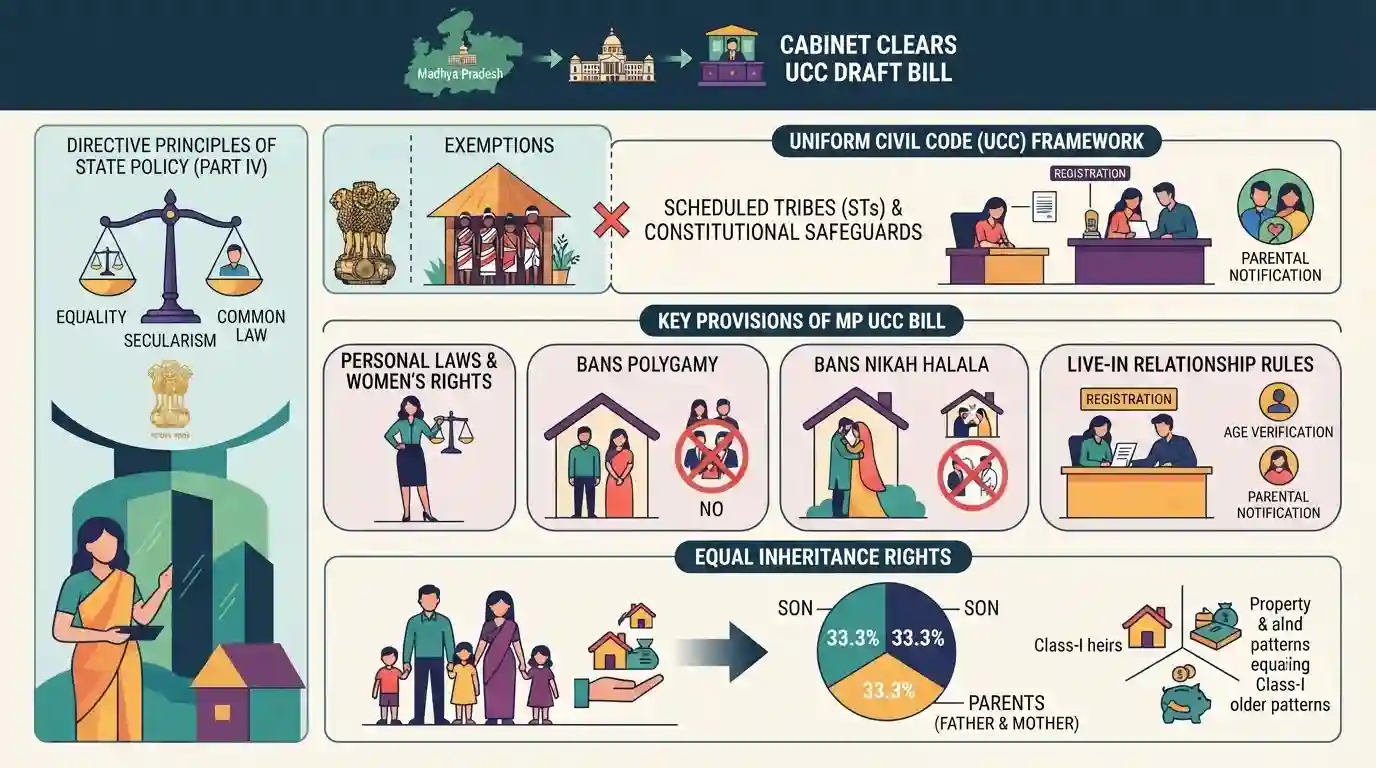
The Madhya Pradesh Cabinet has cleared the draft Uniform Civil Code (UCC) Bill, which exempts Scheduled Tribes but bans polygamy and nikah halala, and introduces stringent rules for live-in relationships. The bill also establishes equal inheritance rights for sons, daughters, and parents (both mother and father as Class-I heirs).
Key Points
- The Madhya Pradesh Cabinet, led by Chief Minister Mohan Yadav, approved the draft Uniform Civil Code (UCC) Bill on July 19, 2026, which was drafted by a six-member committee.
- The draft Bill explicitly exempts Scheduled Tribes (STs) in the state (such as Bhil, Gond, Korku, Baiga, Sahariya, and Bharia) protected under Articles 342 and 366 (Clause 25) and Part XXI of the Indian Constitution, to preserve their cultural heritage.
- It prohibits polygamy and multiple simultaneous marriages across all communities, declaring verbal divorces, informal panchayat divorces, triple talaq, and nikah halala illegal and punishable.
- Registration of all marriages and divorces on government portals is made mandatory to ensure legal protection and alimony rights for women.
- The bill mandates that live-in couples submit an affidavit to the local registrar within a month of entering a relationship. If either partner is under 21, the registrar will notify their parents and the local police.
- Children born out of live-in relationships or marriages are given equal legal status; the term 'illegitimate' is legally removed. Abandoned female partners in live-in relationships can claim maintenance.
- Equal inheritance rights are established for sons and daughters (irrespective of marital status), as well as widows and widowers. Surviving mother and father are both classified as Class-I heirs.
Important Terms
Madhya Pradesh Uniform Civil Code (UCC) Bill

A proposed state legislation establishing common laws for marriage, divorce, and inheritance for all residents. It completely bans polygamy and Nikah Halala, and mandates the legal registration of live-in relationships.
UPSC context
GS Paper 2 (Polity); tests state-level legislative competence regarding Concurrent List subjects and the socio-legal implications of civil codes.
Article 44 of the Constitution
A Directive Principle of State Policy (Part IV) stipulating that the State shall endeavour to secure a Uniform Civil Code for citizens throughout the territory of India.
UPSC context
GS Paper 2 (Indian Constitution); routinely tested on the constitutional balance between secularism, fundamental religious freedoms, and gender justice.
Scheduled Tribes (Constitutional Exemption)
Indigenous communities designated under Articles 342 and 366. The MP UCC specifically exempts them to preserve their unique cultural heritage, customary laws, and traditional lifestyle from uniform legislative overrides.
UPSC context
GS Paper 2 (Social Justice); tests statutory protections, Fifth/Sixth Schedule provisions, and tribal autonomy against uniform national laws.
Polygamy
The practice of having multiple spouses simultaneously. The MP UCC explicitly criminalizes this practice, making monogamy standard and mandatory across all religious communities within the state.
UPSC context
GS Paper 1 & 2 (Social Issues/Women); tests the modernization of traditional personal laws and efforts toward gender equality.
Nikah Halala
A practice in some interpretations of Islamic law where a divorced woman must marry another man, consummate it, and divorce him before remarrying her original husband. The MP UCC criminalizes it.
UPSC context
GS Paper 2 (Women's Rights); evaluated in discussions on uniformly reforming regressive personal laws that violate constitutional rights.
Prelims Trap
A State-enacted Uniform Civil Code applies equally to all residents of that State without any demographic exceptions.
Despite the name "Uniform", both Uttarakhand and Madhya Pradesh's UCC drafts explicitly exempt Scheduled Tribes (STs) to protect their customary rights under constitutional safeguards.
Static Concepts Connected
How does the Constitution define and notify Scheduled Tribes (STs)?
- Article 342: The President issues a public notification specifying the tribes or tribal communities deemed as Scheduled Tribes in relation to that State/UT.
- Parliamentary Power: Only the Parliament can by law include or exclude any tribe or tribal community from the list specified in a notification issued under clause (1).
- Article 366 (25): Defines "Scheduled Tribes" as such tribes or tribal communities as are deemed under Article 342 to be Scheduled Tribes for the purposes of this Constitution.
What is the legal framework for States to enact a Uniform Civil Code?
- Concurrent List (List III): Personal laws (marriage, divorce, inheritance, succession) fall under Entry 5 of the Concurrent List, empowering both Parliament and State Legislatures to enact laws.
- DPSP (Article 44): Article 44 directs the State to secure a Uniform Civil Code. The term "State" under Article 12 includes both the Union and State governments.
- Article 254(2): If a State UCC conflicts with Central personal laws, it requires the President's assent to prevail within that State.
Cross-Topic Patterns
Live-in regulations vs Right to Privacy
Mandatory registration of live-in couples and police notification sets up a direct clash with Article 21 privacy rights, likely to be challenged using the Puttaswamy judgment framework.
Concurrent List and Presidential Assent
State-level UCCs require navigating Entry 5 of the Concurrent List. To override existing Central personal laws (like the Hindu Marriage Act), these State Bills require the President's assent under Article 254(2).

Expect a 2026 prelims question pairing State legislative powers for personal laws (Concurrent List) with Article 342 exemptions for STs.
Linked PYQs · 3
Linked PYQs · 3
- 2023MPPSC_PRELIMSGS1
The Directive Principles of State Policy are explained in Part IV of the Indian Constitution. This system has been taken from the Constitution of which country ?
- 2025MPPSC_PRELIMSGS1
Under which Article of the Indian Constitution does the President issue a public notification for the Scheduled Tribes for a specific state?
- 2025MPPSC_PRELIMSGS1
In which Article of the Indian Constitution is there a provision of reservation of seats for Scheduled Tribes in the State Assembly?
