Madhya Pradesh Draft Uniform Civil Code Bill and Provisions
Source:Indian Express ↗
Why It Matters
The draft bill represents a major shift toward state-level implementation of Article 44 (UCC) in India. It raises critical constitutional and socio-legal questions regarding the limits of state intervention in personal autonomy (such as penalizing non-registration of live-in relationships), the protection of tribal exemptions under Article 342, and the codification of personal laws for ensuring gender justice.
Summary
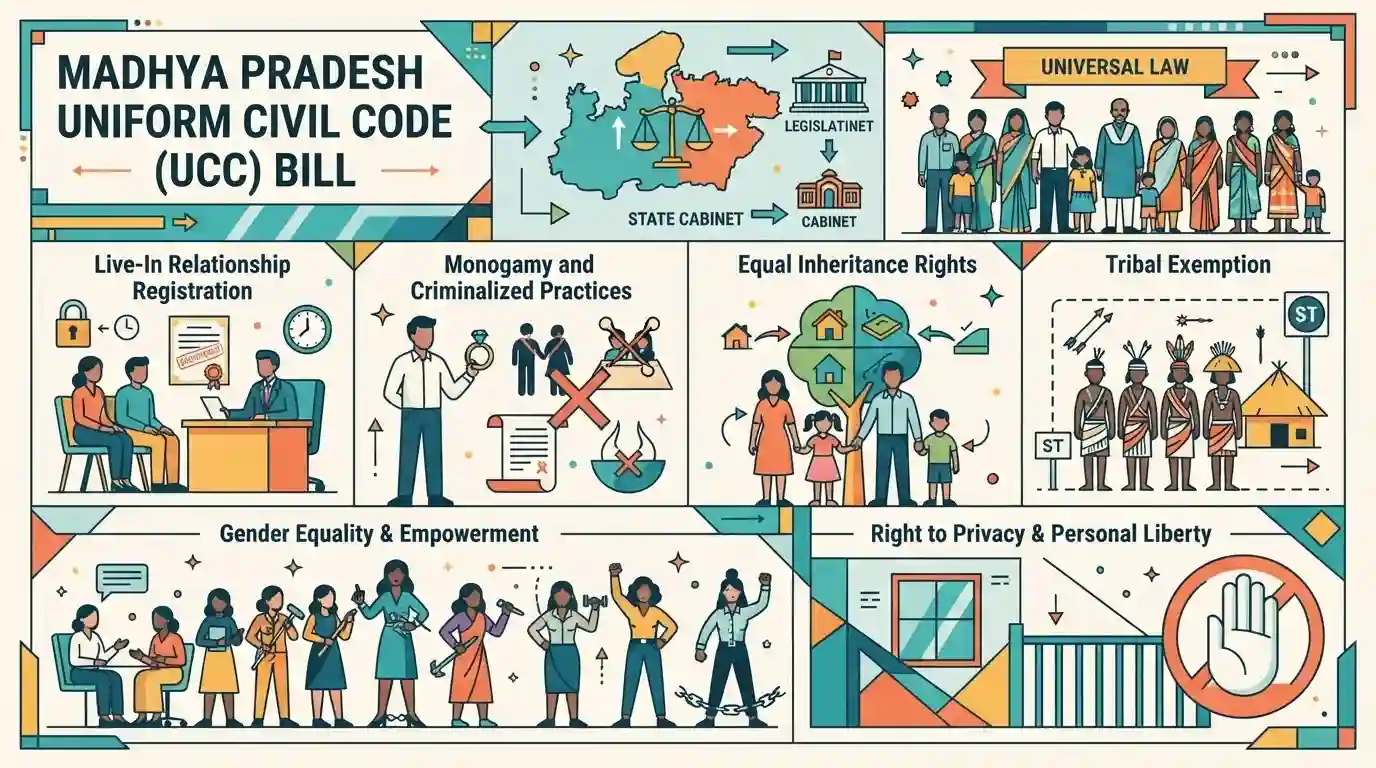
The Madhya Pradesh Cabinet has approved the draft Uniform Civil Code (UCC) Bill, aiming to establish a uniform civil law for all residents in the state. Prepared by a committee headed by retired Supreme Court Judge Justice Ranjana Desai, the bill introduces mandatory registration of live-in relationships (with penal consequences for non-compliance), enforces strict monogamy, criminalizes oral divorce and practices like 'nikah halala', and guarantees equal inheritance rights for sons, daughters, and spouses. To safeguard cultural and customary rights, Scheduled Tribes defined under Articles 342 and 366(25) are exempted from the bill's purview.
Key Points
- The Madhya Pradesh Cabinet approved the draft Uniform Civil Code (UCC) Bill, making it the second BJP-ruled state after Uttarakhand to advance state-level civil code legislation.
- The draft bill mandates the 'declaration of live-in relationship' within one month of cohabitation. Failing to do so can result in up to three months of imprisonment, a fine of Rs 10,000, or both, with notifications sent to parents and local police if a partner is under 21.
- It provides extensive protection for women and children in live-in relationships, allowing deserted female partners to claim maintenance in court and ensuring children born of such unions have full inheritance rights, while banning the term 'illegitimate'.
- The bill enforces monogamy across all communities, sets the legal marriage age at 21 for men and 18 for women, and criminalizes 'nikah halala', oral divorces (triple talaq), and informal panchayat-mandated divorces.
- It ensures absolute gender parity in inheritance, giving sons, daughters (irrespective of marital status), widows, and widowers equal rights to property.
- Scheduled Tribes (such as Bhil, Gond, Korku, Baiga, Sahariya, and Bharia) listed under Articles 342 and 366(25) of the Constitution are exempted from the code to safeguard tribal customary rights.
- The draft was formulated by a high-level committee headed by retired Supreme Court Judge Justice Ranjana Desai.
Important Terms
Uniform Civil Code (UCC)

A proposed common framework of personal laws governing matters like marriage, divorce, inheritance, and adoption for all citizens, irrespective of their religion, to replace diverse religion-based personal laws.
UPSC context
GS Paper II (Indian Constitution & Social Justice); tests knowledge of gender equality, secularism, personal laws, and national integration.
Article 44 of the Constitution of India
A Directive Principle of State Policy (Part IV) stating that the State shall endeavor to secure a Uniform Civil Code for citizens throughout the territory of India.
UPSC context
GS Paper II (Polity & Governance); tests constitutional provisions on DPSPs, fundamental rights vs. directive principles, and judicial interpretations.
Article 342 of the Constitution of India
A constitutional provision empowering the President, after consulting the Governor, to notify specific communities as "Scheduled Tribes" in a state, with modifications allowed only by Parliament.
UPSC context
GS Paper II (Polity & Social Justice); tests affirmative action mechanisms, executive-legislative federal power split, and tribal rights.
Article 366(25) of the Constitution of India
The definitional clause of the Constitution that defines "Scheduled Tribes" as those tribes or tribal communities deemed under Article 342 to be Scheduled Tribes.
UPSC context
GS Paper II (Polity); tests understanding of constitutional glossaries, definition of marginalized groups, and interlinked legal provisions.
Madhya Pradesh Uniform Civil Code (UCC) Bill
State legislation drafted by the Justice Ranjana Desai Committee to mandate monogamy, register live-in relationships, ban oral divorce, and ensure gender-equal inheritance, while exempting Scheduled Tribes.
UPSC context
GS Paper II (Polity); tests state-level implementation of UCC, federal dynamics, and the balance between personal laws and tribal exemptions.
Prelims Trap
State legislatures lack the constitutional competence to enact a Uniform Civil Code because Article 44 explicitly directs the Union to secure it.
Under Entry 5 of the Concurrent List (List III), both Parliament and State Legislatures have power over marriage, divorce, and succession. A state-level UCC is constitutionally valid, provided it receives Presidential assent under Article 254(2).
Static Concepts Connected
What constitutional provisions allow state legislatures to enact laws on marriage and succession?
- Concurrent List Entry 5: Covers marriage, divorce, adoption, wills, and succession, granting legislative competence to both Parliament and State Assemblies.
- Article 254(2) Assent: Enables a state law on a Concurrent subject to prevail over a conflicting Central law within that state, provided it receives the President's assent.
- Article 44 DPSP: Directs the 'State' (which includes state governments under Article 12) to secure a Uniform Civil Code for citizens.
How are Scheduled Tribes defined and notified under the Indian Constitution?
- Article 366(25) Definition: Defines Scheduled Tribes as those tribes or tribal communities deemed under Article 342 to be Scheduled Tribes.
- Article 342(1) Notification: Empowers the President, after consulting the Governor of a State, to notify the initial list of Scheduled Tribes.
- Parliamentary Supremacy: Stipulates that only Parliament can amend the notified list to include or exclude any tribe; state governments cannot alter this list.
Cross-Topic Patterns
UCC surveillance vs. Right to Privacy
Mandatory registration of live-in relationships and police/parental notifications challenge the boundaries of personal autonomy and informational privacy established under the K.S. Puttaswamy judgment (Article 21).
Asymmetric Federalism and Tribal Autonomy
Exempting Scheduled Tribes from UCC highlights the ongoing tension between Article 44 (uniformity) and special constitutional safeguards for tribal customs under Fifth/Sixth Schedules and Article 371.

2026 exams will likely test state competency under Concurrent List Entry 5 to enact UCC vs. Parliament's exclusive power under Article 342.
Linked PYQs · 3
Linked PYQs · 3
- 2015MainsGS2
Discuss the possible factors that inhibit India from enacting for its citizens a uniform civil code as provided for in the Directive Principles of State Policy.
- 2024MainsGS1
Distinguish between gender equality, gender equity and women's empowerment. Why is it important to take gender concerns into account in programme design and implementation?
- 2015PrelimsGS1
The provisions in Fifth Schedule and Sixth Schedule in the Constitution of India are made in order to
