Madhya Pradesh budget focuses on child nutrition and Simhastha funds
Source:Indian Express ↗
Why It Matters
The state budget serves as a practical example of how regional governments allocate resources to address persistent challenges like malnutrition, which is highly relevant for GS2 (Social Justice). Additionally, allocations for the Simhastha Kumbh Mela tie into GS1 (Art and Culture), illustrating the administrative and financial scale required to manage globally recognized intangible cultural heritage events.
Summary
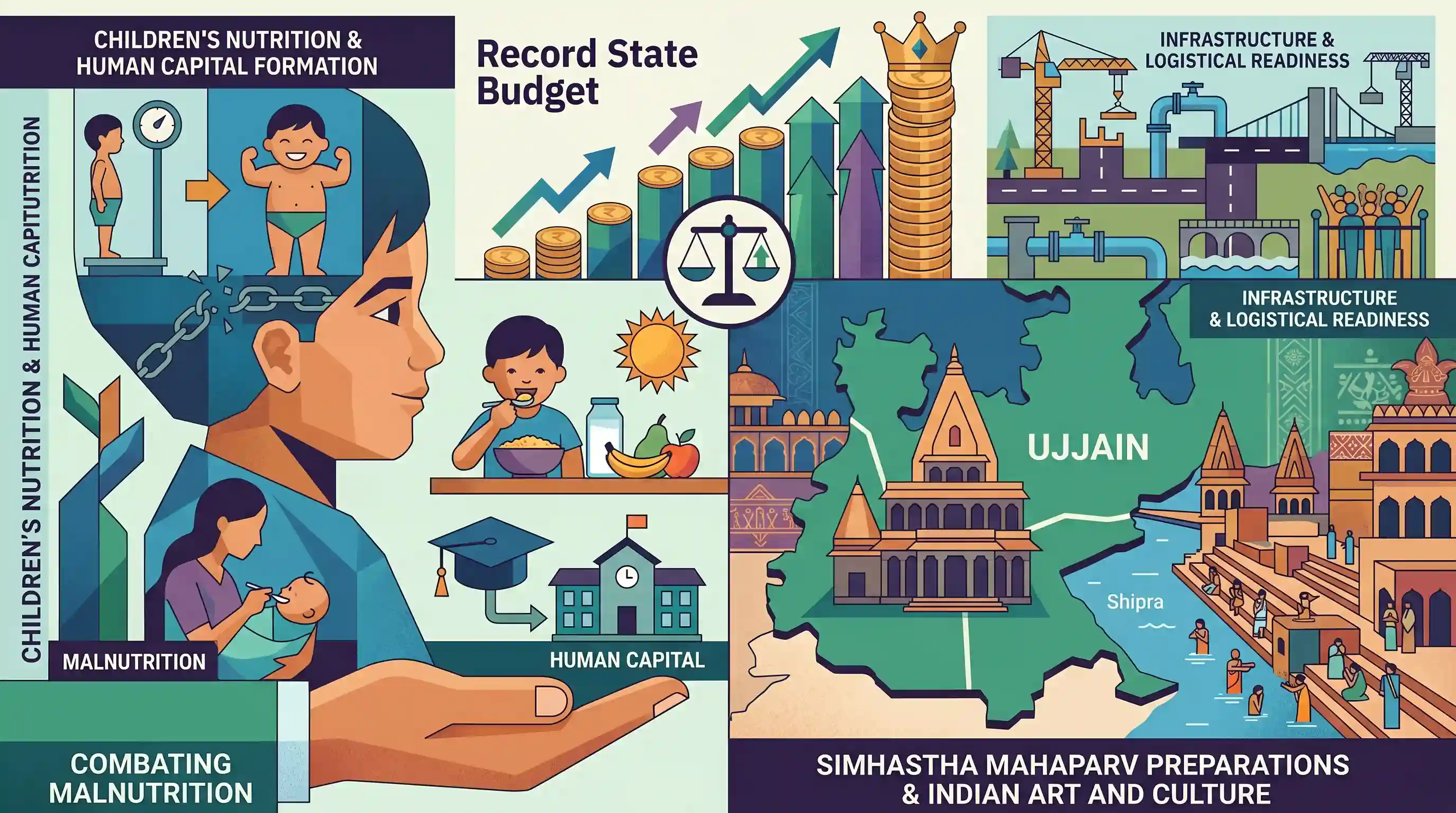
The Madhya Pradesh government has presented a record state budget with a distinct emphasis on enhancing children's nutrition and making extensive preparations for the Simhastha Mahaparv. A significant portion of the fiscal allocation is directed towards combating malnutrition, underscoring a commitment to improving child health and human capital outcomes. Concurrently, the budget sets aside substantial funds for infrastructure and logistical readiness in Ujjain ahead of the Simhastha Kumbh Mela, reflecting the state's prioritization of major cultural and religious congregations.
Key Points
- The Madhya Pradesh state budget features significant allocations aimed at improving children's nutrition and addressing malnutrition in the state.
- Substantial financial provisions have been earmarked for the preparations and infrastructure development for the upcoming Simhastha Mahaparv in Ujjain.
- The budget reflects a dual focus on core human development parameters, specifically health and nutrition, alongside preserving and promoting cultural heritage through mega-events.
- Addressing malnutrition is a crucial step towards human capital formation, aligning with broader national developmental goals.
Important Terms
Simhastha Mahaparv

The Kumbh Mela held in Ujjain, Madhya Pradesh, every 12 years on the banks of the Kshipra river when Jupiter enters Leo (Simha rashi).
UPSC context
GS Paper I (Art and Culture). Relates to major religious festivals, astronomical significance, and cultural heritage of Ujjain.
Kumbh Mela
A massive Hindu pilgrimage held by rotation at four sites, inscribed on the UNESCO Representative List of the Intangible Cultural Heritage of Humanity in 2017.
UPSC context
GS Paper I (Art and Culture). Significant for its status as the world's largest peaceful congregation and intangible heritage recognition.
Human Capital Formation
The process of acquiring and increasing the skills, education, and health of a population, which are critical for economic and political development.
UPSC context
GS Paper III (Economy). Tests understanding of the demographic dividend and the link between social spending and economic growth.
Malnutrition
A condition where nutrient intake is imbalanced, encompassing undernutrition (stunting, wasting, underweight), micronutrient deficiencies, and overnutrition (obesity).
UPSC context
GS Paper II (Social Justice/Health). Vital for issues relating to child health, NFHS data, and social sector interventions.
Fiscal Deficit
The gap between the government's total expenditure and its total receipts (excluding borrowings), representing the total borrowing requirements of the government.
UPSC context
GS Paper III (Economy). Crucial for understanding state financial health, FRBM Act compliance, and fiscal federalism.
Prelims Trap
"Raising the level of nutrition and standard of living of people is a Fundamental Duty of citizens in India."
Raising nutrition levels and improving public health is explicitly a Directive Principle of State Policy (Article 47) directing the State, not a Fundamental Duty.
Static Concepts Connected
Where are the four Kumbh Melas held and on which rivers?
- Prayagraj: Held at the sacred confluence (Sangam) of the Ganga, Yamuna, and the mythical Saraswati rivers.
- Haridwar: Held on the banks of the river Ganga in Uttarakhand.
- Ujjain: Held on the banks of the Shipra river; celebrated as Simhastha when Jupiter enters Leo.
- Nashik: Held on the banks of the Godavari river in Maharashtra.
How is the State Budget defined in the Indian Constitution?
- Article 202: Mandates the Governor to lay the "Annual Financial Statement" of estimated receipts and expenditure before the State Legislature.
- Terminology: The Constitution strictly uses the term "Annual Financial Statement." The word "Budget" does not appear.
- Governor's Recommendation: Like the Union Budget, demands for grants at the state level cannot be made except on the recommendation of the Governor.
Cross-Topic Patterns
Religious Tourism & Capital Expenditure
Mega-events like Simhastha drive heavy infrastructure capital expenditure, highlighting how cultural heritage preservation acts as an economic multiplier for regional tourism and state finances.
Nutrition, DPSP, and Human Capital
Combating child malnutrition fulfills Article 47 (DPSP) mandates while fundamentally breaking intergenerational poverty cycles, a prerequisite for realizing India's demographic dividend.

Multi-statement Prelims questions mapping Kumbh locations to specific rivers, astrological alignments, and UNESCO ICH status are highly likely.
Linked PYQs · 3
Linked PYQs · 3
- 2024MainsGS2
Poverty and malnutrition create a vicious cycle, adversely affecting human capital formation. What steps can be taken to break the cycle ?
- 2021MainsGS2
Can the vicious cycle of gender inequality, poverty and malnutrition be broken through microfinancing of women SHGs? Explain with examples.
- 2024PrelimsGS1
Which one of the following was the latest inclusion in the Intangible Cultural Heritage List of UNESCO?
