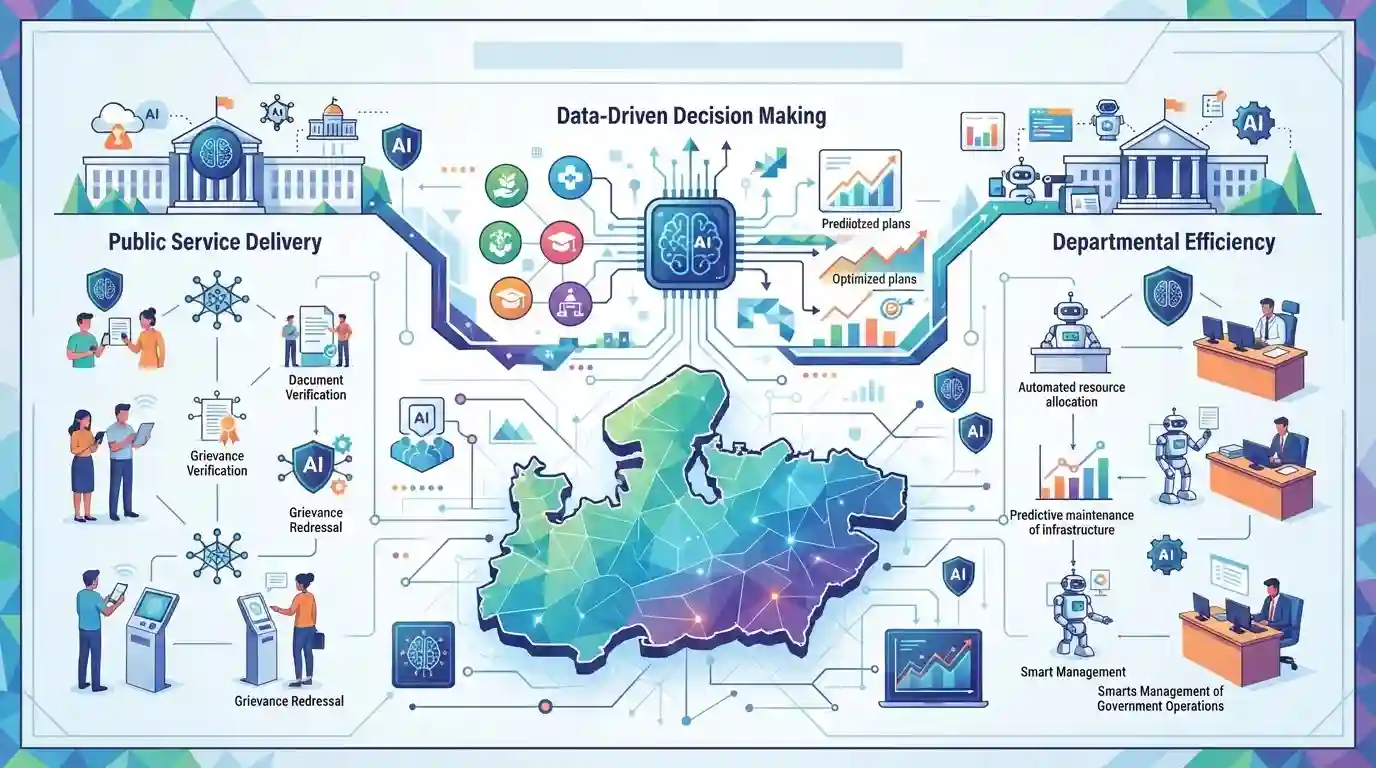
Madhya Pradesh integrates AI to improve public service delivery
Source:Indian Express ↗
Why It Matters
Important for MPPSC aspirants tracking state-level administrative reforms, e-governance implementations, and the integration of emerging technologies like AI into public administration.
Summary
The article discusses Madhya Pradesh's large-scale adoption of Artificial Intelligence (AI) to enhance public service delivery, departmental efficiency, and administrative decision-making, marking a significant step toward tech-driven governance.
Key Points
- Madhya Pradesh is leveraging Artificial Intelligence (AI) to improve public service delivery and decision-making across multiple government departments.
- The initiative focuses on using advanced digital technologies, machine learning, and data analytics to streamline administration and enhance citizen-centric governance.
- Aligns with broader goals of e-governance, digital transformation, and efficient resource allocation within the state.
Important Terms
Madhya Pradesh AI Mission

A phased administrative initiative by the Madhya Pradesh government to integrate Artificial Intelligence across various departments to enhance e-governance, streamline public service delivery, and improve administrative decision-making.
UPSC context
MPPSC Paper III (Science & Tech - AI) and Paper IV (Governance): tests policy interventions, digital transformation, and technology applications in public governance.
Sampada 2.0
An advanced e-governance platform launched by Madhya Pradesh for paperless property registration using GIS mapping, Aadhaar-based e-KYC, video verification, and digital signatures.
UPSC context
MPPSC Paper IV (Public Administration & Governance): tests initiatives in e-governance, transparency, and citizen-centric service delivery mechanisms in Madhya Pradesh.
E-governance
The application of information and communication technologies (ICT) by government bodies to transform relations with citizens, businesses, and other arms of government for efficient service delivery.
UPSC context
MPPSC Paper IV (Public Administration): tests concepts, tools, and models of digital governance, accountability, and administrative reforms.
Prelims Trap
Madhya Pradesh's AI Mission is restricted to urban municipal corporations and police departments from 2026 onwards.
Aspirants might confuse the AI Mission rollout timeline or assume AI deployment is restricted only to urban development rather than core rural sectors like agriculture and health.
Static Concepts Connected
What are the key pillars of the National e-Governance Plan (NeGP) and Digital India initiatives?
- Core Infrastructure: Universal access to mobile connectivity across all rural and urban habitations.
- Service Delivery: Delivery of government services online in real-time through unified portals like UMANG and state e-Seva.
- Digital Databases: Electronic databases and registries ensuring paperless and transparent departmental functioning.
Cross-Topic Patterns
AI Governance + Fiscal Devolution in States
Madhya Pradesh's AI Mission merges digital public infrastructure with the 15th Finance Commission recommendations on state-level administrative reforms and data-driven fiscal devolution.
Multilingual AI + National Digital Public Infrastructure
Integration of voice AI platforms like Gnani.ai links state e-governance with India's National Language Translation Mission (Bhashini).

MPPSC Mains Paper III (E-Governance & ICT) & Paper IV (Ethics/Admin) will test predictive governance models like MP's AI Mission.
Linked PYQs · 3
Linked PYQs · 3
- 2024MPPSC_PRELIMSGS1
UNNATI (Agri-GISl project of Madhya Pradesh Government is for :
- 2022MPPSC_PRELIMSGS1
Which description is appropriate among the following for e-governance?
- 2024MPPSC_PRELIMSGS1
What are the four pillars of E-Governance?
