Madhya Pradesh adopts artificial intelligence in governance
Source:Indian Express ↗
Why It Matters
Crucial for understanding Madhya Pradesh's administrative reforms, state-level technological integration, and e-governance policies relevant to MPPSC State Service Prelims.
Summary
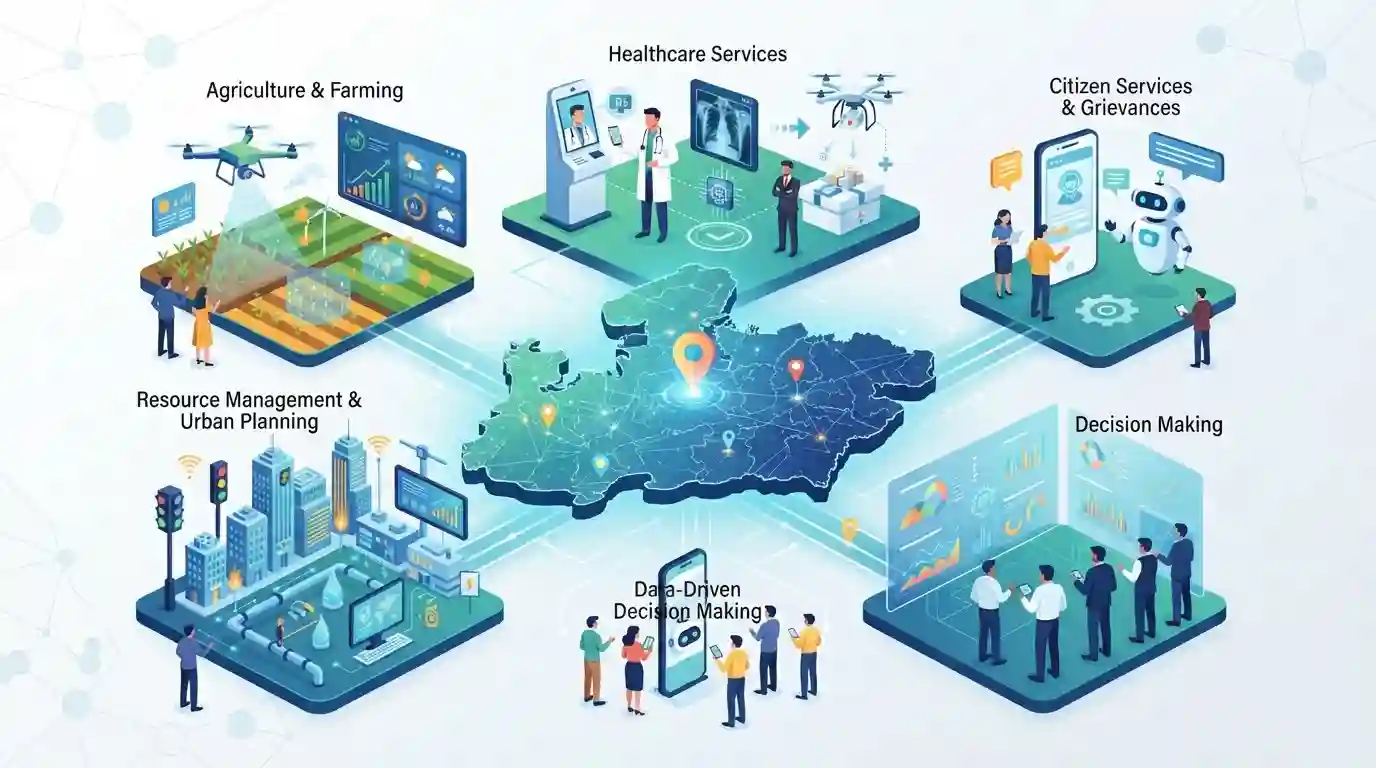
Madhya Pradesh is betting big on Artificial Intelligence (AI) to transform public services, improve governance, and optimize decision-making across government departments, aligning with modern e-governance goals and technological advancement in the state.
Key Points
- Madhya Pradesh is aggressively integrating Artificial Intelligence (AI) across various departments to enhance public service delivery, operational efficiency, and data-driven decision-making.
- The state government aims to leverage emerging digital initiatives, following successful implementations like Agri-GIS (UNNATI), to tackle governance and administrative challenges.
- The focus remains on streamlining citizen-centric schemes, strengthening e-governance pillars (People, Process, Technology, Resources), and leveraging modern technology for transparent administration.
Important Terms
Madhya Pradesh AI Mission

A phased administrative initiative announced by the Madhya Pradesh government to institutionalize Artificial Intelligence across departments, modernize e-governance, and enable predictive governance in sectors like health, agriculture, and disaster management.
UPSC context
Relevant for MPPSC Paper IV (Public Administration & Governance) and Paper III (Information Technology & E-governance), testing knowledge of state-level tech innovations.
Google Cloud India Partnership with MP
A strategic collaboration between the Madhya Pradesh government and Google Cloud India to foster AI-driven governance, establish an AI Center of Excellence in Indore, and manage events like Simhastha 2028.
UPSC context
Important for MPPSC Paper III (Science & Tech) and Paper II (Governance/Public-Private Partnerships), testing understanding of tech collaborations in administration.
Predictive Governance
The use of artificial intelligence and machine learning models by administrative bodies to anticipate risks, forecast demands, and take proactive policy interventions before crises occur.
UPSC context
Core concept for MPPSC Paper IV (Administration and Governance), evaluating modern tools for decision-making and administrative efficiency.
Prelims Trap
UNNATI (Agri-GIS) project
Aspirants often confuse UNNATI with a national-level industrial corridor or central skill scheme, whereas in MP governance it specifically denotes the Agri-GIS geospatial technology project.
Static Concepts Connected
What are the four core pillars of e-governance as adopted in administrative frameworks?
- People Pillar: Focuses on citizen empowerment and capacity building for digital adoption.
- Process Pillar: Refers to re-engineering workflows to eliminate red tape and delays.
- Technology Pillar: Involves secure infrastructure, cloud computing, and AI-driven decision tools.
- Resources Pillar: Ensures adequate financial allocations and skilled manpower for digital infrastructure.
Cross-Topic Patterns
Agri-GIS and E-Governance in MP Agriculture
The integration of Agri-GIS (UNNATI) bridges rural livelihood planning with state-level administrative AI, testing candidates on agricultural geography alongside digital governance.

MP e-governance pillars and specific digital initiatives like UNNATI (Agri-GIS) will feature in MPPSC Prelims Unit 9/10 questions.
Linked PYQs · 3
Linked PYQs · 3
- 2024MPPSC_PRELIMSGS1
UNNATI (Agri-GISl project of Madhya Pradesh Government is for :
- 2024MPPSC_PRELIMSGS1
The branch of Artificial Intelligence is ______
- 2024MPPSC_PRELIMSGS1
What are the four pillars of E-Governance?
