Heavy Rain Alert Issued for Ten Madhya Pradesh Districts
Source:freepressjournal ↗
Why It Matters
Understanding regional variations in rainfall (deficits in eastern vs. western divisions) and monsoon patterns is highly relevant for the MP Geography and Climate sections in the MPPSC Prelims (GS1).
Summary
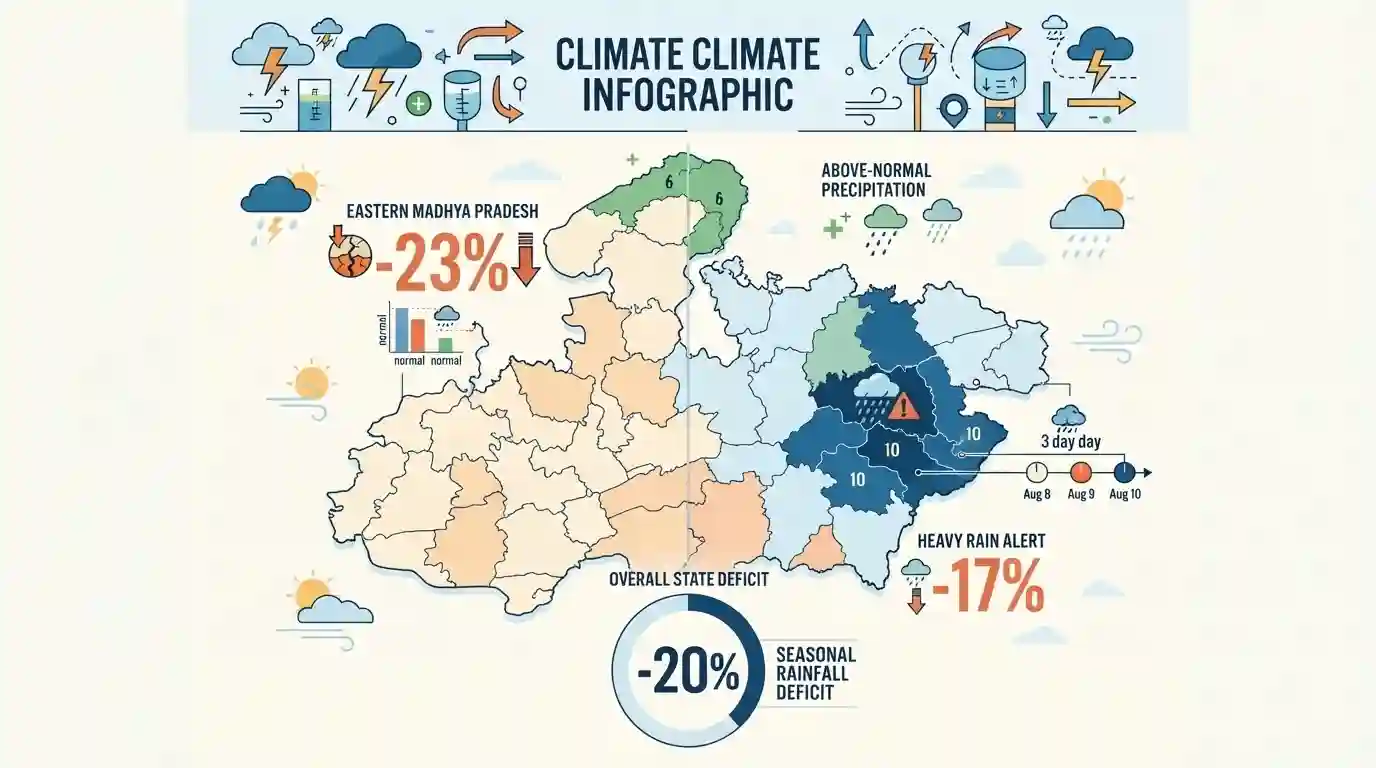
The Indian Meteorological Department has issued a heavy rain alert for 10 districts in Madhya Pradesh over a three-day period starting August 8, 2026. Despite the active monsoon systems bringing widespread showers, the state is currently facing a 20% rainfall deficit for the season. Eastern Madhya Pradesh has experienced a 23% shortfall, while the western regions recorded 17% less rain than normal. Only six districts in the state have reported above-normal precipitation.
Key Points
- A heavy rain alert has been issued for 10 districts in Madhya Pradesh between August 8 and August 10, 2026.
- Despite the predicted heavy rains, Madhya Pradesh has recorded an overall 20% deficit in monsoon rainfall for the season so far (16.8 inches vs. normal 21 inches).
- Eastern Madhya Pradesh (Jabalpur, Shahdol, Rewa, Sagar divisions) recorded a 23% rainfall deficit, while the western part (Bhopal, Indore, Ujjain, Narmadapuram, Gwalior-Chambal) recorded a 17% deficit.
- Only six districts—Gwalior, Bhind, Burhanpur, Dewas, Khandwa, and Khargone—have received more than normal rainfall this monsoon season.
Important Terms
India Meteorological Department (IMD)

India's principal agency under the Ministry of Earth Sciences, established in 1875. It is responsible for meteorological observations, weather forecasting, monsoon tracking, and issuing disaster-related early warnings.
UPSC context
Crucial for GS1 (Geography) and GS3 (Disaster Management), testing knowledge of climate governance, monsoon forecasting, and early warning systems.
Rainfall Deficit
A situation where actual precipitation falls significantly below the Long Period Average (LPA) expected for a specific region and timeframe, risking agricultural stress and water scarcity.
UPSC context
Important for GS1 (Climatology) and GS3 (Agriculture) to analyze drought risks, water security challenges, and kharif crop impacts.
Long Period Average (LPA)
The mean rainfall recorded over a region for a specific timeframe, traditionally calculated over a 50-year span, used by the IMD to classify monsoon rainfall as normal, deficient, or excess.
UPSC context
Relevant to GS1 (Geography). Tests the technical understanding of how Indian monsoons and seasonal precipitation deviations are officially measured.
Spatial Rainfall Distribution
The geographic variation in precipitation across a region due to topography and climatic factors, explaining why some districts face deficits while others concurrently experience heavy rain.
UPSC context
Essential for GS1 (Physical Geography), testing knowledge of regional climate disparities, topographical influences, and their localized agricultural implications.
Prelims Trap
"A Red/Orange heavy rainfall alert indicates the region has surpassed its Long Period Average (LPA) for the season."
Short-term heavy rain alerts are daily/weekly meteorological warnings. They are completely independent of seasonal cumulative rainfall, which can still be deeply deficit (-20% to -59% LPA).
Static Concepts Connected
How does the South-West Monsoon distribute rainfall across Central India?
- Bay of Bengal Branch: Brings maximum rainfall to eastern and south-eastern MP, moving inwards via the monsoon trough.
- Spatial Gradient: Rainfall intensity generally decreases from east to west and from south to north across Central India.
- Arabian Sea Branch: Merges with the BoB branch over central India, primarily influencing western regions via the Narmada-Tapi trough.
What are IMD's criteria for monsoon rainfall classification and early warnings?
- Deficient Rainfall: Classified when cumulative actual rainfall is between -20% and -59% of the Long Period Average (LPA).
- Color-coded Alerts: Uses Green (No warning), Yellow (Be aware), Orange (Be prepared), and Red (Take action) for severe weather events.
Cross-Topic Patterns
Monsoon deficit and Kharif crop yields
Madhya Pradesh is India's 'Soybean Bowl'. A 17-23% rainfall deficit during critical kharif vegetative stages severely impacts soybean yields, feeding directly into edible oil inflation and import dependency.
Climate Change: Dry spells and downpours
Heavy daily rain alerts coexisting with a 20% seasonal deficit exemplify the climate-induced 'short intense spells and long dry periods' pattern heavily impacting Central India's hydrology.

Expect a prelims statement mixing IMD’s color-coded alerts with the definitions of Deficient/Scanty rainfall relative to the LPA.
Linked PYQs · 5
Linked PYQs · 5
- 2025MPPSC_PRELIMSGS1
Read the following statements regarding the climate of Madhya Pradesh and select the correct answer from the codes given below: 1. Most of the rainfall in the state is received from the monsoon. 2. Wind speed during winters is faster than in summer and rainy seasons. 3. Distance from sea also affects the distribution of monsoon rains in the state. 4. Summer temperature in Pachmarhi is related to the altitude above sea level. Codes:
- 2018MPPSC_PRELIMSGS1
The climate of Madhya Pradesh is
- 2024MPPSC_PRELIMSGS1
The south-eastern part of Madhya Pradesh receives maximum rainfall from :
- 2020MPPSC_PRELIMSGS1
In which part of Madhya Pradesh annual variation in temperature is maximum?
- 2022MPPSC_PRELIMSGS1
Which of the following statements regarding the climate of Madhya Pradesh is not correct?
