IMD issues heavy rain orange alert across Madhya Pradesh districts
Source:free-press-journal ↗
Why It Matters
The climate and rainfall distribution of Madhya Pradesh are core components of the MPPSC GS1 Geography syllabus. Understanding the role of low-pressure systems and monsoon troughs in causing heavy rainfall helps candidates analyze precipitation patterns across the state.
Summary
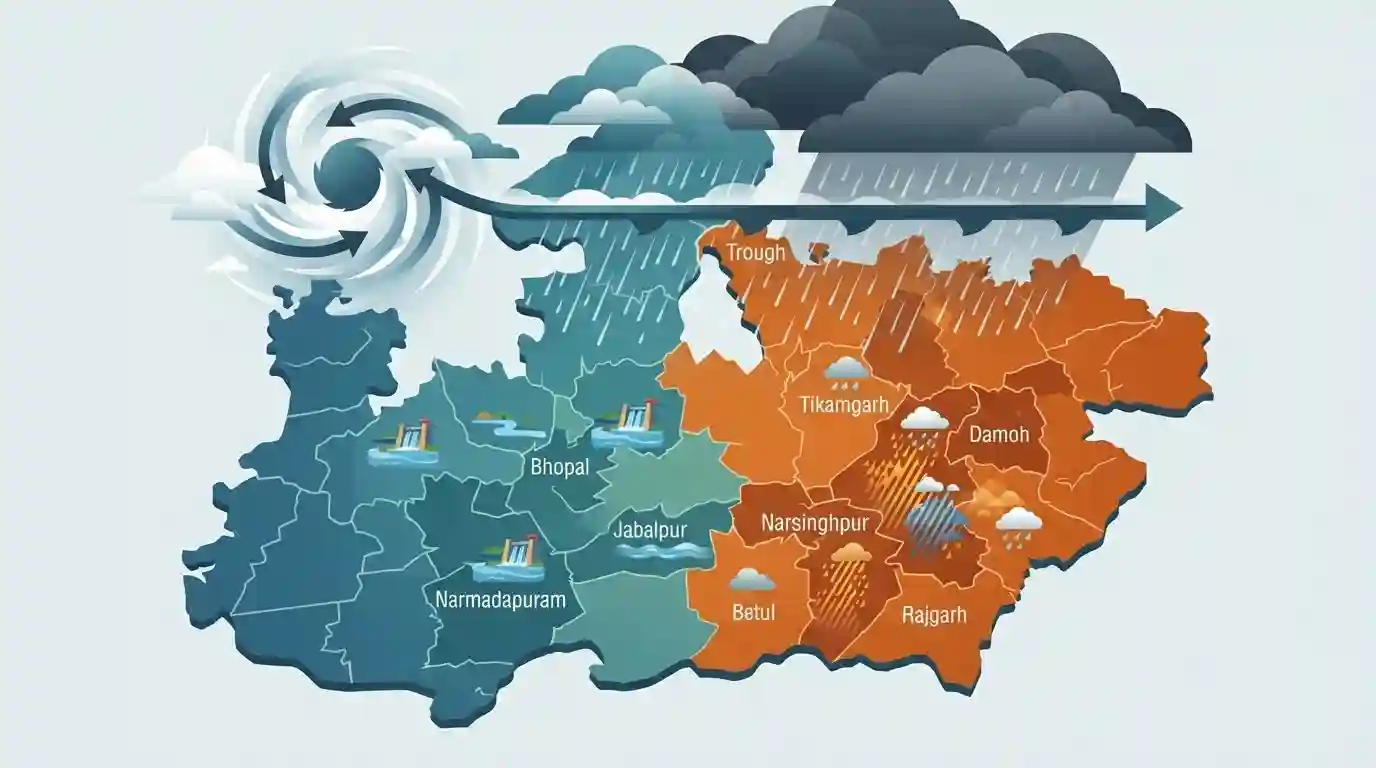
An 'Orange warning' has been issued for heavy rainfall across more than half of Madhya Pradesh by the India Meteorological Department (IMD) for August 25. Districts including Tikamgarh, Damoh, Narsinghpur, Betul, and Rajgarh are expected to receive intense precipitation due to an active low-pressure area and trough system. Key regions like Bhopal, Jabalpur, and Narmadapuram have already recorded significant rainfall, causing rivers and water bodies to swell. The prevailing monsoon conditions highlight the typical heavy rainfall periods in Central India influenced by cyclonic circulations and troughs.
Key Points
- The IMD issued an Orange alert for heavy to very heavy rainfall across multiple districts in Madhya Pradesh, including Tikamgarh, Damoh, and Betul.
- The heavy rainfall is driven by an active low-pressure area and a trough passing over the state.
- Continuous precipitation has elevated water levels in local rivers and reservoirs, notably affecting Bhopal, Narmadapuram, and Jabalpur divisions.
Important Terms
India Meteorological Department (IMD)

The nodal agency under the Ministry of Earth Sciences responsible for meteorological observations, weather forecasting, seismology, and issuing early warnings for extreme weather events in India.
UPSC context
Tested in MPPSC GS Paper 3 (Disaster Management). Important for understanding institutional frameworks and early warning systems for natural hazards.
Orange Warning
A color-coded alert issued by the IMD for expected heavy rainfall (115.6–204.4 mm in 24 hours), signifying authorities and the public must be prepared for potential flooding, waterlogging, and significant disruptions.
UPSC context
Relevant for MPPSC GS Paper 3 (Disaster Management). Tests knowledge of hazard preparedness, impact-based forecasting, and standard operating procedures.
Low-Pressure Area (LPA)
A region where atmospheric pressure is lower than its surroundings. Heating of landmasses creates thermal lows that draw in moisture-laden ocean winds, driving monsoonal circulation and causing widespread cloudiness and heavy precipitation.
UPSC context
Crucial for MPPSC GS Paper 1 (Physical Geography). It explains the fundamental mechanics of the Indian summer monsoon and precipitation distribution.
Monsoon Trough
A semi-permanent, elongated low-pressure system extending across the Indian subcontinent during the summer monsoon. Its periodic southward shift towards Central India triggers vigorous spells of heavy rainfall in Madhya Pradesh.
UPSC context
Tested in MPPSC GS Paper 1 (Geography of India & MP). Essential for explaining spatial rainfall variations and monsoon active/break cycles.
Cyclonic Circulation
A mass of air rotating counter-clockwise in the Northern Hemisphere due to the Coriolis effect. During the monsoon, these lower-tropospheric vortices promote strong upward air motion and moisture convergence, intensifying localized rainfall.
UPSC context
Important for MPPSC GS Paper 1 (Climate). Tests understanding of atmospheric dynamics, weather disturbances, and their influence on local precipitation.
Prelims Trap
"Madhya Pradesh receives its heaviest rainfall in the north-western districts from the Arabian Sea branch."
This is the exact opposite of reality. MP's rainfall gradient actually decreases from the south-east (highest, via Bay of Bengal branch) to the north-west (lowest, Chambal region).
Static Concepts Connected
What is the geographical distribution of monsoon rainfall in Madhya Pradesh?
- South-East Maximum: Districts like Mandla, Balaghat, and Pachmarhi receive the highest rainfall (>150 cm), largely driven by the Bay of Bengal branch of the monsoon.
- North-West Minimum: The Chambal region (Bhind, Morena) receives the lowest annual rainfall (under 75 cm) as the monsoon winds lose their moisture traveling inland.
- Transitional Zone: Central regions (like Bhopal and Jabalpur) experience moderate rainfall (100-125 cm), receiving moisture from both the Arabian Sea and Bay of Bengal branches.
How does the IMD color-coded weather warning system work?
- Yellow Alert: "Be Updated" – Severely bad weather is possible; authorities and the public should stay informed about potential worsening conditions.
- Orange Alert: "Be Prepared" – High potential for significant disruption (e.g., floods, road closures); public must stay ready for adverse conditions.
- Red Alert: "Take Action" – Extremely bad weather expected; severe threat to life and property requires immediate preventive measures or evacuation.
Cross-Topic Patterns
Monsoon Troughs & Kharif Cropping
The spatial position of the monsoon trough directly dictates the success of major Kharif crops, particularly soybean in the Malwa plateau and paddy in the Mahakoshal region.
Satpura Topography & Narmada Catchment
Heavy rains in Betul, Narmadapuram, and Chhindwara rapidly swell the Narmada and Tapti river basins due to the steep runoff gradients and hard-rock topography of the Satpura range.

Expect a statement-based question linking MP's SE-to-NW rainfall gradient with specific climatic zones (e.g., Mahakoshal vs Chambal).
Linked PYQs · 4
Linked PYQs · 4
- 2018MPPSC_PRELIMSGS1
The climate of Madhya Pradesh is
- 2025MPPSC_PRELIMSGS1
Read the following statements regarding the climate of Madhya Pradesh and select the correct answer from the codes given below: 1. Most of the rainfall in the state is received from the monsoon. 2. Wind speed during winters is faster than in summer and rainy seasons. 3. Distance from sea also affects the distribution of monsoon rains in the state. 4. Summer temperature in Pachmarhi is related to the altitude above sea level. Codes:
- 2024MPPSC_PRELIMSGS1
The south-eastern part of Madhya Pradesh receives maximum rainfall from :
- 2023MPPSC_PRELIMSGS1
Which of the following statements is not correct regarding the climate of Madhya Pradesh?
