Madhya Pradesh Monsoon Rainfall Records Deficit Across Divisions
Source:freepressjournal ↗
Why It Matters
This current affairs update serves as a real-world case study of the spatial distribution of the Southwest Monsoon in Madhya Pradesh. It highlights geographical disparities (e.g., Eastern vs. Western MP, Malwa-Nimar plateau rainfall) that are frequently tested in MPPSC Prelims Geography sections.
Summary
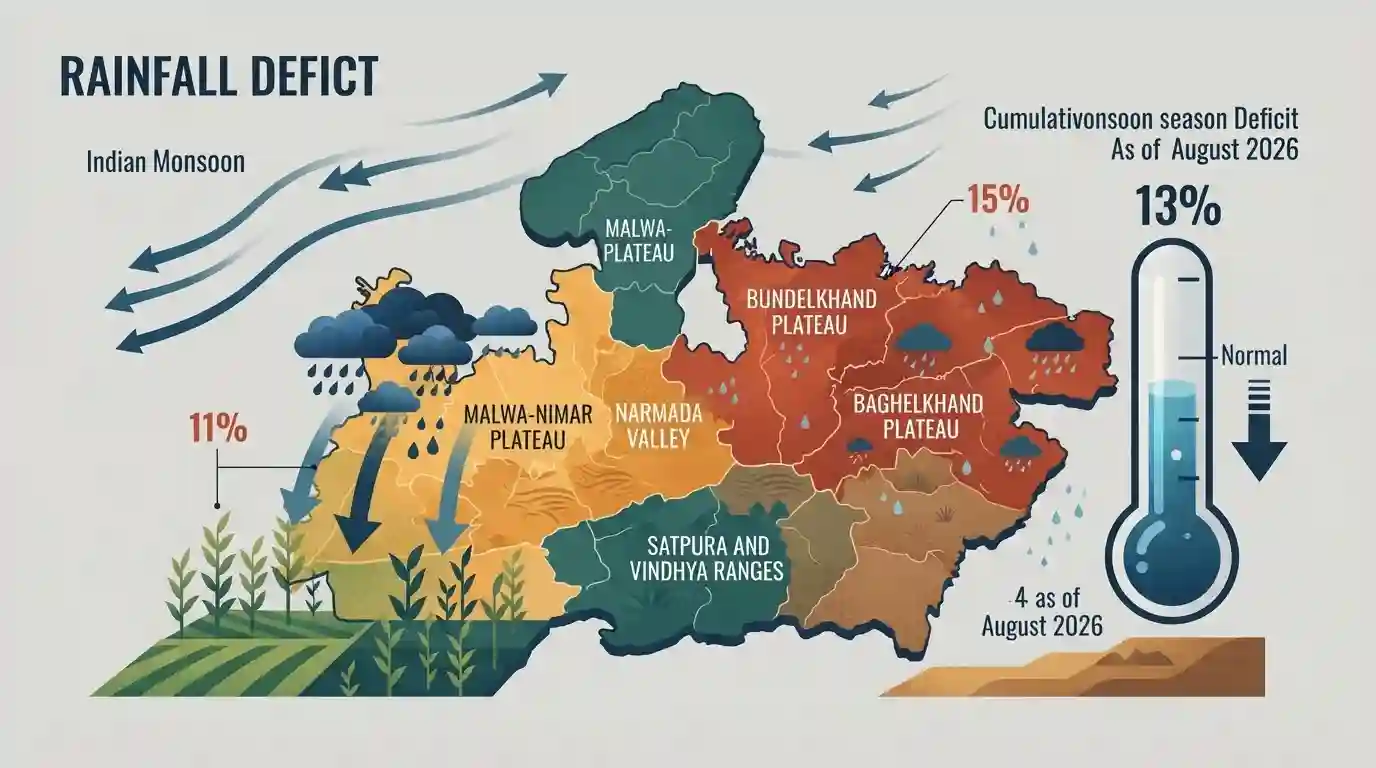
Despite substantial showers in July, Madhya Pradesh is currently experiencing a 13% rainfall deficit for the monsoon season as of August 2026. The India Meteorological Department (IMD) reports that eastern regions are facing a steeper deficit (15%) compared to western areas (11%). Recent heavy rains have primarily benefited the Malwa-Nimar plateau, yet the state continues to lag behind normal seasonal precipitation averages.
Key Points
- Madhya Pradesh's overall monsoon rainfall is 13% below normal as of August 1, 2026, recording 390.3 mm against a normal of 448.4 mm.
- Spatial variation shows Eastern MP experiencing a 15% deficit, while Western MP has an 11% deficit.
- Recent heavy rainfall has been geographically concentrated in the western Malwa-Nimar regions, particularly in the Indore and Ujjain divisions.
- The IMD forecasts scattered showers of 30-35 mm for several districts, but widespread extremely heavy rainfall is unlikely over the next four days.
Important Terms
India Meteorological Department (IMD)

India's principal agency for meteorological observations and weather forecasting, under the Ministry of Earth Sciences. It provides crucial warnings for events like extreme rainfall, cyclones, and heatwaves.
UPSC context
Important for GS Paper 1 (Geography) and GS Paper 3 (Disaster Management) concerning climate services and extreme weather alerts.
Malwa-Nimar plateau
A volcanic plateau region in western Madhya Pradesh characterized by fertile black soils derived from Deccan Traps basalt. It is economically vital for agriculture, supporting major cash crops.
UPSC context
Relevant to GS Paper 1 (Indian Physiography) and State PCS exams for questions on regional physical and agricultural geography.
Monsoon Rainfall Deficit
Occurs when seasonal precipitation falls below 90% of the normal average. IMD categorizes sub-divisional deficits as 'deficient' (20-59% below normal) or 'large deficient' (60-99%).
UPSC context
Tested in GS Paper 1 (Indian Climate/Monsoon) and GS 3 (Economy) regarding the impacts of erratic rainfall on kharif sowing.
Long Period Average (LPA)
The average rainfall recorded over a 50-year period (currently 1971–2020), used by IMD as a statistical benchmark to determine whether seasonal monsoon precipitation is normal, excess, or deficient.
UPSC context
Crucial for GS Paper 1 (Indian Climate) and GS 3 (Agriculture) to understand quantitative monsoon predictions and climate variability.
Prelims Trap
A 13% rainfall deficit officially classifies the monsoon performance in Madhya Pradesh as "Deficient".
IMD categorizes seasonal rainfall deviations between -19% and +19% of the Long Period Average (LPA) as "Normal". Therefore, a 13% deficit is still statistically considered normal, not deficient.
Static Concepts Connected
How does topography dictate spatial rainfall distribution in Central India?
- East-West Gradient: Eastern regions (e.g., Balaghat, Mandla) receive higher average rainfall (100-150 cm), largely capturing moisture directly from the Bay of Bengal branch.
- Moisture Depletion: Western regions like Malwa-Nimar receive lower rainfall (50-75 cm) as the monsoon winds lose moisture travelling inland across the peninsula.
How does the IMD classify seasonal rainfall deviations based on LPA?
- Normal: Recorded when rainfall departure is between -19% and +19% of the Long Period Average.
- Deficient: Recorded when the rainfall departure drops to between -20% and -59% of the LPA.
- Large Deficit: Recorded when the deviation is between -60% and -99% of the LPA.
Cross-Topic Patterns
Malwa-Nimar rains & Kharif sowing
The heavy rains in the Malwa-Nimar (Deccan trap/black soil) region directly influence the sowing success and yield of major kharif commercial crops like cotton and soybean.
Physiography linked to folk traditions
MP's diverse physiography defines distinct cultural belts, often tested as match-the-following pairs, such as 'Maach' in the western Malwa plateau versus 'Mansukha' in the eastern Baghelkhand region.

Questions comparing spatial monsoon variations (Arabian Sea vs Bay of Bengal branch impacts) with local soil types are highly probable.
Linked PYQs · 5
Linked PYQs · 5
- 2018MPPSC_PRELIMSGS1
The climate of Madhya Pradesh is
- 2025MPPSC_PRELIMSGS1
Read the following statements regarding the climate of Madhya Pradesh and select the correct answer from the codes given below: 1. Most of the rainfall in the state is received from the monsoon. 2. Wind speed during winters is faster than in summer and rainy seasons. 3. Distance from sea also affects the distribution of monsoon rains in the state. 4. Summer temperature in Pachmarhi is related to the altitude above sea level. Codes:
- 2024MPPSC_PRELIMSGS1
The south-eastern part of Madhya Pradesh receives maximum rainfall from :
- 2023MPPSC_PRELIMSGS1
Which of the following statements is not correct regarding the climate of Madhya Pradesh?
- 2021MPPSC_PRELIMSGS1
Consider the following statements. 1. Cotton textile mills have been established in Malwa Plateau of Madhya Pradesh. 2. Malwa Plateau is covered with black soil. Select the correct answer from the codes given below:
