Madhav Gadgil Contributions to Ecological Conservation and Biospheres
Source:The Hindu ↗
Why It Matters
Madhav Gadgil's work forms the bedrock of modern Indian ecological policy, particularly regarding the Western Ghats. Questions on the Gadgil Committee vs. Kasturirangan Committee, as well as Biosphere Reserves (especially the Nilgiris) are recurring themes in UPSC Prelims and Mains (GS3).
Summary
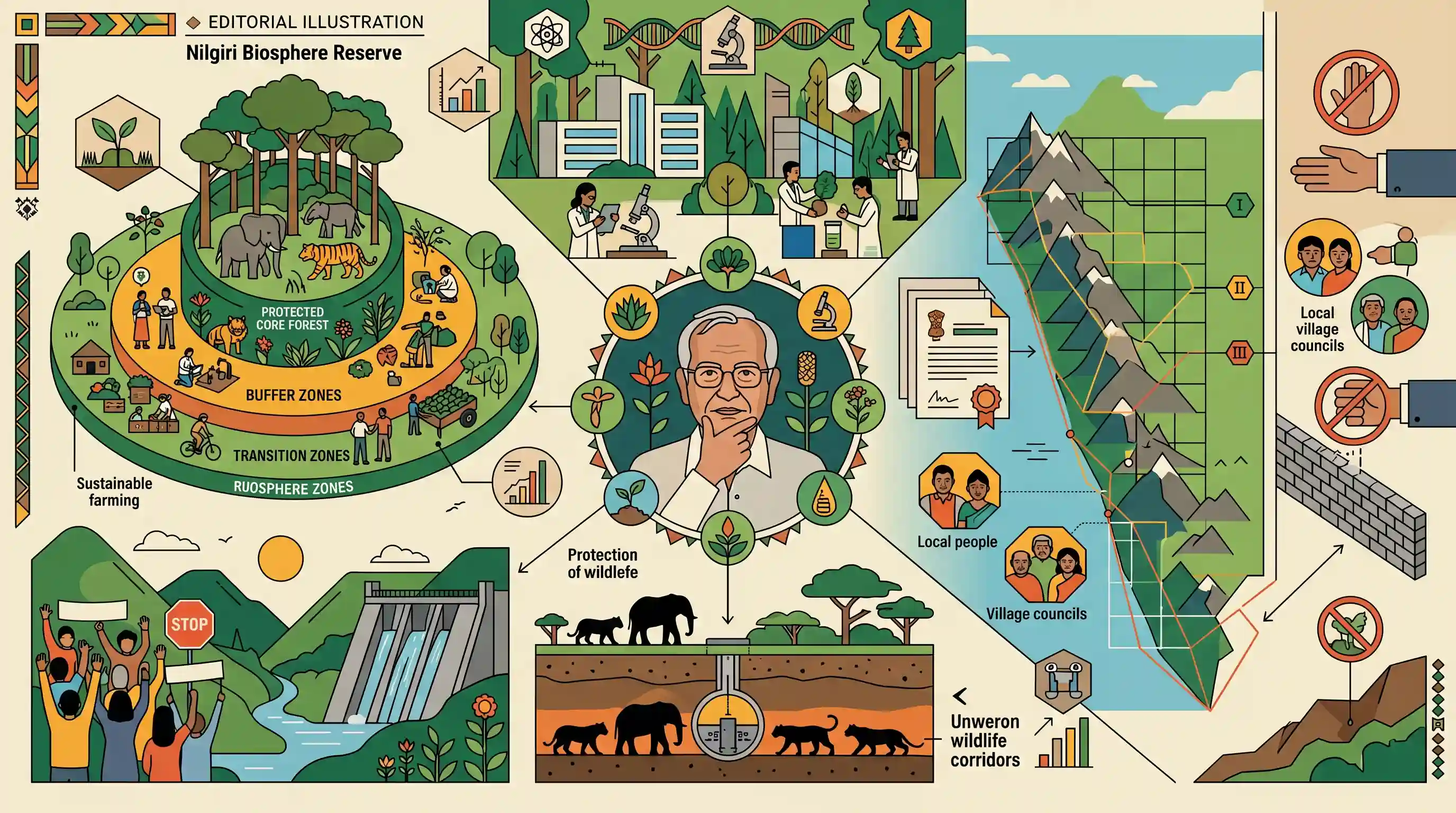
The article commemorates the legacy of eminent ecologist Madhav Gadgil, highlighting his foundational contributions to India's environmental conservation. He was instrumental in establishing the Nilgiri Biosphere Reserve and the Centre for Ecological Sciences at IISc. Gadgil is perhaps best known for authoring the 2011 Western Ghats Ecology Expert Panel (WGEEP) report, which advocated for strict ecological protections and decentralized environmental governance across the Western Ghats, though it faced political rejection. A dedicated conservationist, he actively supported the Save Silent Valley Movement and opposed ecologically damaging projects like the Singara Neutrino Observatory to protect wildlife corridors.
Key Points
- Ecologist Madhav Gadgil authored the concept document for the Nilgiri Biosphere Reserve (NBR), which became India's first Biosphere Reserve under the UNESCO Man and Biosphere (MAB) program.
- He founded the Centre for Ecological Sciences at the Indian Institute of Science (IISc), Bangalore, significantly advancing ecological research in India.
- Gadgil chaired the Western Ghats Ecology Expert Panel (WGEEP) in 2010, which recommended designating the entire Western Ghats as an Ecologically Sensitive Area and emphasized community-centric conservation. The report was ultimately rejected by the government.
- He was a vocal activist, participating in the Save Silent Valley Movement and successfully opposing projects like the Neutrino Observatory in the Mudumalai Tiger Reserve to protect the Segur elephant corridor.
Important Terms
Western Ghats Ecology Expert Panel (WGEEP)

An expert panel (2010) chaired by Madhav Gadgil to assess Western Ghats' ecology. It recommended designating the entire range as ecologically sensitive and advocated for decentralized, bottom-up environmental governance.
UPSC context
GS Paper III (Environment). Essential for questions on conservation vs. development, environmental policy, and Western Ghats protection.
Nilgiri Biosphere Reserve
Established in 1986 as India's first biosphere reserve, it spans Tamil Nadu, Kerala, and Karnataka. It is a UNESCO-recognized biodiversity hotspot and vital wildlife corridor.
UPSC context
GS Paper III (Biodiversity). Frequently tested in Prelims for its location, endemic species (Nilgiri Tahr), and tribal populations.
Man and the Biosphere (MAB) Programme
A UNESCO intergovernmental program (1971) that provides a scientific basis for improving relationships between people and their environment through a global network of biosphere reserves.
UPSC context
GS Paper III (Conservation). Framework for international cooperation in sustainable development and biodiversity conservation.
Ecologically Sensitive Areas (ESAs)
Fragile regions notified under the Environment (Protection) Act, 1986, to act as 'shock absorbers' around protected areas by regulating high-impact human activities like mining.
UPSC context
GS Paper III (EIA/Legislation). Critical for understanding environmental law implementation and land-use conflicts in biodiversity hotspots.
Centre for Ecological Sciences (CES)
A premier research unit at the Indian Institute of Science (IISc), founded by Madhav Gadgil in 1983. It serves as India's first Centre of Excellence for environment.
UPSC context
GS Paper III (Environment). Highlights the role of scientific institutions in shaping India's ecological database and conservation policies.
Gadgil Committee Report
The informal name for the WGEEP report (2011). It is often contrasted with the later Kasturirangan Committee report for its more stringent environmental protections.
UPSC context
GS Paper III (Environment). A landmark report for comparative study of environmental policy recommendations in India.
Prelims Trap
"The Gadgil Committee recommendations form the current legal basis for Ecologically Sensitive Areas in the Western Ghats."
The Gadgil report was politically rejected for being too restrictive. The government later relied on the Kasturirangan committee's watered-down recommendations, limiting ESAs to just ~37% of the region.
Static Concepts Connected
What distinguishes the Gadgil Committee from the Kasturirangan Committee?
- ESA Coverage: Gadgil recommended classifying the entire Western Ghats as an Ecologically Sensitive Area; Kasturirangan reduced this to roughly 37% by separating cultural and natural landscapes.
- Governance approach: Gadgil emphasized Gram Sabha consent and bottom-up environmental governance. Kasturirangan relied more heavily on bureaucratic frameworks and remote-sensing satellite data.
- Development limits: Gadgil proposed a complete ban on mining and large dams across the Ghats, while Kasturirangan allowed regulated development in non-ESA zones.
What constitutes the Nilgiri Biosphere Reserve (NBR) landscape?
- Inter-state spread: Established in 1986 as India's first biosphere reserve under the UNESCO MAB programme, spanning the tri-junction of Tamil Nadu, Kerala, and Karnataka.
- Key Protected Areas: Includes Bandipur, Nagarhole, Mudumalai, and Mukurthi national parks, as well as the Silent Valley and Wayanad wildlife sanctuaries.
- Tribal habitation: Home to uniquely adapted indigenous and pastoral groups, including the Todas, Kotas, Irullas, and Kurumbas.
Cross-Topic Patterns
Mega-Science vs. Eco-Corridors
The Indian Neutrino Observatory (Science/Tech) originally faced EIA hurdles due to its proximity to the Segur elephant corridor, illustrating the recurring UPSC theme of tension between mega-infrastructure and biodiversity.
Decentralized Eco-Governance & FRA
Gadgil’s insistence on community-led conservation directly mirrors the statutory principles of the Forest Rights Act (FRA, 2006) and PESA, integrating tribal polity with environmental governance.

Expect a multi-statement Q mapping NBR protected areas to states, alongside statements contrasting Gadgil and Kasturirangan ESA criteria.
Linked PYQs · 3
Linked PYQs · 3
- 2016PrelimsGS1
'Gadgil Committee Report' and 'Kasturirangan Committee Report', sometimes seen in the news, are related to
- 2019PrelimsGS1
Which of the following are in Agasthyamala Biosphere Reserve?
- 2024MainsGS3
What role do environmental NGOs and activists play in influencing Environmental Impact Assessment (EIA) outcomes for major projects in India? Cite four examples with all important details.
