Emmanuel Macron Urges Democratic Allies to Shape Global AI Rules
Source:The Hindu ↗
Why It Matters
The article highlights the intersection of emerging technologies (AI, DPI) and governance. It provides significant examples for GS3 (Digitalization, India Stack's success) and GS2 (cyber governance protecting children, and strategic tech-diplomacy between India and France).
Summary
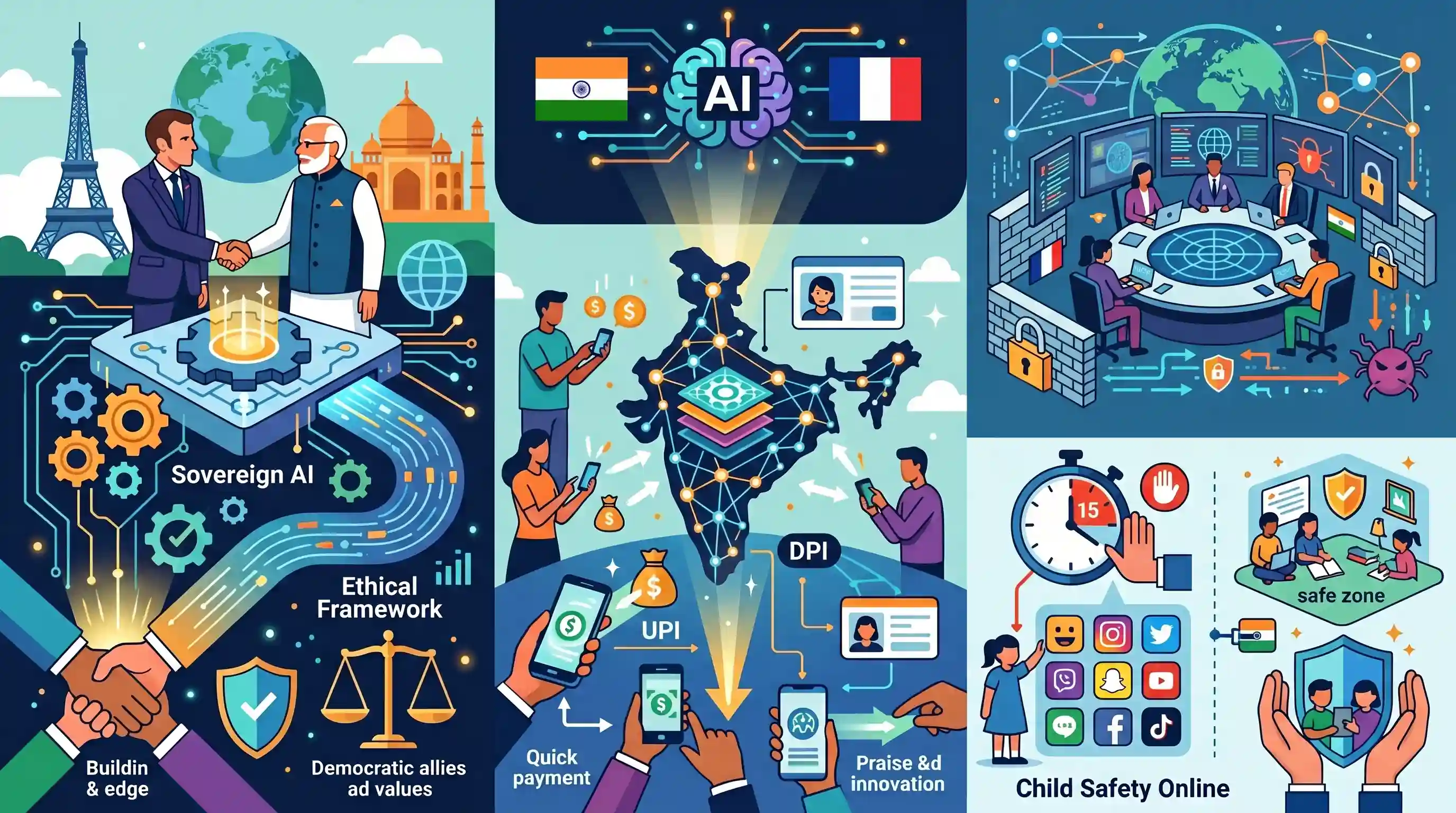
At the AI Impact Summit in New Delhi, French President Emmanuel Macron highlighted the strategic partnership between France and India in shaping the future of global technology. He proposed the development of 'sovereign AI' and ethical frameworks built by democratic allies to ensure digital progress aligns with human values. Macron strongly praised the India Stack and UPI as revolutionary achievements. Additionally, he emphasized the critical need for child safety online, urging India to join European efforts to ban social media usage for minors under the age of 15.
Key Points
- French President Emmanuel Macron advocated for the joint development of 'sovereign AI' with India, aiming for an AI ecosystem that balances technological innovation with ethical responsibility and global shared values.
- Macron announced France's intention to ban social media networks for children under 15, urging India to join a coalition of European nations (including Greece and Spain) to protect minors in the digital space.
- He heavily praised India's digital public infrastructure (India Stack, UPI, and digital health IDs), emphasizing that the creation of digital identities for 1.4 billion people is a 'civilisation story'.
- To remain competitive and shape global rules, France is investing in its tech sector by doubling the training of AI scientists and engineers.
Important Terms
Digital Public Infrastructure (DPI)

Shared, open, and interoperable digital platforms—such as identity, payments, and data exchange—that enable the delivery of essential public and private services at a societal scale.
UPSC context
GS Paper 3 (Technology/Infrastructure) and GS Paper 2 (Governance); critical for digital inclusion and "India Stack" discussions.
India Stack
A unified set of open APIs and digital public infrastructure including Aadhaar (Identity), UPI (Payments), DigiLocker (Paperless), and Account Aggregator (Consent) for scale-based service delivery.
UPSC context
GS Paper 3 (Economy/IT); tests understanding of India's indigenous digital ecosystem and financial inclusion achievements.
Sovereign AI
A nation's capacity to develop, deploy, and govern AI technologies using its own infrastructure, data, and talent, ensuring strategic autonomy from foreign technology giants.
UPSC context
GS Paper 3 (Science and Technology) and GS Paper 2 (Strategic Autonomy); explores technological self-reliance and data governance.
Unified Payments Interface (UPI)
A real-time, mobile-first payment system developed by NPCI that facilitates instant inter-bank peer-to-peer and person-to-merchant transactions through a single interface.
UPSC context
GS Paper 3 (Banking/Digital Economy); fundamental for questions on financial technology (FinTech) and cashless economy.
IndiaAI Mission
A ₹10,300-crore government initiative aimed at building indigenous AI capabilities, including supercomputing infrastructure (GPUs), foundational models, and a robust innovation ecosystem for startups.
UPSC context
GS Paper 3 (Science and Tech/Policy); concerns government efforts toward technological leadership and indigenous AI development.
Digital Majority (Child Online Safety)
Regulatory frameworks (e.g., France's age-15 threshold) that impose minimum age requirements for social media access to protect minors from online risks and mental health issues.
UPSC context
GS Paper 2 (Social Justice/Governance); relevant for discussions on child rights, online regulation, and data privacy.
AI Impact Summit
A high-level global gathering focused on the responsible development, ethical governance, and sovereign deployment of AI across democratic nations.
UPSC context
GS Paper 2 (International Relations); tests knowledge of global tech diplomacy and India's role in setting technology standards.
Prelims Trap
Under the DPDP Act 2023, social media platforms are strictly banned for minors under 18 years of age.
The DPDP Act does not ban social media usage for minors. Instead, it mandates that platforms obtain "verifiable parental consent" before processing their data.
Static Concepts Connected
What are the four foundational layers of the India Stack (DPI)?
- Presenceless Layer: Anchored by Aadhaar, it provides a universal, biometric-backed digital identity for citizens.
- Paperless Layer: Utilizes platforms like DigiLocker to securely store, retrieve, and verify digital records and certificates.
- Cashless Layer: Facilitates fast, interoperable digital payments primarily through the Unified Payments Interface (UPI).
- Consent Layer: Employs Account Aggregators to enable secure, user-consented sharing of personal financial and health data.
What are the defining pillars of 'Sovereign AI'?
- Domestic Compute: Developing indigenous computational hardware, such as national supercomputing grids, to train heavy models locally.
- Sovereign Datasets: Training algorithms on local, culturally and linguistically diverse data (e.g., Bhashini) rather than Western-dominated datasets.
- Strategic Autonomy: Ensuring that a nation's critical AI algorithms and governance frameworks remain free from foreign corporate dependencies.
Cross-Topic Patterns
India Stack as Soft Power
Exporting DPI to the Global South and linking UPI with France demonstrates how India's domestic tech stack has become a crucial pillar of its modern economic diplomacy.
Global age-gating and DPDP Act
France's proposed ban for under-15s mirrors global regulatory shifts towards algorithmic child safety, directly connecting to India's DPDP Act 2023 requirement of verifiable parental consent for users under 18.

Expect a multi-statement question combining India Stack's four layers with the strategic components of Sovereign AI in Prelims 2026.
Linked PYQs · 3
Linked PYQs · 3
- 2023MainsGS3
Introduce the concept of Artificial Intelligence (AI). How does Al help clinical diagnosis? Do you perceive any threat to privacy of the individual in the use of Al in healthcare?
- 2023MainsGS3
What is the status of digitalization in the Indian economy? Examine the problems faced in this regard and suggest improvements.
- 2025MainsGS2
The National Commission for Protection of Child Rights has to address the challenges faced by children in the digital era. Examine the existing policies and suggest measures the Commission can initiate to tackle the issue.
