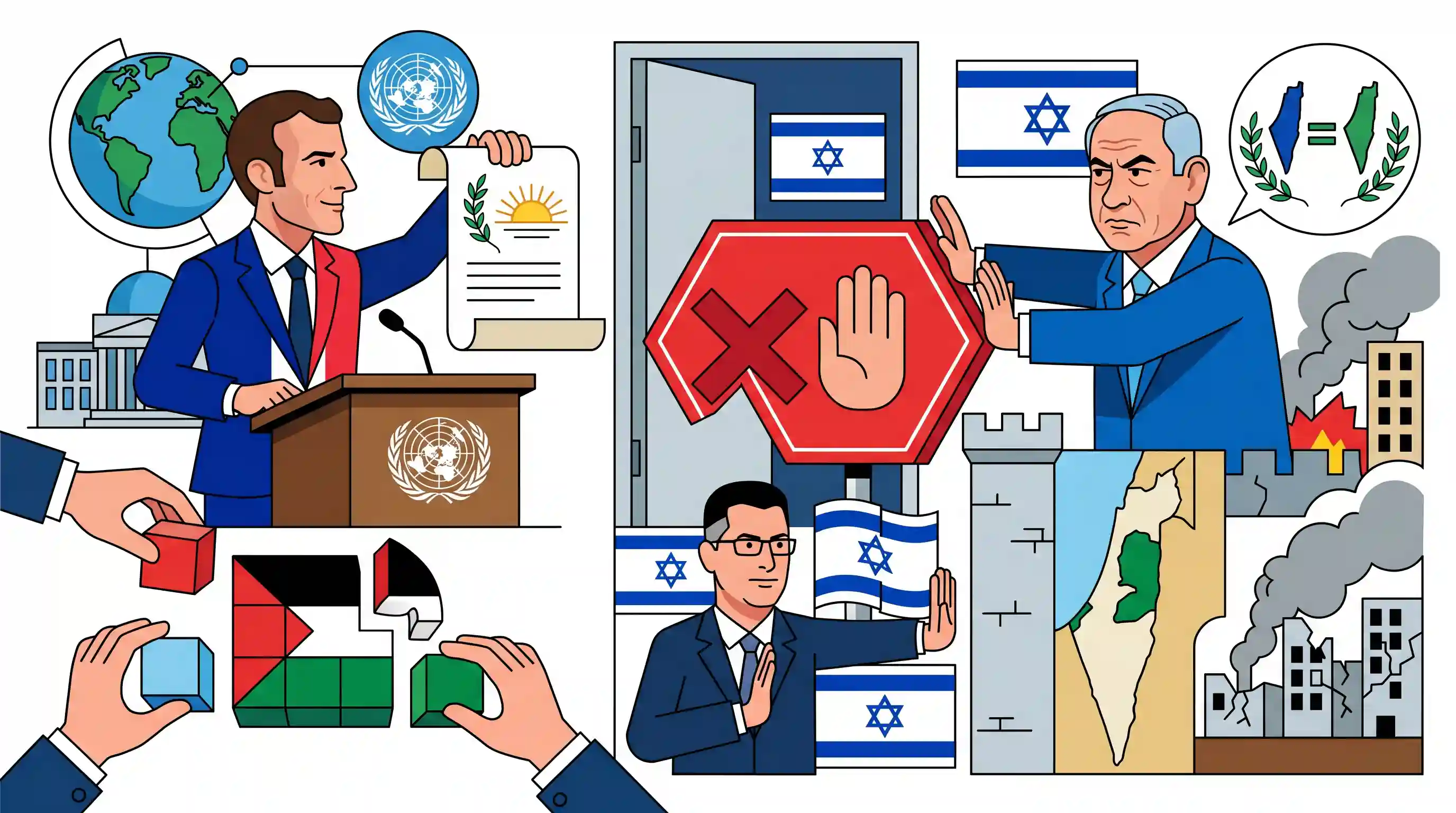
Israel Bars French President Over Palestinian State Recognition
Source:Indian Express ↗
Why It Matters
The Israel-Palestine conflict and the international push for a 'two-state solution' are recurring themes in UPSC, especially in GS2 International Relations. Understanding the diplomatic fallout between a major Western power (France) and Israel highlights the shifting geopolitical dynamics and global stances on Palestinian statehood amidst ongoing conflict.
Summary
Israeli Foreign Minister Gideon Sa'ar declared that French President Emmanuel Macron is not welcome in Israel until France withdraws its plan to formally recognize a Palestinian state. The diplomatic friction arises from Macron's announcement that France will recognize Palestinian statehood during the upcoming UN General Assembly, a move strongly opposed and condemned by Israeli Prime Minister Benjamin Netanyahu. France maintains that military action in Gaza cannot block the path to a two-state solution.
Key Points
- Israeli Foreign Minister Gideon Sa'ar stated that French President Emmanuel Macron is barred from visiting Israel unless France drops its plan to recognize a Palestinian state.
- Macron recently announced that France would formally recognize Palestinian statehood at the upcoming UN General Assembly.
- Israeli PM Benjamin Netanyahu strongly condemned the French President's stance, even accusing him of fomenting antisemitism.
- France maintains that Israel's ongoing offensive in Gaza and territorial annexation efforts cannot derail the momentum toward a two-state solution.
Important Terms
Two-state solution

A proposed diplomatic framework for the Israeli-Palestinian conflict envisioning two independent states—Israel and Palestine—coexisting side-by-side with mutually recognized borders.
UPSC context
GS II (International Relations); central to understanding West Asia geopolitics and India's historical 'de-hyphenated' stance on the conflict.
UN General Assembly (UNGA)
The primary deliberative, policymaking, and representative organ of the United Nations, where all 193 member states have equal voting rights.
UPSC context
GS II (International Organizations); tests knowledge of UN structure and the symbolic power of multi-lateral declarations.
Palestinian Statehood
The formal recognition of Palestine as a sovereign, independent entity by other nations and international bodies, a process involving legal and political self-determination.
UPSC context
GS II (International Relations); relevant to India's voting pattern in the UN and bilateral ties with Israel and Palestine.
Persona Non Grata
A diplomatic term for a foreign person whose entering or remaining in a particular country is prohibited by that country's government.
UPSC context
UPSC Prelims (International Law); tests understanding of the Vienna Convention on Diplomatic Relations and state sovereignty.
Bilateral Relations
The conduct of political, economic, or cultural relations between two sovereign states, often involving direct negotiations outside of multilateral forums.
UPSC context
GS II (IR); fundamental concept for analyzing India's engagement with individual major powers like France and Israel.
Prelims Trap
Palestine can become a full UN Member State solely through a two-thirds majority vote in the UN General Assembly.
False. Full UN membership strictly requires a prior affirmative recommendation from the UN Security Council (subject to P5 vetoes) before the UNGA vote.
Static Concepts Connected
How is a new Member State admitted to the United Nations?
- UNSC Recommendation: Requires an affirmative vote of at least 9 out of 15 members, with no vetoes from the Permanent Five (P5).
- UNGA Vote: Following the UNSC recommendation, admission requires a two-thirds majority vote in the General Assembly.
- Observer Status: Entities like Palestine and the Holy See hold "non-member observer state" status, which is granted by the UNGA alone without UNSC approval.
What is India's "De-hyphenation" policy regarding the Middle East?
- Independent Ties: Treating diplomatic relations with Israel and Palestine as independent and mutually exclusive, rather than linking or balancing them against one another.
- Historical Stance: India officially supports a negotiated Two-State Solution and recognized the State of Palestine in 1988, being the first non-Arab country to do so.
- Strategic Autonomy: Allows India to deepen defense, tech, and agricultural ties with Israel without diluting its historical support for the Palestinian cause.
Cross-Topic Patterns
Fragmented EU foreign policy
While France, Spain, and Ireland push for Palestinian recognition, others strongly back Israel, exposing the EU's structural inability to project a unified geopolitical stance on the Middle East.
Abraham Accords vs. Arab Peace Initiative
The push for UN recognition attempts to revive the traditional Arab Peace Initiative framework (statehood first), contrasting with Israel's recent Abraham Accords strategy (normalization bypassing Palestinian statehood).

UN membership rules (UNSC veto vs UNGA majority) and observer state privileges are highly likely to appear as a multi-statement question.
Linked PYQs · 3
Linked PYQs · 3
- 2018PrelimsGS1
The term "two-state solution" is sometimes mentioned in the news in the context of the affairs of
- 2023PrelimsGS1
Consider the following statements: Statement-I: Israel has established diplomatic relations with some Arab States. Statement-II: The 'Arab Peace Initiative' mediated by Saudi Arabia was signed by Israel and Arab League. Which one of the following is correct in respect of the above statements?
- 2018MainsGS2
“India’s relations with Israel have, of late, acquired a depth and diversity, which cannot be rolled back.” Discuss.
