Macron Urges Europe and UK to Derisk Ties With US and China
Source:The Hindu ↗
Why It Matters
This article highlights the shifting geopolitical landscape where Europe seeks 'strategic autonomy' and 'de-risking' amid the US-China rivalry. It is relevant for UPSC aspirants to understand the evolving transatlantic dynamics, the challenges to multilateral trade institutions like the WTO, and how these global shifts affect international security architectures such as NATO.
Summary
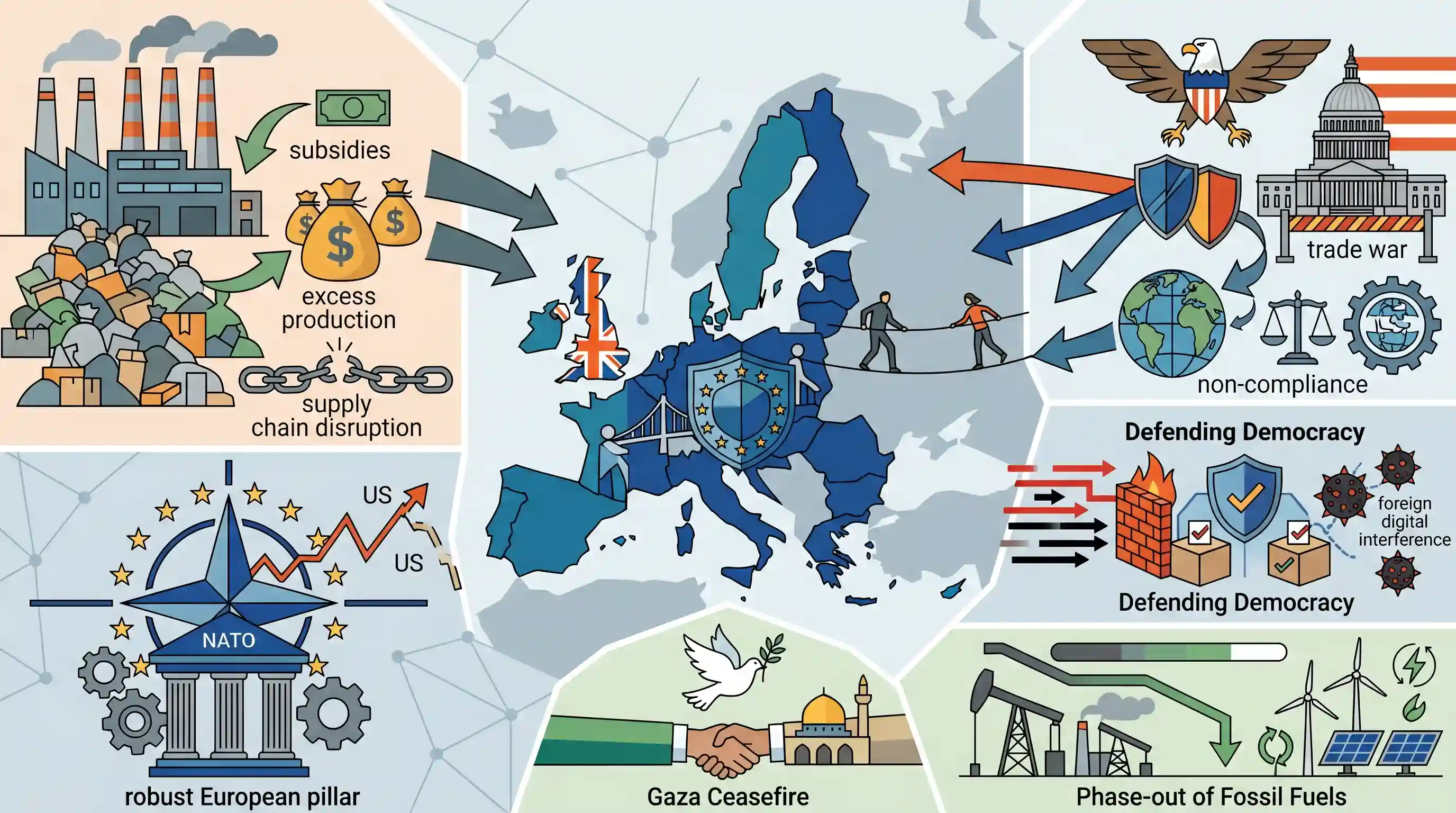
During a state visit to the UK, French President Emmanuel Macron delivered a speech to the British Parliament advocating for Europe and the UK to 'de-risk' their relations with both the US and China. He emphasized the necessity of European strategic autonomy, warning against excessive dependencies that could leave the region vulnerable. Macron pointed to China's capacity to disrupt global supply chains through subsidies and excess production, while also criticizing US trade war strategies for explicitly non-complying with the WTO framework. He also called for the establishment of a robust European pillar within NATO in light of potential shifts in US transatlantic policy. Beyond economic and security autonomy, Macron touched upon defending democracies from foreign digital interference, achieving an unconditional ceasefire in Gaza, and phasing out fossil fuels.
Key Points
- French President Emmanuel Macron urged the UK and Europe to adopt a 'de-risking' strategy to reduce excessive dependency on the US and China.
- He highlighted concerns over China's potential to distort global supply chains through excess capacity and subsidies.
- Macron criticized US trade wars as explicit decisions to bypass the World Trade Organization (WTO).
- He advocated for a stronger 'European pillar' within NATO to manage transatlantic relationship shifts, especially regarding Donald Trump's return to the White House.
- Other areas of focus included defending democracies against foreign technological interference, addressing the Gaza conflict with a two-state solution, and phasing out fossil fuels.
Important Terms
Strategic Autonomy

The ability of a state or entity (like the EU) to conduct independent foreign policy and defend its interests without excessive dependence on other powers.
UPSC context
GS Paper II (International Relations); tests understanding of shifting global power dynamics and India's similar 'Multi-alignment' policy.
De-risking
A strategic approach to diversify supply chains and reduce economic dependencies on specific nations to mitigate vulnerabilities, without completely severing trade ties (decoupling).
UPSC context
GS Paper II & III (IR/Economy); relevant for questions on global supply chain resilience and 'China Plus One' strategies.
WTO (World Trade Organization)
The global intergovernmental organization that regulates international trade and resolves disputes between member nations based on a rules-based framework.
UPSC context
GS Paper II & III; crucial for topics on multilateralism, trade wars, and the crisis in international institutional governance.
European Pillar of NATO
A concept advocating for European members to take greater responsibility for their own defense and capability development within the North Atlantic Treaty Organization framework.
UPSC context
GS Paper II (International Relations); tests knowledge of regional security architectures and burden-sharing debates within traditional military alliances.
Transatlantic Relations
The historic and evolving security, economic, and diplomatic partnership between the United States and European nations, primarily managed through NATO and EU-US dialogues.
UPSC context
GS Paper II (Effect of policies of developed countries); tests understanding of how US-Europe shifts impact global stability and India’s interests.
Prelims Trap
De-risking implies the complete severance of bilateral economic and trade ties to protect national supply chains.
Complete severance is "decoupling." "De-risking" simply means minimizing critical vulnerabilities and diversifying supply chains while maintaining broader economic ties.
Static Concepts Connected
How does the WTO Dispute Settlement Mechanism function?
- Panel Stage: Ad-hoc panels evaluate trade disputes between member nations if initial consultations fail.
- Appellate Body: A standing 7-member committee that hears appeals. Paralyzed since 2019 due to the US consistently blocking new judicial appointments.
- Reverse Consensus: Decisions are adopted automatically unless all WTO member countries explicitly vote against them.
What are the 3 key trade remedial measures under WTO?
- Anti-dumping Duty: Levied when foreign goods are exported at prices below their normal fair market value.
- Countervailing Duty: Imposed to neutralize the market-distorting impact of direct state subsidies provided to foreign exporters.
- Safeguard Measures: Temporary import restrictions used to protect domestic industries from sudden, unforeseen import surges.
Cross-Topic Patterns
Strategic Autonomy: India vs Europe
Europe seeks military and economic independence from the US, whereas India’s strategic autonomy is historically rooted in non-alignment and maintaining multi-vector global partnerships without formal alliances.
Friend-shoring & Supply Chains
Macron's "de-risking" rhetoric echoes the Quad's Supply Chain Resilience Initiative (SCRI) and US "friend-shoring" policies aimed at bypassing China's dominance in critical tech and green energy transitions.

Expect Prelims to test differences between 'de-risking', 'decoupling', & 'friend-shoring', alongside the WTO Appellate Body paralysis.
Linked PYQs · 3
Linked PYQs · 3
- 2023MainsGS2
‘The expansion and strengthening of NATO and a stronger US-Europe strategic partnership works well for India.’ What is your opinion about this statement ? Give reasons and examples to support your answer.
- 2025MainsGS2
"With the waning of globalization, post-Cold War world is becoming a site of sovereign nationalism.” Elucidate.
- 2014MainsGS2
WTO is an important international institution where decisions taken affect countries in a profound manner. What is the mandate of WTO and how binding are their decisions ? Critically analyse India's stand on the latest round of talks on Food security.
