West Asia Crisis Impacts Indian Industrial Output and Core Sectors
Source:The Hindu ↗
Why It Matters
The article connects geopolitical events (West Asia crisis) directly to domestic macroeconomic indicators (Index of Eight Core Industries, inflation, manufacturing PMI). This is highly relevant for GS3 questions on how external shocks impact India's energy security, industrial growth, and overall economic stability.
Summary
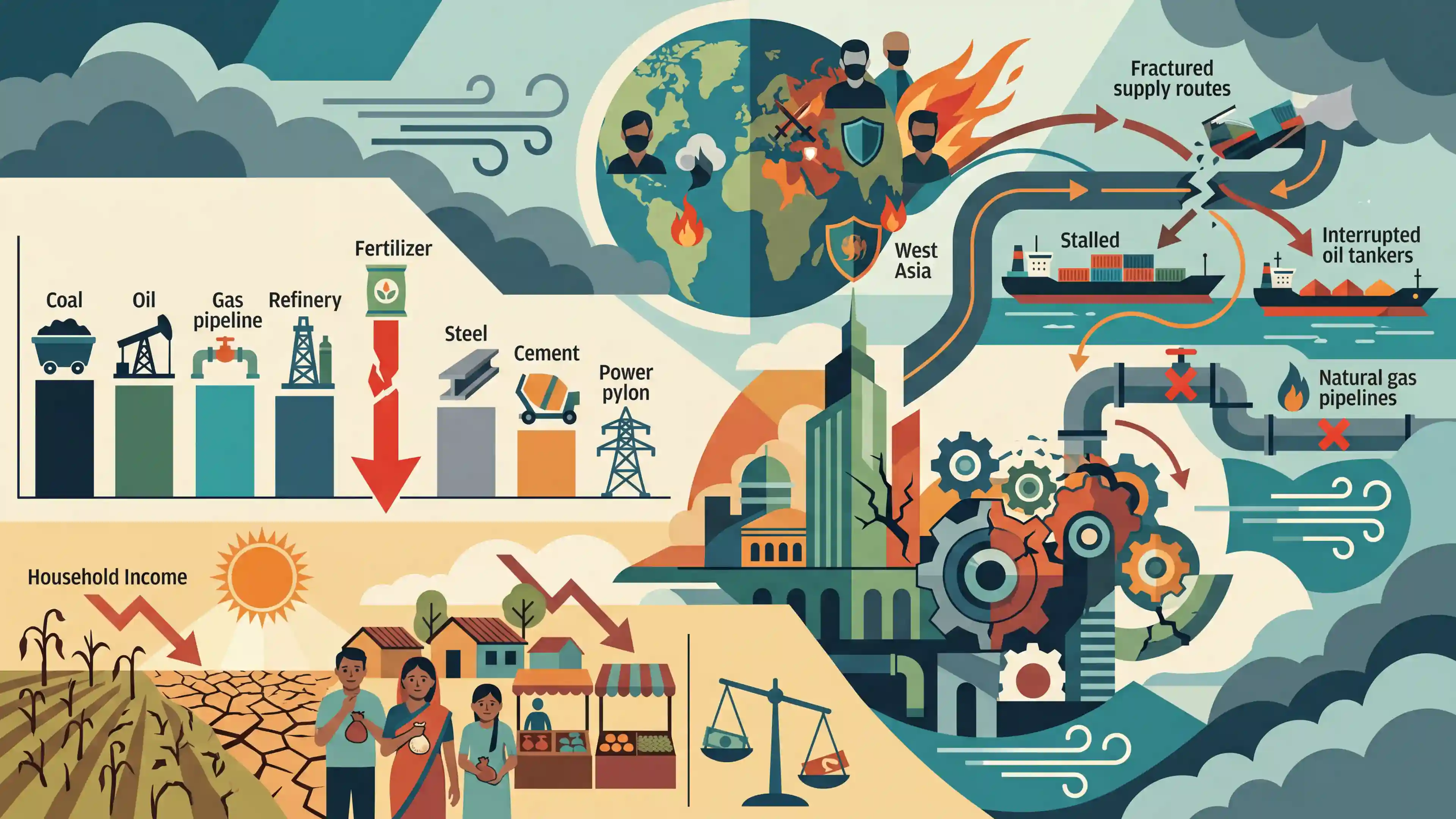
The article examines the recent indicators of a slowdown in the Indian economy, triggered by both domestic constraints and external geopolitical shocks in West Asia. Highlighting a contraction in the Index of Eight Core Industries—particularly a sharp 24.6% drop in fertilizer output due to natural gas import constraints—the piece underscores India's vulnerability to global supply chain disruptions. Tensions between Israel and Iran pose risks to energy security, threatening to inflate crude oil prices. Combined with the lingering effects of El Nino on rural demand and stagnant household incomes, India's macroeconomic stability faces significant headwinds, making it a hostage to global dynamics.
Key Points
- India's Index of Eight Core Industries contracted by 0.4% in March, the first such decline in 19 months.
- The steepest slump was recorded in fertilizer production (down 24.6%), severely impacted by supply constraints in imported natural gas.
- Slowdowns in the steel and cement sectors point to a plateau or pause in construction and infrastructure activities.
- Geopolitical tensions in West Asia (Israel-Iran conflict) threaten to spike crude oil prices, potentially importing inflation and reversing previous gains from discounted Russian oil.
- Domestic factors such as stagnant household incomes, potential El Nino impacts on the monsoon, and a drop in manufacturing PMI compound the macroeconomic challenges.
Important Terms
Index of Eight Core Industries (ICI)

An index measuring production across eight key sectors: Coal, Crude Oil, Natural Gas, Refinery Products, Fertilizers, Steel, Cement, and Electricity. It represents ~40.27% of the Index of Industrial Production (IIP).
UPSC context
GS Paper 3: Industrial Growth. It is a lead indicator used to track factory output and overall industrial health.
Energy Security
The reliable availability of energy sources at an affordable price. For India, this is vulnerable to West Asian tensions due to high dependency on oil (~85%) and gas (~50%) imports.
UPSC context
GS Paper 3: Infrastructure (Energy). Tests understanding of strategic petroleum reserves and import diversification.
El Niño
A climate pattern involving abnormal warming of surface waters in the eastern Pacific Ocean. In India, it is often associated with below-normal monsoons, agricultural distress, and high food inflation.
UPSC context
GS Paper 1 & 3: Geography and Agriculture. Vital for understanding links between climate cycles and rural economic demand.
Macroeconomic Stability
A condition where an economy experiences low inflation, sustainable fiscal and current account deficits, and steady growth. It is threatened by external shocks like energy price spikes.
UPSC context
GS Paper 3: Indian Economy. Central to discussions on fiscal policy, monetary policy, and resilience against global volatility.
Feedstock
The raw materials required for an industrial process. In the Indian fertilizer industry, natural gas is the primary feedstock for urea; its shortage directly impacts domestic agricultural inputs.
UPSC context
GS Paper 3: Industry & Agriculture. Critical for understanding supply chain links between the energy sector and food security.
Current Account Deficit (CAD)
A measure of a country's trade where the value of imported goods and services exceeds the value of exports. Higher oil prices significantly widen India's CAD.
UPSC context
GS Paper 3: External Sector. Tests understanding of balance of payments and rupee stability.
S&P Global
A major global credit rating agency that provides sovereign credit ratings and economic forecasts, influencing international investor confidence and India's borrowing costs.
UPSC context
GS Paper 3: Investment Models & Economic Development. Relevant for sovereign ratings and capital flow analysis.
Prelims Trap
"Fertilizers carry the highest weight in the Index of Eight Core Industries due to India's agrarian economy."
Refinery products actually hold the highest weight (28.04%), while fertilizers have the lowest weight (2.63%), despite their critical mass for Indian agriculture.
Static Concepts Connected
What constitutes the Index of Eight Core Industries (ICI) and its weightage?
- Core Composition: Comprises Coal, Crude Oil, Natural Gas, Refinery Products, Fertilizers, Steel, Cement, and Electricity.
- Weightage Structure: Refinery products hold the maximum weight (~28%), followed by Electricity and Steel. Fertilizers carry the lowest weight (~2.6%).
- IIP Relevance: These eight foundational industries collectively account for 40.27% of the total weight of items included in the Index of Industrial Production (IIP).
How does natural gas function as a feedstock in fertilizer production?
- Ammonia Synthesis: Natural gas (methane) is steam reformed to produce hydrogen, which combines with atmospheric nitrogen via the Haber process to create ammonia.
- Urea Production: Ammonia reacts with carbon dioxide (a byproduct of the methane reforming process) to manufacture urea, the most widely used fertilizer in India.
- Import Dependency: India relies on imported Liquefied Natural Gas (LNG) for a large portion of its natural gas needs, making urea output vulnerable to global shocks.
Cross-Topic Patterns
Energy security vs. Macroeconomic stability
Disruptions in West Asia (Israel-Iran) inflate crude and LNG prices, directly transmitting into India as cost-push "imported inflation," widening the Current Account Deficit and depreciating the Rupee.
Climate anomalies hitting industrial output
El Nino-induced monsoon deficits depress rural farm incomes, stalling rural aggregate demand for FMCG and housing, which indirectly triggers contractions in core manufacturing sectors.

Expect a multi-statement prelims question linking Core Industries weightage, fertilizer feedstock dependency, and natural gas imports.
Linked PYQs · 4
Linked PYQs · 4
- 2015PrelimsGS1
In the 'Index of Eight Core Industries', which one of the following is given the highest weight?
- 2012PrelimsGS1
In India, in the overall Index of Industrial Production, the Indices of Eight Core Industries have a combined weight of 37.90%. Which of the following are among those Eight Core Industries? 1. Cement 2. Fertilizers 3. Natural gas 4. Refinery products 5. Textiles Select the correct answer using the codes given below:
- 2020PrelimsGS1
With reference to chemical fertilizers in India, consider the following statements : 1. At present, the retail price of chemical fertilizers is market-driven and not administered by the Government. 2. Ammonia, which is an input of urea, is produced from natural gas. 3. Sulphur, which is a raw material for phosphoric acid fertilizer, is a by-product of oil refineries. Which of the statements given above is/are correct?
- 2018MainsGS3
How would the recent phenomena of protectionism and currency manipulations in world trade affect macroeconomic stability of India?
