Geopolitical Shocks and Industrial Slowdown in Indian Economy
Source:The Hindu ↗
Why It Matters
It perfectly illustrates the interconnectedness of domestic economic indicators (IIP, inflation) with international geopolitical events (West Asia war) and environmental factors (El Nino). This multi-dimensional crisis is a quintessential UPSC GS3 case study on macroeconomic management.
Summary
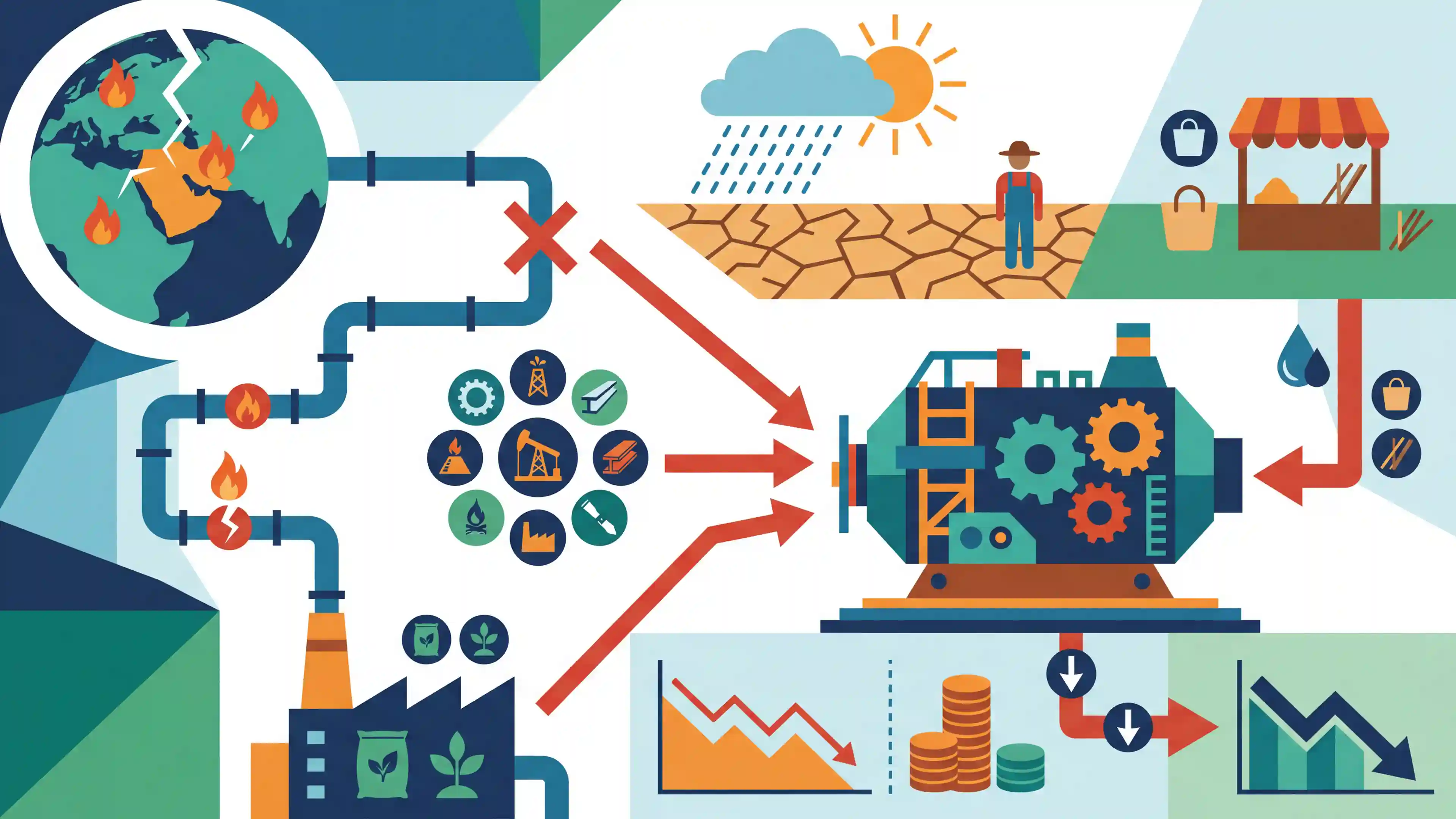
The article analyzes the multifaceted economic slowdown in India, exacerbated by geopolitical tensions in West Asia and domestic vulnerabilities. Key indicators such as the Index of Eight Core Industries and the manufacturing PMI show contraction and deceleration. Disruptions in natural gas imports due to the Iran conflict have severely hit fertilizer production. Compounding these industrial shocks, an El Niño-driven below-normal monsoon threatens agriculture and rural demand. Together with stagnant real incomes and global uncertainties, India faces significant headwinds, challenging its status as the world's fastest-growing major economy.
Key Points
- India's Index of Eight Core Industries contracted by 0.4% in March 2026, marking its worst performance in 19 months alongside a noticeable slowdown in the manufacturing PMI.
- The ongoing war involving Iran has disrupted global supply chains, severely constraining natural gas imports and causing India's fertilizer sector to contract by 24.6%.
- The IMD predicts an El Niño-affected, below-normal monsoon, which threatens agricultural output, rural demand, and risks driving up inflation.
- The Indian economy faces multiple headwinds including stagnant real household incomes, energy security vulnerabilities, and potential foreign investor jitters over US trade friction.
Important Terms
Index of Eight Core Industries (ICI)

A monthly index measuring the performance of eight lead sectors (Coal, Crude Oil, Natural Gas, Refinery Products, Fertilizers, Steel, Cement, and Electricity).
UPSC context
GS Paper 3 (Industrial Growth); crucial as these sectors comprise ~40.27% of the total Index of Industrial Production (IIP).
Purchasing Managers’ Index (PMI)
A survey-based economic indicator measuring the health of the manufacturing and services sectors. A score above 50 signifies expansion, while below 50 indicates contraction.
UPSC context
GS Paper 3 (Economics); serves as a leading indicator of economic trends before official GDP or IIP data release.
El Niño
A climate pattern involving unusual warming of surface waters in the eastern tropical Pacific Ocean, typically weakening the Indian monsoon and disrupting global weather.
UPSC context
GS Paper 1 (Geography) and GS Paper 3 (Agriculture); vital for understanding rainfall variability and its impact on food security.
India Meteorological Department (IMD)
The principal government agency under the Ministry of Earth Sciences responsible for meteorological observations, weather forecasting, and seismic monitoring in India.
UPSC context
GS Paper 1 (Geography); essential for agricultural planning and disaster management through monsoon and cyclone alerts.
Real Income
Individual or national earnings adjusted for inflation, representing the actual purchasing power in terms of goods and services one can afford.
UPSC context
GS Paper 3 (Economics); fundamental for assessing the standard of living and the true distributive effects of economic growth.
Energy Security
The uninterrupted availability of energy sources at an affordable price, involving long-term supply stability and the resilience to short-term geopolitical or economic shocks.
UPSC context
GS Paper 3 (Infrastructure/Security); critical for India given its high import dependency for natural gas and crude oil.
Prelims Trap
"Fertilizers hold the highest weightage in the Index of Eight Core Industries due to their importance for India's agriculture."
Aspirants often conflate agricultural importance with index weightage. Fertilizers actually hold the lowest weight (2.63%), while Refinery Products hold the highest (28.04%).
Static Concepts Connected
What are the Eight Core Industries and their IIP weightage?
- Composition: Comprises Coal, Crude Oil, Natural Gas, Refinery Products, Fertilizers, Steel, Cement, and Electricity.
- IIP Weight: These eight sectors hold a combined weight of 40.27% in the broader Index of Industrial Production (IIP).
- Highest and Lowest: Refinery Products have the highest weightage (28.04%), while Fertilizers hold the lowest (2.63%).
Why is natural gas critical for India's fertilizer production?
- Primary Feedstock: Natural gas provides the essential hydrogen required to produce ammonia, the base for nitrogenous fertilizers.
- Urea Synthesis: Ammonia is synthesized via the Haber-Bosch process and then combined with carbon dioxide to manufacture urea.
- Import Dependency: Heavy reliance on imported LNG exposes India's agriculture sector to global geopolitical energy shocks.
Cross-Topic Patterns
West Asia shocks directly hit Indian soil
The Iran conflict disrupting natural gas supply directly contracts India's fertilizer output, showing how energy security is deeply intertwined with food security and rural inflation.
El Niño's multiplier effect on stagflation
A weak monsoon due to El Niño suppresses rural wage growth and demand, compounding the industrial slowdown evident in PMI and IIP data.

A composite question linking West Asia energy shocks, natural gas feedstock for urea, and IIP Core Industry weightages is highly probable.
Linked PYQs · 4
Linked PYQs · 4
- 2015PrelimsGS1
In the 'Index of Eight Core Industries', which one of the following is given the highest weight?
- 2012PrelimsGS1
In India, in the overall Index of Industrial Production, the Indices of Eight Core Industries have a combined weight of 37.90%. Which of the following are among those Eight Core Industries? 1. Cement 2. Fertilizers 3. Natural gas 4. Refinery products 5. Textiles Select the correct answer using the codes given below:
- 2025MainsGS2
"Energy security constitutes the dominant kingpin of India's foreign policy, and is linked with India's overarching influence in Middle Eastern countries.” How would you integrate energy security with India's foreign policy trajectories in the coming years?
- 2017MainsGS2
The question of India's Energy Security constitutes the most important part of India's economic progress. Analyze India's energy policy cooperation with West Asian countries.
