Aspirants Stage Protest in Lucknow Over Competitive Exam Flaws
Source:newindianexpress ↗
Why It Matters
The article touches upon the vital democratic right of peaceful assembly (Article 19(1)(b)), the influence of youth-led pressure groups on union policies, and the governance challenges surrounding administrative transparency and security in competitive exams.
Summary
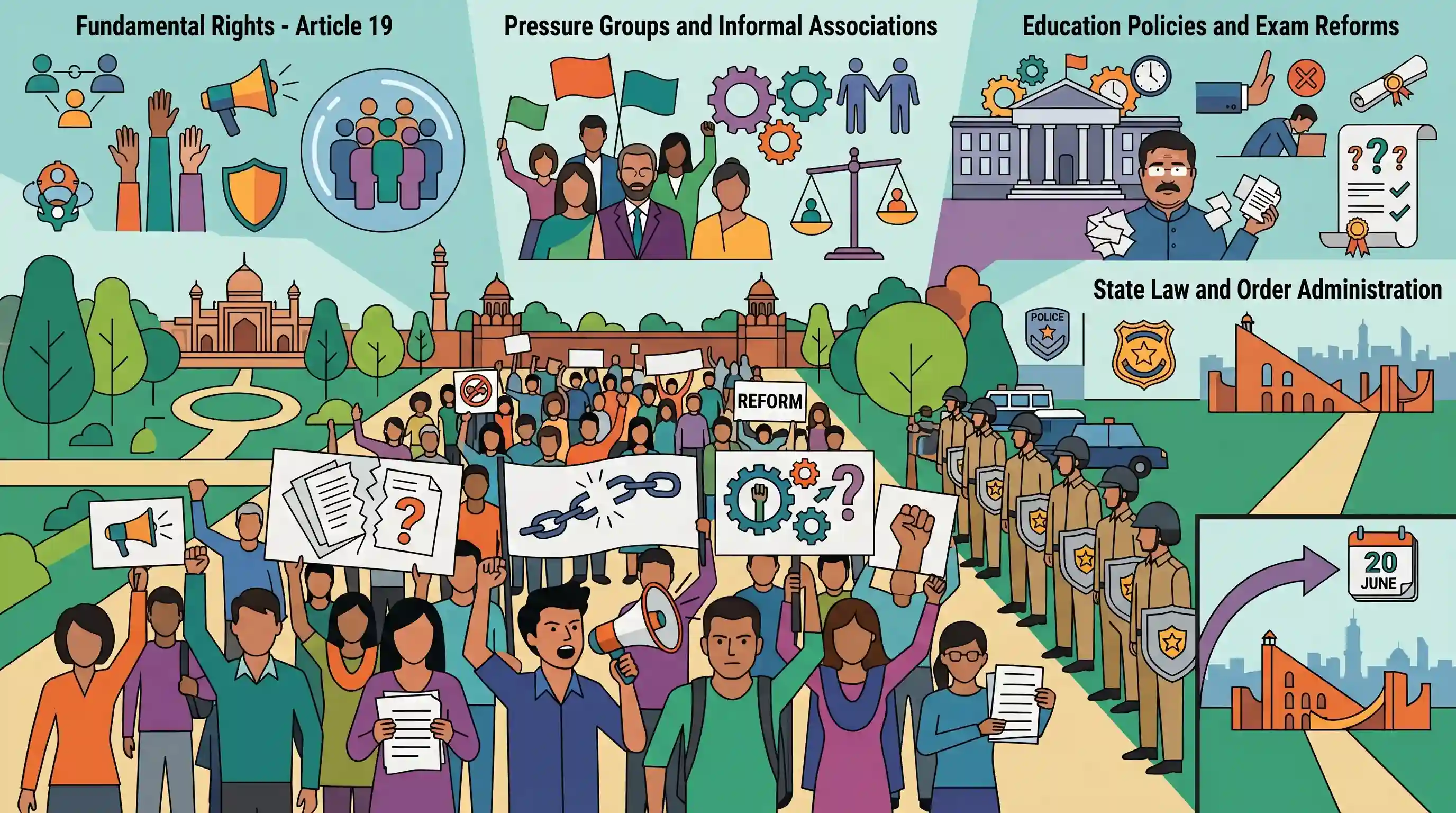
A massive protest was organized at Eco Garden in Lucknow, Uttar Pradesh, by competitive exam aspirants and student leaders against the recent wave of paper leaks and exam irregularities. Demonstrators, including CJP chief Abhijeet Dipke, demanded systemic educational testing reforms and the immediate resignation of Union Education Minister Dharmendra Pradhan. The peaceful assembly was closely monitored by the Lucknow Police Commissionerate to maintain law and order, and organizers announced plans to shift their protests to Jantar Mantar, New Delhi, on June 20, 2026.
Key Points
- A significant protest was organized by student groups and aspirants at Eco Garden in Lucknow, Uttar Pradesh, over irregularities and leaks in competitive exams conducted by national bodies.
- Abhijeet Dipke, founder of the Cockroach Janta Party (CJP), participated in the protest and reiterated demands for the resignation of Union Education Minister Dharmendra Pradhan over structural failures in exams like NEET-UG and NET.
- The protest was conducted peacefully under administrative surveillance, with permissions monitored by Additional Commissioner of Police (Law and Order) Babloo Kumar and application filed by teacher-activist Vivek Kumar.
- Protesters announced plans to scale up their agitation with a larger demonstration scheduled at Jantar Mantar in New Delhi on June 20, 2026.
- The demonstration highlights the active role of youth pressure groups in public policy, administrative accountability in educational testing, and the execution of the fundamental right to peaceful assembly.
Important Terms
National Testing Agency (NTA)

An autonomous, self-sustained testing organization under the Ministry of Education, established to conduct efficient, transparent, and international-standard entrance examinations for admission and fellowships in higher educational institutions.
UPSC context
GS Paper II (Polity & Governance) and GS Paper III (Education). Tests statutory/non-statutory bodies and exam reform issues.
Article 19 of the Constitution of India
A fundamental constitutional provision guaranteeing citizens six basic democratic freedoms—speech, assembly, association, movement, residence, and profession—subject to "reasonable restrictions" for public order, security, and national sovereignty.
UPSC context
GS Paper II (Polity & Constitution). Tests fundamental rights, civil liberties, and the scope of reasonable state restrictions.
Public Examinations (Prevention of Unfair Means) Act
A 2024 Indian law enacted to deter malpractices like paper leaks, organized cheating, and impersonation in public exams by prescribing strict penalties, including up to 10 years of imprisonment and heavy fines.
UPSC context
GS Paper II (Polity, Governance & Education). Tests legislative measures to curb corruption, paper leaks, and promote transparent governance.
Lucknow Police Commissionerate
The primary law enforcement agency for Lucknow, headed by a Commissioner of Police who holds magisterial powers to maintain public order and handle crime under a direct, localized policing command system.
UPSC context
GS Paper II (Polity & Governance). Tests urban policing models, law and order administration, and internal security mechanisms.
Cockroach Janta Party (CJP)
A youth-led satirical political movement in India founded in 2026 by Abhijeet Dipke using digital memes and protests to campaign for educational accountability, systemic testing reforms, and civil liberties.
UPSC context
GS Paper II (Polity & Governance). Tests the role of pressure groups, digital mobilization, and public protest in a democracy.
Prelims Trap
The Right to Assemble under Article 19(1)(b) can be restricted on the grounds of decency, morality, or friendly relations with foreign states.
These restrictions only apply to Article 19(2) (speech). Under Article 19(3) (assembly), restrictions are strictly limited to sovereignty/integrity of India and public order.
Static Concepts Connected
What are the restriction grounds under Article 19(3)?
- Sovereignty and integrity: Added by the 16th Constitutional Amendment Act of 1963 to curb secessionist or anti-national assemblies.
- Public order: Enables the state to restrict gatherings that pose an imminent threat to civic peace or public safety.
What is the legal and organizational status of NTA?
- Non-statutory society: Registered under the Societies Registration Act, 1860; it is not a statutory or constitutional body.
- Nodal ministry: Functions as an autonomous, self-sustained testing organization under the Ministry of Education's Department of Higher Education.
Cross-Topic Patterns
Exam integrity and demographic dividend
Systemic paper leaks jeopardize meritocracy, causing prolonged youth unemployment and undermining the economic potential of India's massive demographic dividend.
Executive policing and protest control
The handling of urban student protests highlights the legal transition from dual police-magistrate control to unified Police Commissionerate systems.

Constitutional limits of Article 19(1)(b) alongside the stringent penal provisions of the Public Exams Act 2024 will likely feature in 2026.
Linked PYQs · 2
Linked PYQs · 2
- 2024UPPSC_PRELIMSGS1
Which of the following freedoms is not guaranteed by the Indian Constitution under Article 19 ?
- 2022UPPSC_PRELIMSGS1
Consider the following cities of Uttar Pradesh and arrange them in descending order in terms of their population. I. Ghaziabad II. Kanpur III. Agra IV. Lucknow Select the correct answer from the code given below :
