Lucknow International Cyber Fraud Syndicate Investigation and Arrests
Source:etvbharat ↗
Why It Matters
Highlights the evolving challenges of transnational organized cybercrime operating within Indian borders. It underscores the critical enforcement of India's updated legal framework—integrating the Bharatiya Nyaya Sanhita (BNS), the Telecommunications Act 2023, and the IT Act 2000—and illustrates the necessity of international police cooperation networks (such as CBI's BHARATPOL) in tackling global cyber threats.
Summary
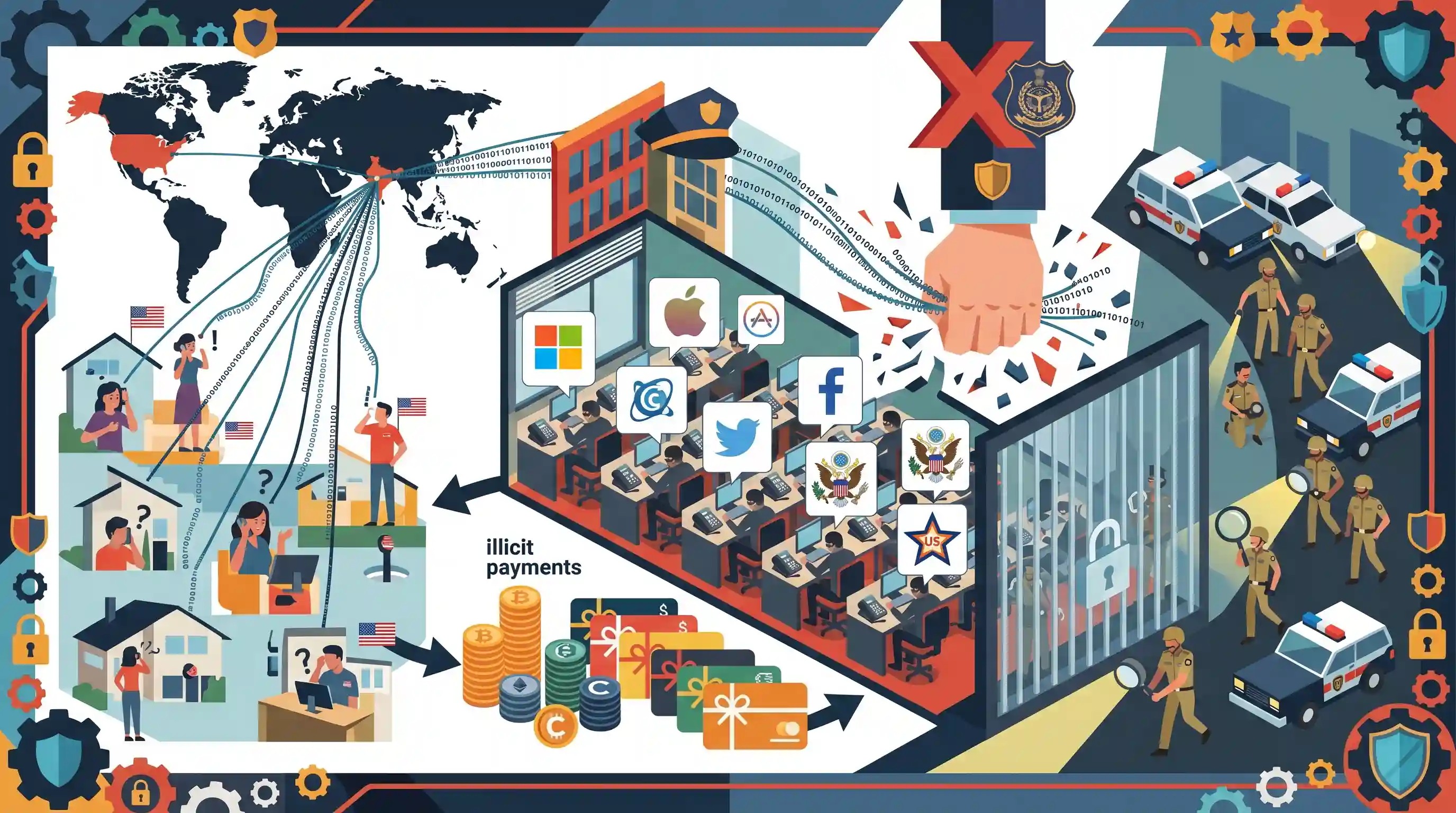
The Lucknow Police busted a massive Rs 200-crore international cyber fraud syndicate operating from a rented office in Vibhuti Khand, Lucknow, arresting 119 people. The organized racket targeted United States citizens by impersonating major technology companies and US federal agencies, collecting illicit payments via cryptocurrencies and gift cards.
Key Points
- The Lucknow Police successfully busted an international cyber fraud racket operating from the 11th floor of the Summit Building in Lucknow, arresting 119 individuals (including 40 women).
- The racket operated like a highly organized corporate call center, primarily targeting foreign nationals in the United States, and had been active for several years with monthly operational costs running up to Rs 3 crore.
- Modus operandi involved employing English-speaking women (many from India's Northeastern states) on fixed salaries and a 10% commission to pose as customer support executives of prominent tech and service companies.
- Once trust was established, scammers impersonated officials from US government agencies such as the Federal Bureau of Investigation (FBI) and the Federal Trade Commission (FTC), threatening victims with legal action to extract payments.
- Funds from the victims were collected via difficult-to-trace channels, including cryptocurrency, digital vouchers, and gift cards.
- Seized equipment included Voice over Internet Protocol (VoIP) calling systems, Eyebeam dialers, call scripts, customer databases of foreign nationals, and forged documents.
- A case has been registered at the Cyber Crime Police Station in Lucknow under provisions of the Bharatiya Nyaya Sanhita (BNS), the Information Technology (IT) Act, and the Telecommunications Act.
Important Terms
Bharatiya Nyaya Sanhita (BNS)

India's primary substantive criminal code that replaced the colonial-era Indian Penal Code of 1860, modernising offences and introducing restorative justice.
UPSC context
GS Paper 2 (Judiciary/Governance); tests knowledge of criminal justice reforms and statutory laws.
Information Technology Act, 2000
India's primary cyber law governing e-commerce, digital transactions, and cybercrimes, providing legal recognition to electronic records and prescribing penalties for digital offenses.
UPSC context
GS Paper 3 (Cyber Security); tests understanding of regulatory frameworks for digital crime and governance.
Telecommunications Act, 2023
A consolidated legal framework replacing colonial-era telecom laws with a modern, single-window authorisation system, regulating spectrum allocation and bolstering national security.
UPSC context
GS Paper 3 (IT & Infrastructure/Security); tests knowledge of digital regulation, connectivity policies, and state powers.
Federal Bureau of Investigation (FBI)
The primary federal law enforcement and domestic intelligence agency of the United States, responsible for investigating high-technology crimes, cyber warfare, and transnational syndicates.
UPSC context
GS Paper 3 (Security/Cyber Warfare); tests awareness of international law enforcement cooperation and global cyber threats.
Federal Trade Commission (FTC)
An independent agency of the United States government responsible for protecting consumers and enforcing antitrust laws against unfair, deceptive, or anticompetitive business practices.
UPSC context
GS Paper 2 (International Institutions/Governance); tests comprehension of global consumer rights, corporate regulation, and antitrust frameworks.
Prelims Trap
Provisions banning and penalizing caller ID spoofing (Calling Line Identity tampering) are established primarily under the Information Technology (IT) Act, 2000.
Caller ID spoofing and tampering with telecommunication identity (CLI) are explicitly banned and made cognizable/non-bailable under Section 42 of the Telecommunications Act, 2023, not the IT Act, 2000.
Static Concepts Connected
What is the Indian Cyber Crime Coordination Centre (I4C) and its role?
- Establishment & Mandate: MHA-led initiative established to provide a national-level coordination framework for law enforcement agencies to combat cybercrime systematically.
- Key Components: Includes the National Cyber Crime Threat Analytics Unit (TAU), Joint Cyber Crime Investigation Team, and the National Cyber Crime Reporting Portal.
- PMLA Integration: Recently integrated under Section 66 of the PMLA, 2002, to enable seamless intelligence sharing with the Enforcement Directorate.
How is international cyber-crime policing coordinated in India?
- CBI as Nodal Agency: Acts as the National Central Bureau (NCB) for INTERPOL in India, leading international police cooperation efforts.
- BHARATPOL Portal: A digital portal launched by CBI to securely connect Indian state/UT police forces directly with INTERPOL’s global databases in real time.
- Operation Chakra: A CBI-led national campaign executing coordinated operations with I4C, FBI, and Interpol against technology-enabled organized syndicates.
Cross-Topic Patterns
Cyber-laundering + PMLA convergence
Explores the intersection of cyber crime and money laundering where crypto and digital gift cards evade standard banking channels, requiring regulatory convergence between I4C and Enforcement Directorate under PMLA.
Federalism + Transnational Policing
Highlights how local state police must navigate federal agencies (CBI, I4C) and foreign bodies (FBI, INTERPOL) to tackle cross-border crimes, redefining traditional State-List police boundaries.

Mains 2026: UPSC may test Telecommunications Act provisions on spoofing alongside CBI's BHARATPOL and transnational cyber-fraud operations.
Linked PYQs · 1
Linked PYQs · 1
- 2025UPPSC_PRELIMSGS1
BHARATPOL', an online portal for International Police Co-operation has been developed by which of the following?
