Lucknow Kanpur Expressway Faces NHAI Probe After Surface Damage
Source:theprint ↗
Why It Matters
This issue underscores the challenges in monitoring and maintaining quality control in large-scale PPP infrastructure projects. It is relevant for evaluating the efficacy of the BOT model, NHAI's regulatory mechanisms, and the state of physical infrastructure in Uttar Pradesh.
Summary
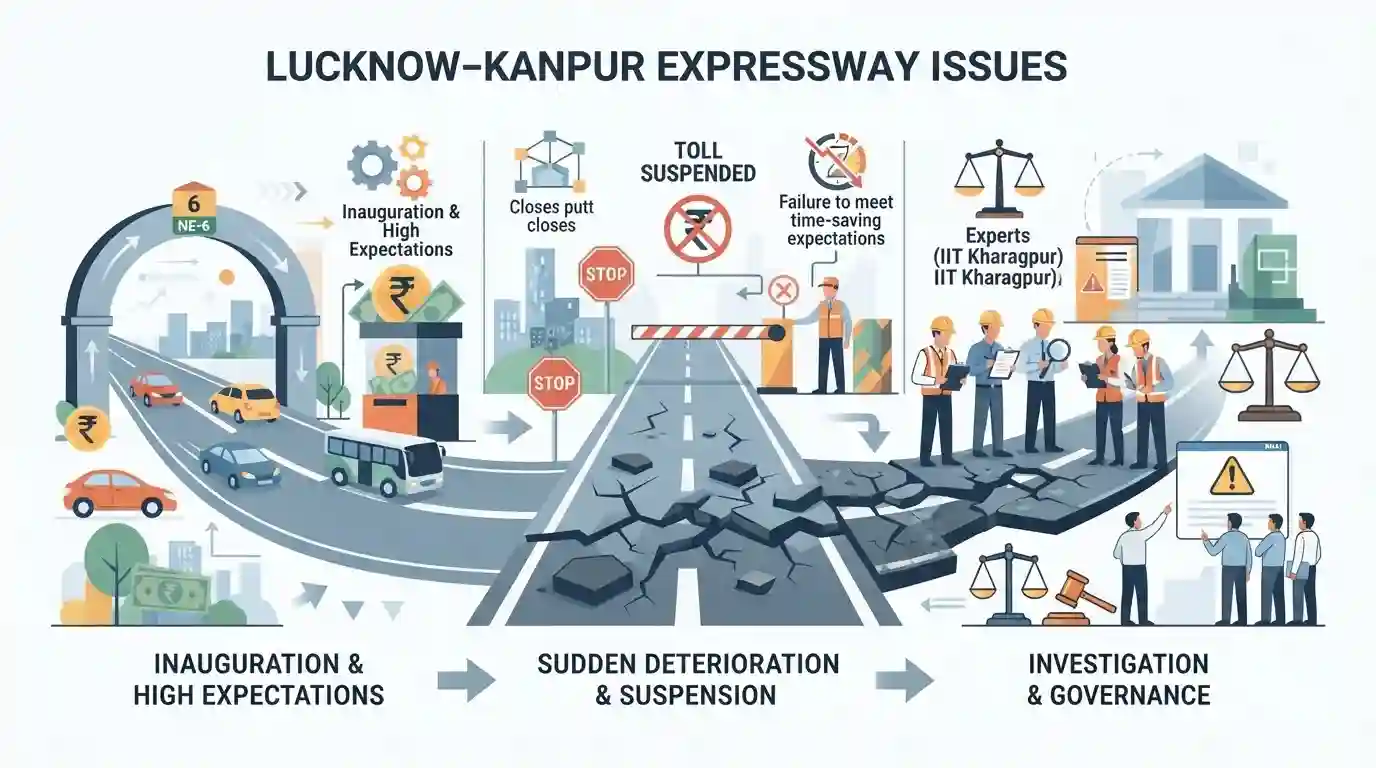
The Lucknow-Kanpur Expressway (National Expressway-6) experienced significant surface damage shortly after its inauguration, leading the NHAI to suspend toll collection. Constructed at a cost of Rs 4,700 crore under a Build-Operate-Transfer (BOT) model by Awadh Expressway Pvt Ltd (a subsidiary of PNC Infratech), the 63-km access-controlled corridor was designed to cut travel time to 40-45 minutes. Following the sudden deterioration, the NHAI has formed an investigative committee led by IIT Kharagpur experts and warned of severe penalties against the concessionaire, highlighting concerns over quality control in major infrastructure projects.
Key Points
- The newly inaugurated 63-km Lucknow-Kanpur Expressway (National Expressway-6) faced surface damage and slippage barely a fortnight after its opening, prompting the NHAI to halt toll operations.
- Built at a cost of Rs 4,700 crore under the Build-Operate-Transfer (BOT) model, the project features advanced systems like Multi-Lane Free Flow tolling, ANPR, and 3D Automated Machine Guidance.
- NHAI has initiated an investigation led by an IIT Kharagpur committee to determine the cause of the defects, specifically in Package 2 of the highway.
- The concessionaire, Awadh Expressway Pvt Ltd, faces potential penalties, including being declared a 'non-performer' and possible debarment.
Important Terms
National Highways Authority of India (NHAI)

An autonomous statutory agency under the Ministry of Road Transport and Highways, established in 1988, responsible for developing, maintaining, and managing India's national highway network.
UPSC context
Relevant for GS Paper 3 (Infrastructure). Tests knowledge of statutory bodies, transport architecture, and infrastructure project execution.
Build-Operate-Transfer (BOT) model
A public-private partnership (PPP) framework where a private entity finances, constructs, and operates an infrastructure project for a specified period to recoup costs before transferring it back to the government.
UPSC context
Crucial for GS Paper 3 (Investment Models). Tests understanding of PPP frameworks, highway financing, and public-private risk-sharing mechanisms.
FASTag
An electronic toll collection system operated by NHAI using Radio Frequency Identification (RFID) technology, enabling cashless, contactless toll payments directly from linked accounts while vehicles are in motion.
UPSC context
GS Paper 3 (Infrastructure & Tech). Tests understanding of digital governance, revenue transparency, and congestion-reduction tech on highways.
Lucknow-Kanpur Expressway (NE-6)
A 63-km access-controlled greenfield economic corridor being developed to significantly reduce travel time between the two major UP cities, aiming to boost regional industrial and logistics efficiency.
UPSC context
GS Paper 3 (Infrastructure) and UP state exams. Highlights regional connectivity, economic corridors, and state-level infrastructure milestones.
IIT Kharagpur
An Institute of National Importance in India, frequently tapped by the government to provide specialized technical expertise, structural engineering audits, and quality-control investigations for major public infrastructure projects.
UPSC context
GS Paper 2 (Governance/Education). Illustrates the growing role of premier academic institutions in ensuring structural accountability in public works.
Prelims Trap
"Under the BOT model, ownership of the highway asset is transferred to the private concessionaire for the concession period."
Ownership remains strictly with the government. The private entity only holds the concession right to build, operate, and toll the asset for a specified time before handing it back.
Static Concepts Connected
What are the key differences between BOT, EPC, and HAM models?
- BOT (Toll): Private player bears both construction and traffic risks, recovering investments directly through toll collection.
- EPC Model: Government bears all financial and traffic risks. The private contractor simply builds the project for a fixed cost.
- HAM (Hybrid Annuity): Government pays 40% upfront; 60% is paid as annuities. Construction risk is shared; traffic risk stays with the government.
How do MLFF and GNSS tolling systems function?
- ANPR & RFID: Multi-Lane Free Flow uses Automatic Number Plate Recognition and FASTag to deduct tolls without physical barriers or stopping vehicles.
- GNSS Tolling: Uses Global Navigation Satellite Systems to track exact vehicle movement, charging commuters precisely for the distance traveled.
Cross-Topic Patterns
Infra execution vs governance quality
Expressway surface failures immediately post-inauguration raise GS2/GS4 themes on regulatory oversight, the efficacy of NHAI's independent engineers, and corporate accountability in mega-projects.
Shifting highway PPP models
NHAI's fluctuating preference between EPC, HAM, and BOT models directly correlates with private sector risk appetite and the banking sector's NPA cycle over the last decade.

Expect a multi-statement prelims question on risk allocation in BOT vs HAM, and the transition mechanisms of GNSS-based MLFF tolling.
Linked PYQs · 3
Linked PYQs · 3
- 2023UPPSC_PRELIMSGS1
Which of the following Scheme/Programme is not the Central Government Programme and it is Uttar Pradesh Government's Programme?
- 2011UPPSC_PRELIMSGS1
The main source of fund for the National Highway Authority of India is
- 2013UPPSC_PRELIMSGS1
The North-South and East West corridors of the National Highway Development Project meet at
