Lucknow Kanpur expressway inaugurated to boost regional connectivity
Source:mid-day ↗
Why It Matters
UPPSC frequently asks detailed questions about expressway projects in Uttar Pradesh, including their lengths, districts traversed (e.g., Purvanchal Expressway routes), and administrative authorities (distinguishing between state UPEIDA-led projects like the Ganga Expressway and central NHAI-led National Expressways like NE-6).
Summary
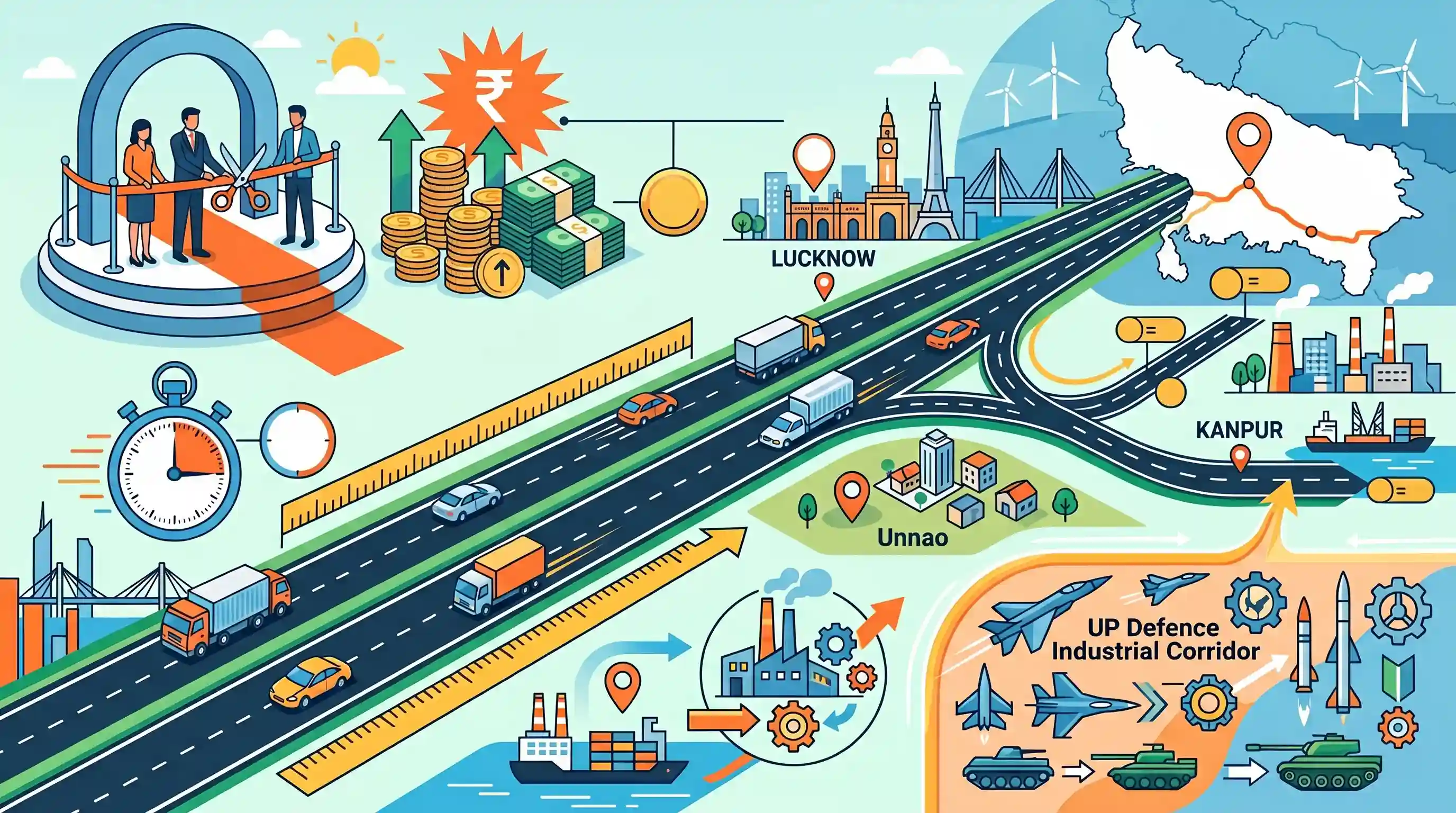
On July 13, 2026, Union Ministers Rajnath Singh and Nitin Gadkari, alongside UP CM Yogi Adityanath, inaugurated the 63 km long Lucknow-Kanpur Expressway (National Expressway 6). Along with this flagship corridor, three other National Highway projects were launched, totaling an investment of over ₹4,850 crore. The access-controlled NE-6, built by NHAI, connects Lucknow (Shaheed Path) to Kanpur (Chakeri) through Unnao district, slashing travel times to under 45 minutes and boosting regional commerce and the UP Defence Industrial Corridor.
Key Points
- Union Defence Minister Rajnath Singh, Union Road Transport and Highways Minister Nitin Gadkari, and UP Chief Minister Yogi Adityanath jointly inaugurated the 63 km long Lucknow-Kanpur Expressway on July 13, 2026.
- The leaders also inaugurated and laid foundation stones for three other National Highway projects, with a combined project cost of over ₹4,850 crore.
- The Lucknow-Kanpur Expressway is designated as National Expressway 6 (NE-6) and is developed as a 6-lane (expandable to 8-lane) access-controlled greenfield-cum-brownfield corridor.
- Unlike other flagship UP expressways (Ganga, Purvanchal, Bundelkhand) which are state-funded and developed by UPEIDA, the Lucknow-Kanpur Expressway is a central project implemented by the National Highways Authority of India (NHAI).
- The 62.76 km alignment starts from Shaheed Path in Lucknow (near Amausi Airport), passes mainly through Lucknow and Unnao districts, and terminates at Chakeri in Kanpur.
- The corridor will drastically reduce the transit time between the capital city (Lucknow) and the industrial hub (Kanpur) from 1.5–2 hours to around 35–45 minutes, fostering economic integration and bolstering the UP Defence Industrial Corridor nodes.
Important Terms
National Expressway 6 (NE-6)

A 63 km-long, six-lane access-controlled greenfield expressway connecting Lucknow and Kanpur. Officially inaugurated in July 2026, it is India's first barrier-less expressway, significantly enhancing regional logistics and connectivity.
UPSC context
GS Paper III (Infrastructure: Roads); tests knowledge of national expressways, transport connectivity, and advanced technological implementations like barrier-less tolling.
Uttar Pradesh Defence Industrial Corridor
A landmark Union Government initiative to reduce defence import dependency. It spans six nodes—Agra, Aligarh, Chitrakoot, Jhansi, Kanpur, and Lucknow—to foster domestic defence and aerospace manufacturing.
UPSC context
GS Paper III (Security & Economy); tests policies on indigenisation of defence procurement, MSME involvement, and regional manufacturing clusters.
National Highways Authority of India (NHAI)
A statutory body established under the NHAI Act, 1988, under the Ministry of Road Transport and Highways. It is mandated to develop, maintain, and manage India's extensive National Highways and Expressways network.
UPSC context
GS Paper II (Statutory Bodies) & GS III (Infrastructure); tests understanding of central agencies executing mega transport and connectivity projects.
Uttar Pradesh Expressways Industrial Development Authority (UPEIDA)
A state agency established in 2007 under the UP Industrial Area Development Act. It oversees the planning, land acquisition, construction, and monetization of expressways and industrial corridors in Uttar Pradesh.
UPSC context
GS Paper III (Infrastructure & Economy); tests state-level infrastructure execution, land acquisition policies, and industrial cluster development models.
Ministry of Road Transport and Highways (MoRTH)
The apex Union ministry responsible for formulating and administering policies, legislation, and road safety regulations for national highways, state connectivity corridors, and transport technology implementation in India.
UPSC context
GS Paper II (Union Executive); tests understanding of policy frameworks, regulatory mandates, and administrative divisions governing national transport connectivity.
Prelims Trap
The Lucknow-Kanpur Expressway (NE-6) is developed and maintained by the Uttar Pradesh Expressways Industrial Development Authority (UPEIDA).
While major UP expressways like Ganga, Purvanchal, and Bundelkhand are state-funded under UPEIDA, NE-6 is a centrally-funded National Expressway developed directly by the National Highways Authority of India (NHAI).
Static Concepts Connected
What is the difference between National Highways and National Expressways in India?
- Access Control: Expressways feature full access control with grade-separated interchanges, entry/exit ramps, and no at-grade crossings, unlike standard national highways.
- Legal Classification: National Highways are designated under the National Highways Act, 1956, while National Expressways represent a higher tier of speed-optimized, access-controlled corridors.
- Implementing Agencies: National Expressways can be developed by central agencies like NHAI or state-level agencies like UPEIDA depending on project funding and jurisdiction.
What are 3D Automated Machine Guidance (AMG) and Multi-Lane Free Flow (MLFF) in construction?
- 3D AMG Technology: Integrates 3D digital models with GNSS and laser sensors to guide earthwork and paving machinery automatically, drastically reducing human survey errors and material waste.
- MLFF Tolling: A barrier-free tolling system that automatically charges vehicles at highway speeds using ANPR cameras and FASTag, eliminating physical toll booths.
Cross-Topic Patterns
Infra integration + defense indigenization
Linking expressways like NE-6 directly to the UP Defence Industrial Corridor shows how transport logistics feed directly into domestic strategic manufacturing and industrial clusters.
Next-gen tolling + logistics efficiency
Transitioning to barrier-free tolling (MLFF) using ANPR and GNSS highlights India's push for digital public infrastructure to eliminate logistics friction and emissions.

2026 Prelims may test frontier transport technologies (3D AMG, MLFF) alongside the institutional division of NHAI vs state road authorities.
Linked PYQs · 2
Linked PYQs · 2
- 2023UPPSC_PRELIMSGS1
Which of the following Scheme/Programme is not the Central Government Programme and it is Uttar Pradesh Government's Programme?
- 2018UPPSC_PRELIMSGS1
'Purvanchal Express Way' in Uttar Pradesh will not pass through which of the following cities?
