Lucknow Fire Tragedy Probe Recommends Action Against 25 Officials
Source:indiatvnews ↗
Why It Matters
This incident emphasizes civil service accountability, regulatory compliance in urban development, and disaster management protocols. For UPPSC aspirants, it underscores the functioning of Local Development Authorities (like LDA), administrative ethics/PCS disciplinary action, and the application of municipal fire-safety laws in urban governance.
Summary
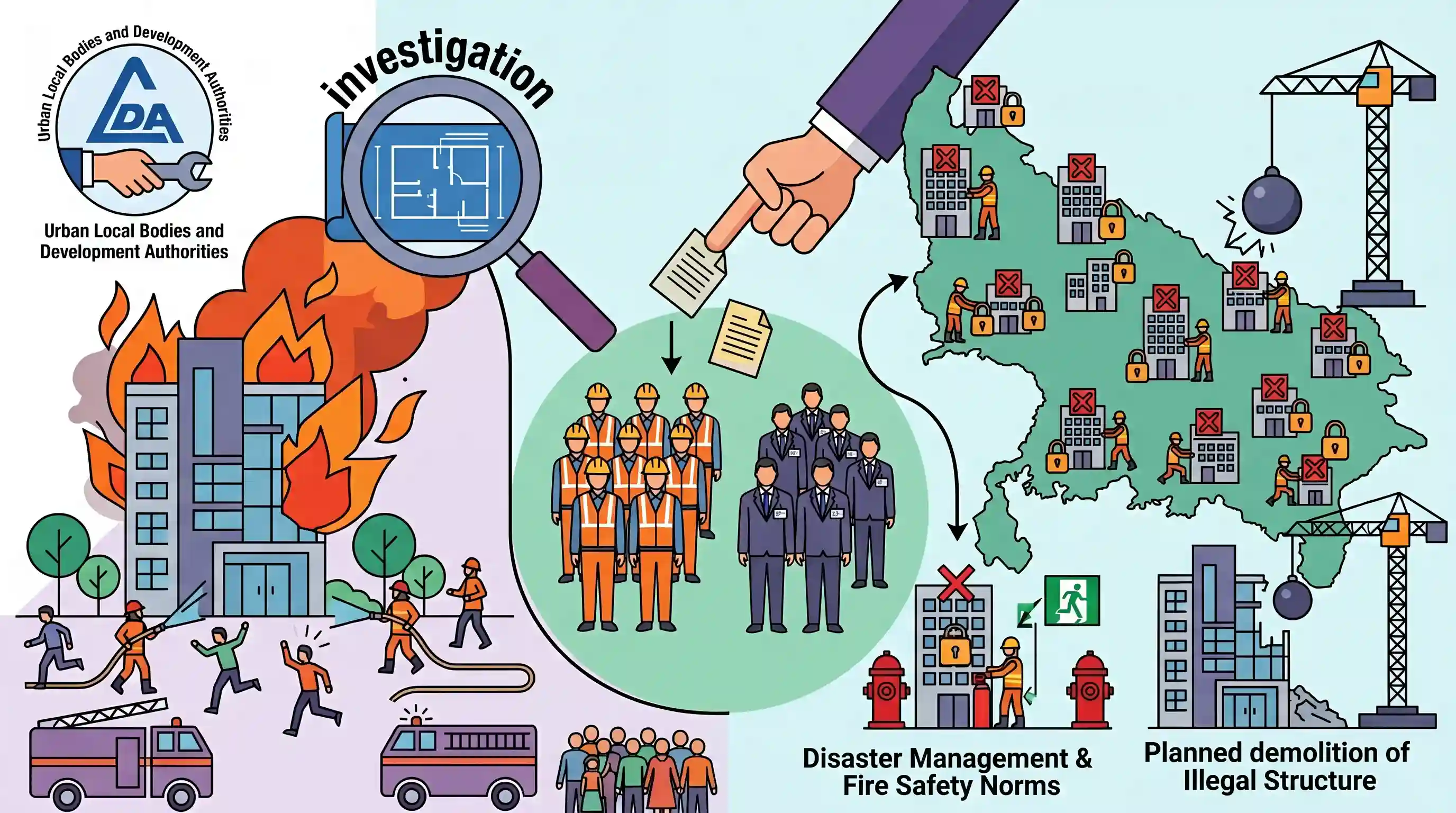
An investigation by the Lucknow Development Authority (LDA) into the June 2026 Aliganj coaching centre fire tragedy, which claimed 15 lives, has revealed extensive negligence by 25 public officials—including 19 engineers and 6 PCS officers. Recommended actions against these officials accompany a massive statewide crackdown, leading to the sealing of over 100 non-compliant buildings and educational coaching centres across Uttar Pradesh, alongside proposed plans to demolish the illegal Aliganj structure.
Key Points
- A devastating fire in an illegal commercial building in Lucknow's Aliganj area on June 22, 2026, resulted in the loss of 15 lives.
- A formal probe by the Lucknow Development Authority (LDA) uncovered deep administrative negligence and recommended strict disciplinary action against 25 government officials, including 19 engineers and 6 Provincial Civil Services (PCS) officers.
- In response to the tragedy, the Uttar Pradesh government initiated a statewide safety verification campaign, resulting in the sealing of over 100 non-compliant buildings, including 15 coaching centres in Lucknow alone.
- The illegal Aliganj commercial structure is being proposed for demolition due to major construction irregularities and fire-safety violations.
- The incident highlights the critical need for strict enforcement of urban planning standards, municipal building bylaws, and National Building Code guidelines in rapidly growing educational hubs.
Important Terms
National Building Code of India

A comprehensive national code published by the Bureau of Indian Standards providing recommendatory guidelines for regulating building construction, structural design, and fire safety requirements across India.
UPSC context
GS Paper III (Disaster Management) and GS Paper I (Urbanization); tests regulatory frameworks for urban safety.
Disaster Management Act, 2005
A landmark central legislation providing the legal and institutional framework for disaster preparedness, mitigation, capacity-building, and coordinated emergency response across India.
UPSC context
GS Paper III (Disaster Management); tests institutional mechanisms and executive powers during national emergencies.
Lucknow Development Authority (LDA)
A statutory urban planning and development authority in Uttar Pradesh responsible for master planning, land-use zoning, and enforcing building bye-laws in Lucknow.
UPSC context
GS Paper II (Urban Local Bodies); tests governance issues, decentralization, and urban developmental administration.
Uttar Pradesh Fire Service Act
The principal state-level legislation (enacted in 1944) governing the establishment, administration, and legal powers of fire safety personnel and fire prevention services in Uttar Pradesh.
UPSC context
GS Paper II (State Legislations) and GS Paper III (Disaster Management); tests state regulatory regimes for public safety.
Uttar Pradesh Fire Department
The state government agency, officially termed Uttar Pradesh Fire Services, functioning under the state police to ensure fire prevention, firefighting, and rescue management.
UPSC context
GS Paper III (Disaster Management) and GS Paper II (Governance); tests agency-level execution of hazard mitigation.
Prelims Trap
The National Building Code of India (NBC) is a legally binding central statute applicable uniformly across all states.
The NBC is published by the Bureau of Indian Standards (BIS) as a recommendatory document. It only gains statutory force once adopted into state municipal building bylaws.
Static Concepts Connected
Under which constitutional provisions do fire services and safety fall in India?
- Seventh Schedule: Listed under Entry 6 of the State List, placing primary administrative and legislative responsibility on State Governments.
- Twelfth Schedule: Recognized as a municipal function under Entry 7, enabling states to devolve fire services to urban local bodies.
- SFAC Role: The Standing Fire Advisory Council (MHA) recommends national norms, but fire administration remains a decentralized state subject.
What is the regulatory status of the National Building Code of India (NBC)?
- BIS Formulation: Formulated and published by the Bureau of Indian Standards (BIS) to serve as a national model code.
- Enforcement Status: Serves purely as a recommendatory document and lacks independent statutory force unless adopted by states.
- Part 4 Focus: Outlines detailed technical guidelines specifically dedicated to fire prevention, structural protection, and egress safety.
Cross-Topic Patterns
Public Ethics vs. Regulatory Capture
The involvement of public engineers in safety lapses demonstrates how ethical deficits in local governance directly compromise life-saving disaster resilience measures.
74th Amendment and Municipal Deficits
Decentralized fire safety under the 12th Schedule remains weak due to structural resource deficits, forcing state-level crackdowns over local municipal enforcement.

Expect a GS-3/GS-2 question on local body accountability, highlighting structural audit lapses and National Building Code adoption challenges.
Linked PYQs · 3
Linked PYQs · 3
- 2021UPPSC_PRELIMSGS1
The functions of the State Public Service Commission of Uttar Pradesh can be extended by
- 2021UPPSC_PRELIMSGS1
The National Disaster Management Division in India is the nodal division in the Ministry of Home Affairs for disaster management. Who is the Ex-officio Chairman of the National Disaster Management Authority?
- 2020UPPSC_PRELIMSGS1
During the 'lockdown', the extraordinary powers used by the Government of India received legal basis from which of the following laws? 1. Mental Health Care Act, 2017 2. Disaster Management Act, 2005 3. Enemy Property Act, 1968 4. Epidemic Diseases Act, 1897 Select the correct answer using the codes given below.
