Lt Gen Dhiraj Seth appointed as next Chief of Army Staff
Source:Indian Express ↗
Why It Matters
The appointment of the Chief of Army Staff is a highly significant event in India's national security framework. Understanding the background and focus areas of military leadership—especially emphasis on modernization, counter-insurgency, and emerging technologies—is essential for grasping the strategic direction of India's defense forces, which is relevant for GS3 Internal Security and Defense capability development topics.
Summary
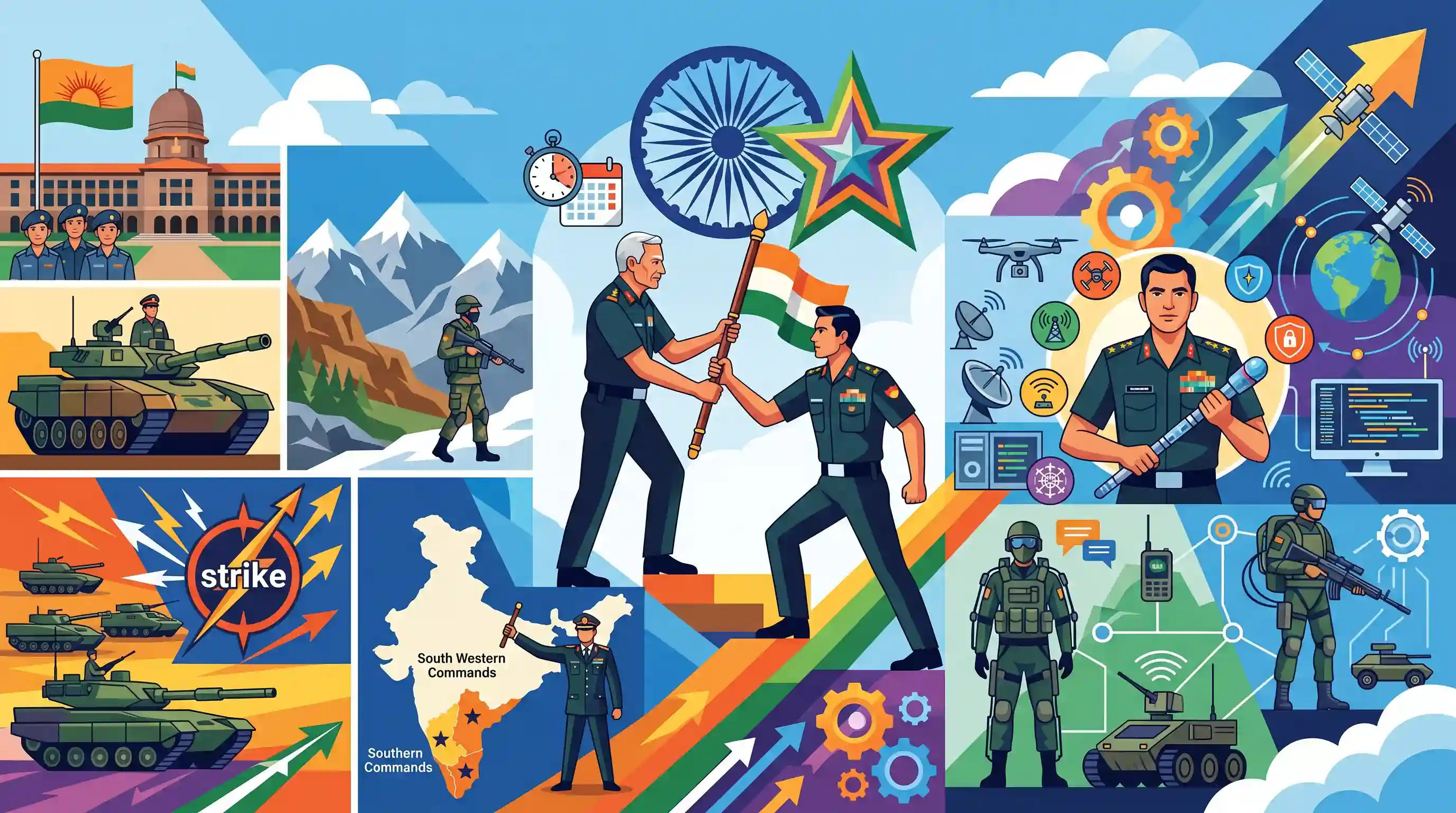
Lieutenant General Dhiraj Seth has been appointed as the next Chief of Army Staff (COAS) of the Indian Army, succeeding General Upendra Dwivedi upon his retirement on June 30, 2026. An alumnus of the National Defence Academy and commissioned into the Armoured Corps, Seth has an extensive operational background. His command tenures include a Counter-Insurgency Force in Jammu and Kashmir, a strike formation (Sudarshan Chakra Corps), and leadership of both the South Western and Southern Commands. Beyond operational command, Seth is recognized for his instrumental role in advancing the Indian Army's modernization trajectory, championing capability development, strategic planning, and the integration of emerging technologies to meet evolving security challenges.
Key Points
- Lt Gen Dhiraj Seth has been appointed as the next Chief of Army Staff (COAS) of the Indian Army, succeeding General Upendra Dwivedi on June 30, 2026.
- Commissioned into the Armoured Corps, he has extensive command experience across diverse environments, including desert sectors and counter-insurgency operations in Jammu & Kashmir.
- He has previously served as the General Officer Commanding-in-Chief of both the South Western Command and the Southern Command.
- Seth has played a crucial role in shaping the Army's modernization efforts, with a strong focus on strategic planning, capability development, and integrating emerging technologies into military operations.
Important Terms
Indian Army

The land-based branch of the Indian Armed Forces, tasked with territorial integrity, national security, and defense against external aggression and internal threats.
UPSC context
GS Paper III (Security); fundamental for understanding the structure, mandate, and role of defense forces in national defense.
National Defence Academy (NDA)
A premier tri-service training institution in Khadakwasla, Pune, where cadets from the Army, Navy, and Air Force train together before joining their respective academies.
UPSC context
GS Paper III (Security); tests knowledge of premier training institutions and the integration of the three services.
Southern Command
The Indian Army's largest command by geographic area, headquartered in Pune, overseeing operations in southern and western India, including coastal defense and training.
UPSC context
GS Paper III (Internal Security); relevant for geographical command structures and theater-specific security management.
South Western Command
Headquartered in Jaipur, it is the Army's newest operational command (established 2005) focused on the arid western frontier and bridging gaps between Western and Southern Commands.
UPSC context
GS Paper III (Internal Security); important for studying border management and the evolution of strategic command responses.
Sudarshan Chakra Corps
The XXI Corps, headquartered in Bhopal, is the premier strike corps of the Southern Command, designed for rapid offensive operations and mechanized warfare.
UPSC context
GS Paper III (Security); crucial for understanding specialized offensive formations and the "Strike Corps" concept in military doctrine.
Armoured Corps
A primary combat arm of the Indian Army specializing in mechanized warfare, utilizing tanks and armored vehicles to provide mobile firepower and shock action.
UPSC context
GS Paper III (Security/Technology); relevant for studying military modernization, mechanized forces, and indigenous capability development like the Arjun MBT.
Prelims Trap
The Chief of Army Staff is appointed by the President on the binding advice of the Chief of Defence Staff.
While the President is the Supreme Commander, top military appointments like the COAS are approved by the Appointments Committee of the Cabinet (ACC), headed by the PM.
Static Concepts Connected
How is the Indian Army structurally organized into commands?
- Operational Commands: There are six operational commands handling active borders and internal security: Northern, Western, Central, Southern, South Western, and Eastern.
- Training Command: ARTRAC (Army Training Command), based in Shimla, is the sole command dedicated to institutional training and formulating military doctrines.
- Leadership: Each command is led by a General Officer Commanding-in-Chief (GOC-in-C) holding the rank of Lieutenant General.
What is the mandate of the Appointments Committee of the Cabinet (ACC)?
- Exclusive Composition: It comprises only the Prime Minister (who serves as the Chairman) and the Minister of Home Affairs.
- Approval Authority: The ACC approves all senior-level appointments, including the Service Chiefs, Chief of Defence Staff (CDS), and highest-ranking bureaucrats across the government.
Cross-Topic Patterns
Defense Modernization & Theater Commands
The emphasis on tech integration by incoming Army leadership mirrors the broader structural shift toward integrated theater commands being spearheaded by the Chief of Defence Staff (CDS).
Strike Formations & Cold Start Doctrine
Command experience in strike formations (like Sudarshan Chakra Corps) inherently ties into India's 'Proactive Strategy' (Cold Start doctrine), aimed at rapid mobilization against cross-border threats.

Expect GS-3 Mains questions on how Army modernization and tech integration intersect with the impending rollout of theater commands.
Linked PYQs · 2
Linked PYQs · 2
- 2015MainsGS3
Considering the threats cyberspace poses for the country, India needs a "Digital Armed Force" to prevent crimes. Critically evaluate the National Cyber Security Policy, 2013 outlining the challenges perceived in its effective implementation.
- 2016MainsGS3
The terms 'Hot Pursuit' and 'Surgical Strikes' are often used in connection with armed action against terrorist attacks. Discuss the strategic impact of such actions.
