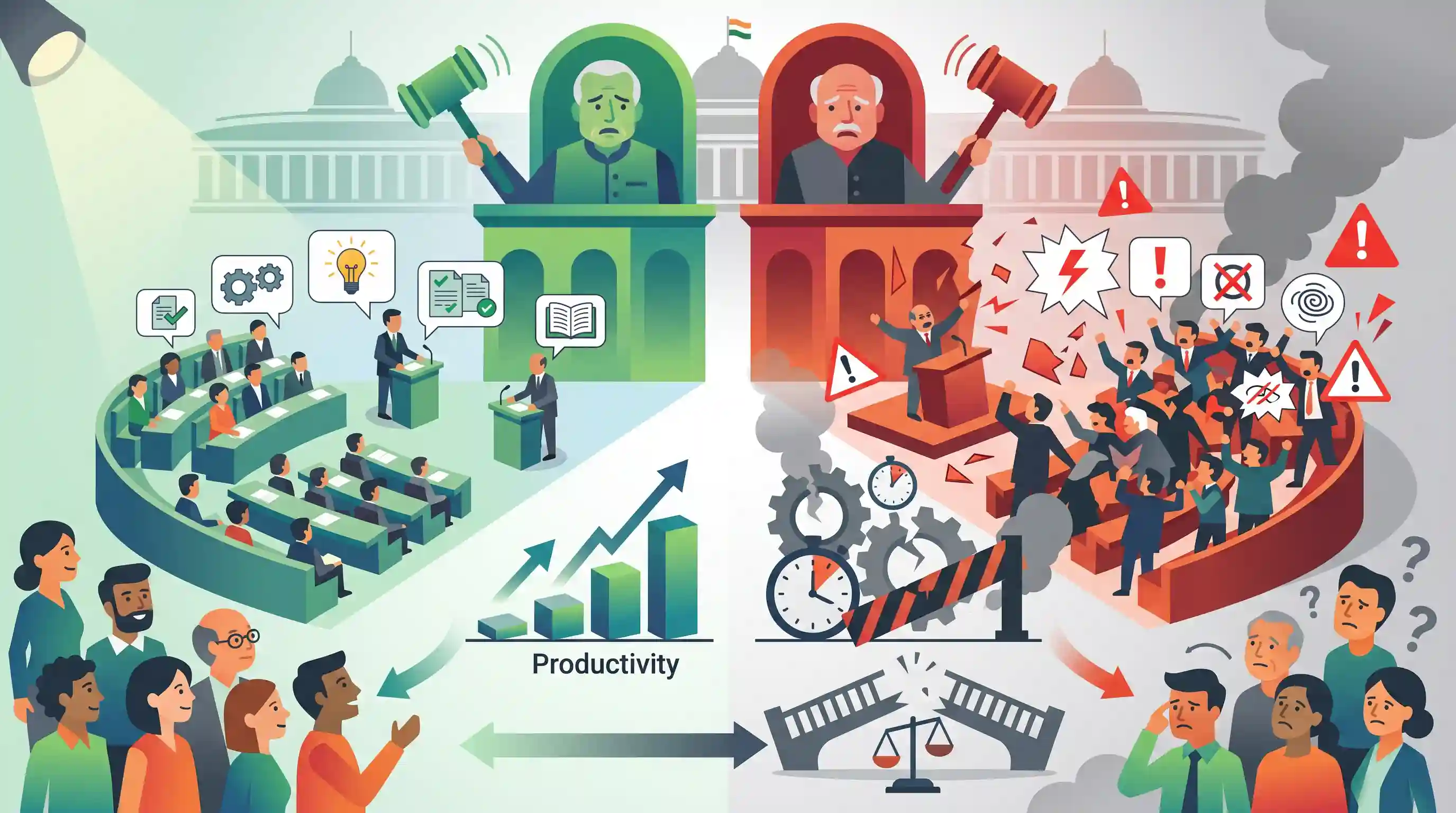
Presiding officers express concern over parliamentary disruptions
Source:Indian Express ↗
Why It Matters
The decline in parliamentary standards and frequent disruptions directly impact legislative outcomes and executive accountability. This is a recurring theme in UPSC Mains GS-II and requires aspirants to analyze the role of presiding officers, parliamentary rules, and potential reforms to ensure the smooth functioning of democratic institutions.
Summary
The Lok Sabha Speaker and Rajya Sabha Deputy Chairman have expressed serious concerns over the increasing frequency of disruptions in Parliament and State legislatures. They highlighted that such behavior significantly hampers legislative productivity, stalls critical debates, and tarnishes the credibility of democratic institutions in the eyes of the public. The presiding officers emphasized the necessity of upholding parliamentary decorum, arguing that constructive dialogue and debate are the cornerstones of a functioning democracy, while persistent disruptions undermine the very purpose of legislative bodies.
Key Points
- Presiding officers of both Houses of Parliament have flagged deep concerns regarding the frequent disruptions and adjournments occurring in legislative bodies.
- Consistent disruptions severely impair legislative productivity and adversely affect the public image and credibility of India's democratic institutions.
- There is a pressing need for elected representatives to prioritize constructive debate, dialogue, and dissent over persistent disruptions.
- The role of presiding officers (Speakers and Chairpersons) is critical in enforcing rules, maintaining parliamentary decorum, and ensuring smooth functioning of the Houses.
Important Terms
Lok Sabha

The lower house of India’s bicameral Parliament, composed of representatives directly elected by the people. It holds primary power over financial bills and the executive's accountability.
UPSC context
GS Paper II: Parliament structure and functioning; tests understanding of direct representation and legislative-executive relations.
Rajya Sabha
The permanent upper house of Parliament representing states and UTs. Members are indirectly elected by state legislatures, providing a federal check and a revising chamber for national legislation.
UPSC context
GS Paper II: Federalism and Parliament; tests state representation and the bicameral legislative process.
Speaker of Lok Sabha
The constitutional presiding officer of the Lok Sabha, elected by its members. They maintain order, interpret procedural rules, and hold final authority on certifying Money Bills.
UPSC context
GS Paper II: Role of Presiding Officers; focuses on neutrality, disciplinary powers, and House management.
Deputy Chairman of Rajya Sabha
A constitutional official elected by the Rajya Sabha to preside in the absence of the Chairman. They possess full presiding authority to conduct business and maintain House decorum.
UPSC context
GS Paper II: Parliament; relevant for understanding legislative leadership and constitutional roles within the Upper House.
Parliamentary Disruption
Frequent interruptions such as sloganeering and protests that stall legislative business. It hampers productivity, delays vital laws, and erodes the public's trust in democratic institutions.
UPSC context
GS Paper II: Functioning of legislatures; central to debates on democratic accountability and institutional effectiveness.
Parliamentary Decorum
The standard of conduct and etiquette required for orderly legislative proceedings. Presiding officers enforce these norms to ensure debates remain constructive and respectful of democratic traditions.
UPSC context
GS Paper II: Conduct of Business; tests knowledge of procedural ethics and the health of deliberative democracy.
State Legislatures
Legislative bodies at the state level, either unicameral or bicameral. They exercise law-making powers on state and concurrent subjects, mirroring the central parliamentary framework.
UPSC context
GS Paper II: State Legislatures; focuses on sub-national governance, federalism, and legislative functioning issues.
Prelims Trap
"The Rajya Sabha Chairman has the power to automatically suspend an unruly MP for the remainder of the session."
Under Rule 256, the RS Chairman can only 'name' a member. The House must then pass a motion to suspend them. Only the LS Speaker has automatic suspension powers (Rule 374A).
Static Concepts Connected
How do the suspension powers of the Lok Sabha Speaker and Rajya Sabha Chairman differ?
- Lok Sabha Speaker: Under Rule 374A, the Speaker can automatically suspend an MP for grave disorder for five sittings or the session's remainder.
- Rajya Sabha Chairman: Under Rule 256, the Chairman can only 'name' a member. The House must then formally adopt a motion to suspend the unruly member.
- Revocation: In both Houses, the power to revoke the suspension rests exclusively with the House via a motion, not the presiding officer.
What is the constitutional procedure to remove the Deputy Chairman of the Rajya Sabha?
- Constitutional Provision: Article 90 dictates they can be removed by a resolution passed by a majority of all the then members of the Council (Effective Majority).
- Notice Period: A resolution for removal requires at least 14 days' advance notice to be moved in the House.
- Presiding Restriction: While the resolution for their removal is under consideration, the Deputy Chairman cannot preside over the sittings of the House.
Cross-Topic Patterns
Disruptions & Executive Ordinance Making
Persistent parliamentary disruptions create a legislative vacuum, which is often used by the executive to justify the frequent promulgation of Ordinances, thereby bypassing detailed democratic scrutiny.
Tribunal Role vs House Decorum
The Speaker's struggle to maintain daily House decorum contrasts sharply with their vast quasi-judicial powers under the 10th Schedule, sparking debates on adopting the UK's strictly independent Speaker model.

Expect a 2026 Prelims multi-statement question contrasting the exact suspension powers of the LS Speaker versus the RS Chairman.
Linked PYQs · 5
Linked PYQs · 5
- 2019MainsGS2
Individual Parliamentarian's role as the national law maker is on a decline, which in turn, has adversely impacted the quality of debates and their outcome. Discuss.
- 2023MainsGS2
Discuss the role of Presiding Officers of state legislatures in maintaining order and impartiality in conducting legislative work and in facilitating best democratic practices.
- 2022PrelimsGS1
With reference to Deputy Speaker of Lok Sabha, consider the following statements: 1. As per the Rules of Procedure and Conduct of Business in Lok Sabha, the election of Deputy Speaker shall be held on such date as the Speaker may fix. 2. There is a mandatory provision that the election of a candidate as Deputy Speaker of Lok Sabha shall be from either the principal opposition party or the ruling party. 3. The Deputy Speaker has the same power as of the Speaker when presiding over the sitting of the House and no appeal lies against his rulings. 4. The well established parliamentary practice regarding the appointment of Deputy Speaker is that the motion is moved by the Speaker and duly seconded by the Prime Minister. Which of the statements given above are correct?
- 2024PrelimsGS1
With reference to the Speaker of the Lok Sabha, consider the following statements : While any resolution for the removal of the Speaker of the Lok Sabha is under consideration 1. He/She shall not preside. 2. He/She shall not have the right to speak. 3. He/She shall not be entitled to vote on the resolution in the first instance. Which of the statements given above is/are correct?
- 2025PrelimsGS1
Consider the following statements : I. On the dissolution of the House of the People, the Speaker shall not vacate his/her office until immediately before the first meeting of the House of the People after the dissolution. II. According to the provisions of the Constitution of India, a Member of the House of the People on being elected as Speaker shall resign from his/her political party immediately. III. The Speaker of the House of the People may be removed from his/her office by a resolution of the House of the People passed by a majority of all the then Members of the House, provided that no resolution shall be moved unless at least fourteen days' notice has been given of the intention to move the resolution. Which of the statements given above are correct?
