Domestic LPG demand stabilizes with onset of summer season
Source:Indian Express ↗
Why It Matters
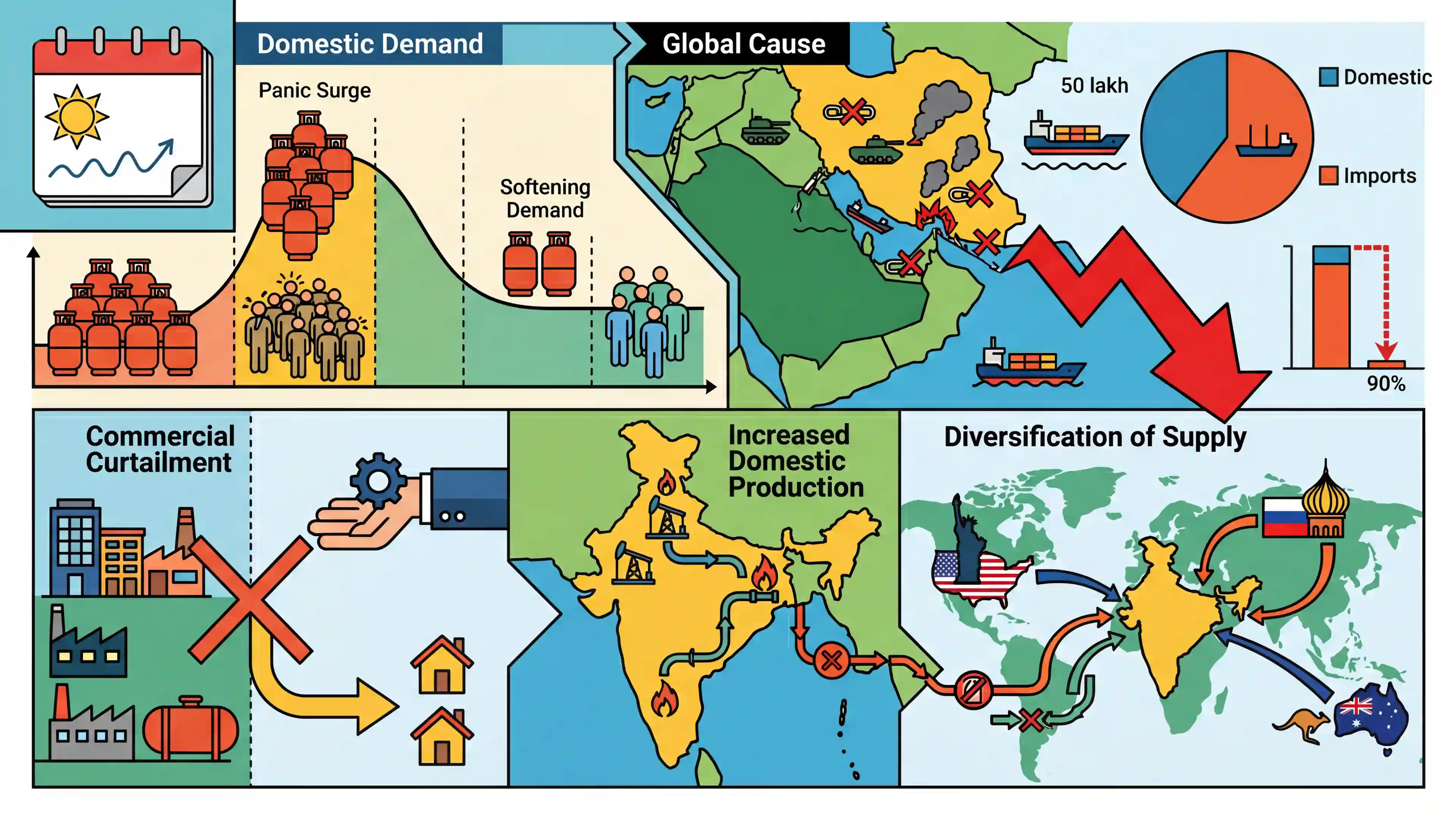
Highlights India's strategic vulnerability to geopolitical maritime chokepoints (Strait of Hormuz) for critical energy supplies. It practically demonstrates the government's crisis management strategies—such as rationing commercial use, diversifying import sources away from the Middle East, and boosting domestic refinery output—to ensure national energy security and household stability.
Summary
The onset of summer has led to a softening in domestic LPG demand, with daily household bookings falling below 50 lakh cylinders and signaling a return to normalcy after recent panic buying. The previous surge in demand was triggered by the West Asia conflict and the effective closure of the Strait of Hormuz, which severely disrupted India's LPG imports. Relying on imports for 60% of its LPG needs—90% of which transit through the Strait—India faced a major energy supply shock. In response, the government managed the crisis by temporarily curtailing commercial LPG to protect households, maximizing domestic production, and diversifying its supply chain by securing alternative imports from countries like the US, Russia, and Australia.
Key Points
- Daily household LPG bookings have dropped below 50 lakh from a peak of 89 lakh, aided by the natural seasonal decrease in demand during summer.
- The West Asia war and the effective closure of the Strait of Hormuz had previously disrupted 54% of India's LPG supplies, prompting panic buying and hoarding.
- India is highly vulnerable to Gulf supply shocks, depending on imports for 60% of its LPG needs, with 90% of those imports traditionally routed through the Strait of Hormuz.
- To manage the crisis, the government halted commercial and industrial LPG supplies to prioritize household distribution and ordered refiners to maximize domestic production.
- Supply stability has been restored by boosting domestic production to cover 58-63% of daily demand and securing alternative import cargoes from non-Gulf nations like the US, Russia, and Australia.
Important Terms
Energy Security

The uninterrupted availability of energy sources at an affordable price, balancing domestic production with diversified imports to mitigate risks from geopolitical conflicts or supply chain disruptions.
UPSC context
GS Paper III: Indian Economy and Infrastructure. Tests understanding of self-reliance, import dependency, and strategic resilience in critical sectors.
Ministry of Petroleum and Natural Gas (MoPNG)
The nodal Indian ministry responsible for the exploration, production, refining, distribution, and marketing of petroleum and natural gas, including the management of domestic LPG supplies.
UPSC context
GS Paper II: Statutory/Regulatory Bodies. Relevant for executive interventions in market stability and energy policy.
Oil Marketing Companies (OMCs)
Public and private entities (e.g., IOCL, HPCL, BPCL) that refine, distribute, and market petroleum products, serving as the vital link between energy imports and final consumers.
UPSC context
GS Paper III: Economics. Tests knowledge of the public sector’s role in managing essential commodity distribution and price stability.
Strait of Hormuz
A critical maritime chokepoint between the Persian Gulf and the Gulf of Oman, facilitating roughly 20% of global oil trade and 90% of India's LPG imports.
UPSC context
GS Paper I: Geography; GS Paper II: IR. Tests knowledge of critical global trade routes and geopolitical vulnerabilities.
Strategic Petroleum Reserves (SPR)
Underground storage facilities used to stockpile crude oil or petroleum products as a buffer against global supply shocks or emergency disruptions.
UPSC context
GS Paper III: Infrastructure/Energy. Tests technical understanding of national disaster management and economic hedging strategies.
Piped Natural Gas (PNG)
Methane-rich gas delivered via pipelines directly to households and industries, promoted as a reliable, domestic alternative to portable LPG cylinders.
UPSC context
GS Paper III: Environment and Infrastructure. Relevant for discussing clean energy transitions and reducing import reliance.
Energy Supply Chain
The sequence of processes involved in the production and distribution of energy products, often managed through real-time data monitoring to prevent shortages.
UPSC context
GS Paper III: Economy/Logistics. Tests ability to analyze efficiency and risk management in essential resource management.
Prelims Trap
"India maintains massive Strategic LPG Reserves in underground caverns similar to its crude oil SPRs to mitigate supply shocks."
While India has Strategic Petroleum Reserves (SPRs) for crude oil, it currently lacks dedicated cavern-based strategic reserves for LPG, relying on operational tankage for just 15 days of cover.
Static Concepts Connected
What are the key maritime chokepoints in West Asia relevant to India's energy security?
- Strait of Hormuz: Connects the Persian Gulf to the Gulf of Oman and Arabian Sea. Over 90% of India's LPG and a large share of crude transit here.
- Bab-el-Mandeb: Connects the Red Sea to the Gulf of Aden and Arabian Sea. Critical for Suez Canal maritime traffic and trade with Europe.
- Strait of Tiran: Connects the Gulf of Aqaba to the Red Sea, bordered by Egypt, Israel, Jordan, and Saudi Arabia.
How does the success of PMUY impact India's macroeconomic resilience?
- Inelastic Demand: By expanding household clean cooking coverage, LPG demand has become highly inelastic. Households cannot easily switch fuels during price or supply shocks.
- Import Dependency: Domestic refinery output cannot meet enhanced Ujjwala-driven consumption, resulting in a structural import dependency of roughly 60% for LPG needs.
Cross-Topic Patterns
Energy SPRs: Crude vs LPG disparities
The crisis exposes the glaring gap between India's crude SPR development (at Mangalore, Padur, Visakhapatnam) and its lack of deep underground strategic cavern reserves for LPG and natural gas.
Gulf chokepoints and imported inflation
Disruption in the Strait of Hormuz directly cascades into India's CPI via imported fuel inflation, squeezing household budgets and limiting the RBI's monetary policy room during geopolitical shocks.

Map-matching questions linking West Asian chokepoints (Hormuz, Bab-el-Mandeb) to specific energy import vulnerabilities are highly likely.
Linked PYQs · 3
Linked PYQs · 3
- 2025MainsGS2
"Energy security constitutes the dominant kingpin of India's foreign policy, and is linked with India's overarching influence in Middle Eastern countries.” How would you integrate energy security with India's foreign policy trajectories in the coming years?
- 2017MainsGS2
The question of India's Energy Security constitutes the most important part of India's economic progress. Analyze India's energy policy cooperation with West Asian countries.
- 2018MainsGS3
“Access to affordable, reliable, sustainable and modern energy is the sine qua non to achieve Sustainable Development Goals (SDGs).” Comment on the progress made in India in this regard.
