LPG Rationing Exposes Vulnerabilities of Rural Women Under PMUY
Source:Indian Express ↗
Why It Matters
It provides a powerful contemporary case study of how international geopolitical crises filter down to impact grassroots social welfare. It is highly relevant for analyzing the efficacy and resilience of government schemes (like PMUY) and the critical need to incorporate gender equity in crisis-response policy design.
Summary
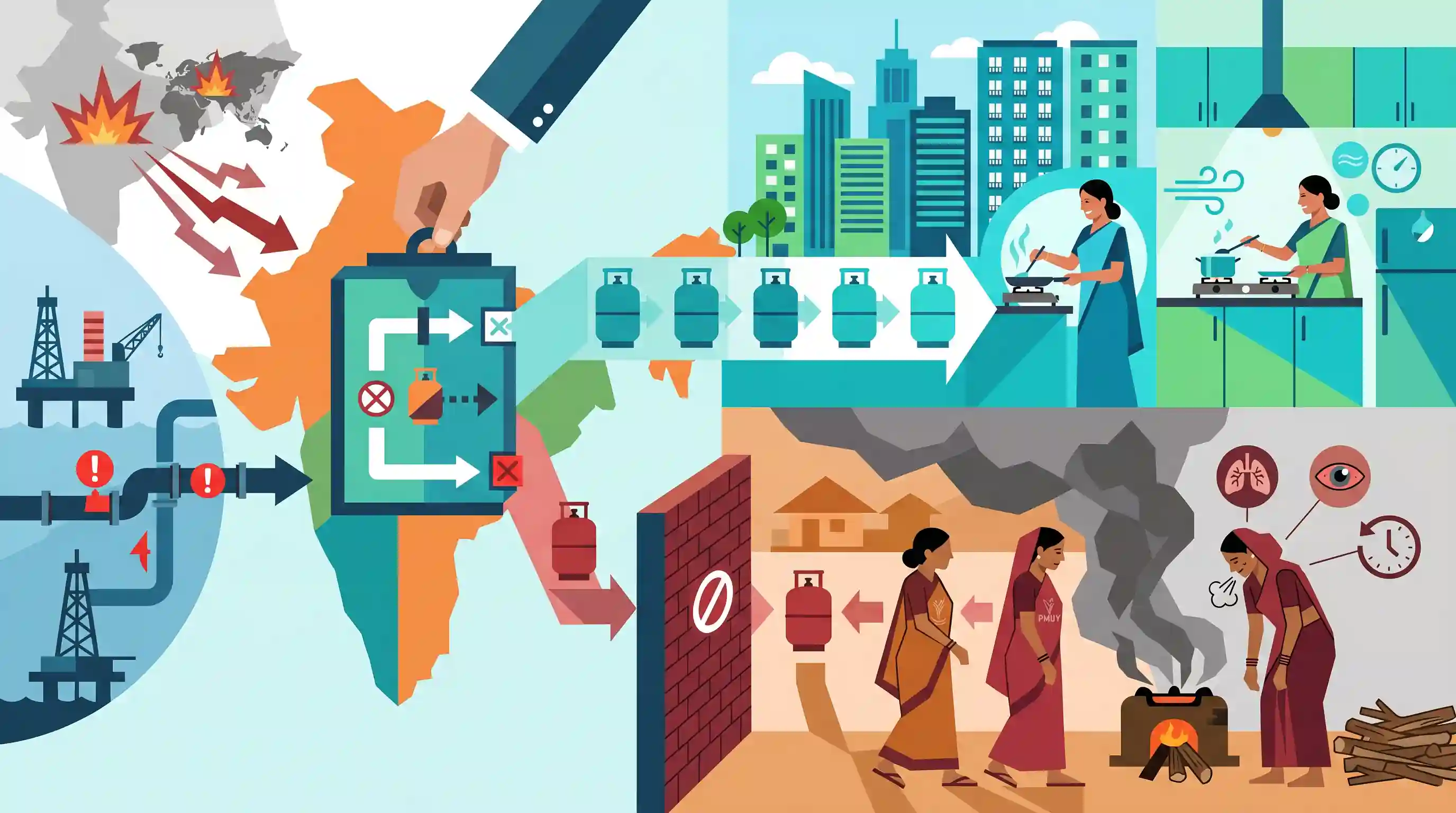
The article critiques India's new '25/45 Rule' for LPG rationing, an intervention designed to manage supply constraints fueled by global geopolitical tensions, including Iran-US war lines. The author argues that this rationing mechanism inadvertently serves as a 'silent strike' against rural women by widening the rural-urban divide. While urban consumers remain largely insulated, the policy restricts rural access, forcing Pradhan Mantri Ujjwala Yojana (PMUY) beneficiaries to regress to hazardous traditional biomass cooking fuels. This policy response to an external energy shock threatens to reverse significant gains in indoor air quality, health, and female empowerment, highlighting critical gaps in gender-sensitive program design during macroeconomic crises.
Key Points
- Global geopolitical tensions (e.g., Iran-US conflicts) have triggered energy supply chain disruptions, prompting India to implement domestic LPG rationing.
- The newly introduced '25/45 Rule' for LPG cylinder allocation disproportionately restricts access for rural consumers while safeguarding urban energy demands.
- This rationing acts as a 'silent strike' on rural women, effectively reversing the health and empowerment milestones achieved under the Pradhan Mantri Ujjwala Yojana (PMUY).
- Deprived of affordable and consistent LPG refills, rural households are forced back to using traditional, highly polluting biomass fuels (chulhas).
- The situation underscores the necessity of integrating gender and rural equity into energy crisis management and policy design.
Important Terms
Pradhan Mantri Ujjwala Yojana (PMUY)

A Ministry of Petroleum and Natural Gas scheme providing deposit-free LPG connections to women from poor households to ensure clean cooking fuel access and empowerment.
UPSC context
GS Paper II: Government Schemes for Vulnerable Sections. Tests assessment of welfare implementation, health outcomes, and gender-based empowerment.
25/45 Rule (LPG Rationing)
A 2026 emergency rationing policy where urban households can book LPG refills every 25 days, while rural consumers face a 45-day waiting period.
UPSC context
GS Paper II: Policy Interventions. Tests understanding of discriminatory rationing, rural-urban divide, and crisis management during energy shocks.
Energy Security
The uninterrupted availability of energy sources at an affordable price, critical for India's high import dependency on oil and gas during geopolitical crises.
UPSC context
GS Paper III: Infrastructure/Energy. Tests knowledge of strategic reserves, import diversification, and impact of global conflicts on domestic supply.
Sustainable Development Goal 7 (SDG 7)
One of 17 UN targets for 2030, aiming to ensure "universal access to affordable, reliable, sustainable and modern energy for all."
UPSC context
GS Paper III: Environment/Economy. Tests India's progress toward global energy targets and clean energy transition.
Indoor Air Pollution (IAP)
Hazardous household air quality resulting from burning traditional solid fuels (wood, dung), primarily causing respiratory illnesses among rural women and children.
UPSC context
GS Paper II: Issues Relating to Health. Tests understanding of the health-energy-poverty nexus and public health challenges.
Biomass Fuel
Traditional organic matter (firewood, crop residue, animal dung) used for heating and cooking, known for high smoke emission and low thermal efficiency.
UPSC context
GS Paper III: Energy/Environment. Tests awareness of the transition from solid fuels to clean energy and associated socio-economic barriers.
Prelims Trap
"PMUY guarantees fully free LPG cylinder refills for BPL households indefinitely."
PMUY provides a deposit-free initial connection and a targeted per-cylinder subsidy (via DBT), but beneficiaries still pay the subsidized market price for refills.
Static Concepts Connected
What are the core entitlements and mechanisms of PMUY?
- Targeted Beneficiaries: Adult women belonging to BPL households, later expanded to cover SC/ST, forest dwellers, and tea garden tribes.
- Financial Assistance: Provides a deposit-free LPG connection with cash assistance of ₹1600 to cover the cylinder, pressure regulator, and hose.
- Refill Subsidy: A targeted per-cylinder subsidy is routed via Direct Benefit Transfer (PAHAL scheme) directly into the beneficiary's bank account.
What are the primary pollutants from traditional biomass cooking (chulhas)?
- Particulate Matter: High emissions of fine particulate matter (PM2.5 and PM10), which are the primary drivers of degraded indoor air quality.
- Toxic Gases: Releases Carbon Monoxide (CO), which reduces blood oxygen-carrying capacity, alongside carcinogenic Volatile Organic Compounds (VOCs).
- Black Carbon: Emits soot (black carbon), a potent short-lived climate forcing agent that accelerates regional atmospheric warming.
Cross-Topic Patterns
Geopolitics dictating rural health
West Asian supply shocks directly dictate rural India's indoor air quality, linking GS2 International Relations with GS3 Environment and GS1 Society.
Gender-blind crisis management
Demonstrates how supposedly neutral macroeconomic rationing disproportionately impacts women, a critical theme for GS2 Social Justice and gender equity.

GS2/GS3 Mains will likely link West Asian energy supply shocks directly to the reversal of domestic welfare milestones like PMUY.
Linked PYQs · 4
Linked PYQs · 4
- 2018MainsGS3
“Access to affordable, reliable, sustainable and modern energy is the sine qua non to achieve Sustainable Development Goals (SDGs).” Comment on the progress made in India in this regard.
- 2024MainsGS1
Distinguish between gender equality, gender equity and women's empowerment. Why is it important to take gender concerns into account in programme design and implementation?
- 2019MainsGS2
Performance of welfare schemes that are implemented for vulnerable sections is not so effective due to absence of their awareness and active involvement at all stages of policy process. Discuss.
- 2021MainsGS2
Can the vicious cycle of gender inequality, poverty and malnutrition be broken through microfinancing of women SHGs? Explain with examples.
